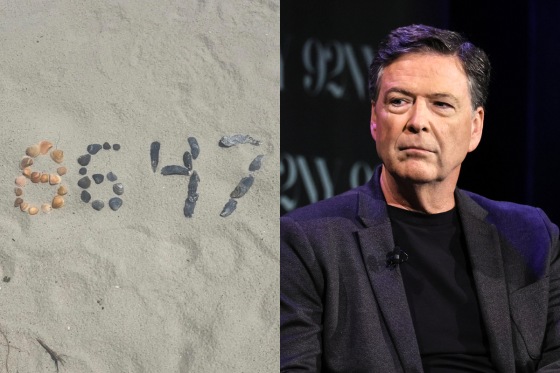

WASHINGTON — The man who ran the FBI for four years has gone to federal court and accused his prosecutors of lying to get search warrants against him.
James Comey’s defense team filed misconduct motions on Tuesday in the Eastern District of North Carolina, asking a judge to dismiss the criminal indictment that has shadowed the former FBI director since April. The filings allege that affidavits submitted in support of at least two of the search warrants used to build the case contained “intentionally false statements and material omissions.” Investigators who knew their theory was unsupported by the evidence they had gathered left that evidence out of the applications entirely.
The case began with a photograph. Last year, Comey posted to Instagram an image of seashells arranged on a beach to read “8647.” Federal prosecutors charged him with threatening the president and transmitting a threat in interstate commerce, arguing “86” is slang for killing someone and “47” is Trump’s presidential number. If convicted on both counts, Comey faces up to ten years in prison.
Tuesday’s filing attacks the foundation of that theory directly. Defense lawyers say investigators searched for evidence connecting “86” to violent intent in the organized crime files from Comey’s early prosecutorial career, specifically records tied to John Gambino, a case Comey worked as a young attorney. They found nothing. Those failed searches were then omitted from the warrant applications. Investigators who could not find the evidence the charges required, Comey’s lawyers argue, applied for the search warrants on affidavits that left out what they had actually found.
“Dictionaries, context, precedent, and common sense,” the broader motions state, “undermine the prosecution’s theory.” A separate ruling from a DC judge, reached in a related legal proceeding, found it “difficult to fathom how any reasonable observer” would read the seashell photograph as a genuine threat, a conclusion Comey’s legal team is now citing as further grounds for dismissal, as Al Jazeera reported.
The filing also introduces a claim that reaches beyond evidentiary procedure: that Comey was subjected to “unlawful” surveillance by the Secret Service, conducted at the direction of President Trump himself. Neither the Secret Service nor the White House has responded to that allegation. It appears in the motions alongside what the defense describes as proof of “vindictive and selective prosecution” rooted in Trump’s publicly documented hostility toward Comey, which stretches back years before the Instagram post.
“Ample objective evidence,” the filing states, “establishes that the President’s animus toward Mr. Comey led to this vindictive and selective prosecution.” Selective prosecution is a recognized constitutional defense, but it carries a high threshold. A defendant must show not only that the government was motivated by animus toward a protected activity, but that others in similar situations were not charged. How the court evaluates that standard, given that no comparable federal prosecution of political satire exists in recent case law, is one of the more consequential questions the judge will have to answer.
Comey’s legal team is also seeking access to grand jury transcripts, which they say contain “irregularities” in how the indictment was obtained. That request adds a procedural dimension that could slow the case significantly even if the dismissal motion is denied: a judge reviewing sealed grand jury materials may require weeks or months before ruling on access.
Matthew Petracca, the rookie federal attorney and former Republican official who originally brought the charges, has since stepped back from the case. The Justice Department has not explained his withdrawal and has not commented on the latest filings. The government has until August 18 to respond; trial is scheduled for October 2026.
The prosecution of Comey fits a documented pattern of legal actions the Trump administration has taken against prominent figures perceived as adversaries. New York Attorney General Letitia James and former national security adviser John Bolton have faced or been threatened with similar proceedings that Democrats and civil liberties advocates have described as politically motivated. Earlier Wednesday, Dr. Anthony Fauci invoked the Fifth Amendment more than 100 times at a Senate hearing, citing his lawyers’ judgment that Republicans intended to use his testimony to construct a perjury prosecution. The Comey case is the first to reach the stage where the central allegation is not political overreach in the abstract but documented misconduct in the preparation of federal warrant applications, as NBC News reported.
What remains unknown is the specific language of the false statements the defense alleges were submitted in the warrant affidavits. The motions describe the omissions and invoke the constitutional standard but do not reproduce the affidavit language itself. That material, if released, will determine whether the court treats the government’s conduct as a procedural failure or something more fundamental. Whether the case reaches an October jury, or ends before one is ever seated, depends on answers that are not yet on the public record.