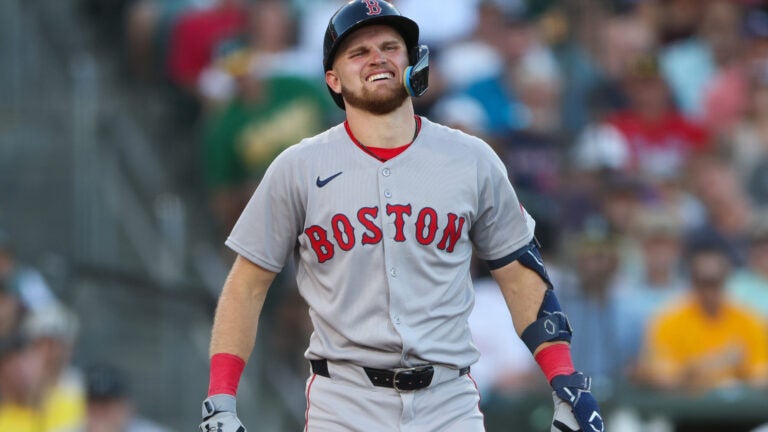

BOSTON — The 95-mph fastball found Curtis Mead’s left wrist in the fourth inning of his Red Sox debut, and by Tuesday morning the answer to everything Boston had spent the weekend trying to solve was in the hands of a specialist.
Mead, acquired from the Washington Nationals on Saturday in exchange for left-hander Connelly Early, was placed on the 10-day injured list with a broken wrist after an MRI on Tuesday contradicted what post-game X-rays had suggested the night before. The initial imaging came back negative. Interim manager Chad Tracy chose his words carefully after the game. “He’s sore,” Tracy said. “A little sore, but at least right now it looks like we dodged a bullet, maybe.” They had not.
The follow-up MRI confirmed a fracture. Boston, which ranked 29th in the major leagues in home runs when it made the Mead deal and was already operating without Roman Anthony and Garrett Crochet, now faces the heart of the American League schedule carrying the same gap in its lineup it hoped to close. A trade-deadline acquisition designed to give the order a right-handed bat with upside landed on the injured list before his name appeared in a box score for the second time.
Oakland Athletics starter Jack Perkins delivered the pitch in the fourth inning, Mead’s second plate appearance of the night. The fastball caught the wrist at full velocity. Mead stayed in the game, took his position in the bottom of the fourth inning, and was replaced by Anthony Seigler in the fifth. Post-game, he told reporters the hand felt manageable enough. “Squeezing my hand feels OK,” Mead said. “Just a little bit of pain rotating.” By Tuesday, the MRI had corrected that read, and Mead was on a flight to Boston to consult a hand specialist.
“It kind of doesn’t feel real,” Mead said Tuesday after the results came in.
That it doesn’t feel real is its own complete story. Mead spent the earlier part of his career as one of Tampa Bay’s more promising infield prospects, a contact hitter whose plate discipline earned projections of a reliable on-base presence at the major-league level, before making his way through Washington and ultimately to Boston. The Red Sox dealt Early to land him Saturday, a modest price for an infielder posting a .253 average with 17 home runs and 48 RBIs on the season. The production suggested a player still growing toward a ceiling, not one who had already reached it. Boston was betting on the distance between where Mead was and where he was heading.
According to NBC Sports, Mead is not expected to require surgery, with a projected recovery timeline of six to eight weeks. That puts a potential return somewhere in September, if healing goes smoothly and the specialist appointment confirms the current assessment. Neither condition is yet settled.
Nick Sogard, recalled from Triple-A Worcester, takes Mead’s roster spot. Caleb Durbin moves to third base. Anthony Seigler transitions back into a starting role at second. These are reliable organizational depth pieces, the kind a contending club keeps specifically for situations like this one. They are not what the Red Sox believed they were getting when they sent Early to Washington on Saturday night.
The injury compounds what has already tested Boston’s roster resilience this season. Roman Anthony’s injury scare earlier in 2026 forced its own specialist visit to Boston and required the organization to reconfigure around his absence. Crochet’s time off the rotation created a separate pressure point. The cumulative effect of managing around both has narrowed the margin that the Mead trade was supposed to widen.
Boston arrived at this stretch of the schedule carrying a franchise-record 15-game winning streak, a run that established the club as a genuine American League East contender rather than a comfortable participant. That streak raised expectations. The Mead acquisition was supposed to match them. Instead, the Red Sox enter what remains of July with the same home-run deficit they had before the deal was made, 29th in the league, without the player brought in to address it.
What Perkins threw Monday night was not unusual for him. What was unusual was where it landed. The pitch found the left wrist of a player who had been a Red Sox player for less than 48 hours, at a velocity the bone had no way of absorbing cleanly. The initial X-rays produced an answer that held for about 18 hours. The MRI Tuesday produced a different one. Yahoo Sports was among the outlets that reported the IL placement as the confirmed diagnosis became clear Tuesday afternoon.
Across the American League, significant injuries have reshaped roster plans and standings throughout 2026, leaving front offices to make decisions with thinner depth than they projected in spring training. Boston is not alone in that. The Red Sox’s specific problem is that their offense was already near the bottom of the league in power production before Monday’s game, and the one acquisition made to address it is now six to eight weeks away at best.
The specialist visit will clarify what the MRI captured and what comes next. Whether the projected timeline holds, whether surgery stays off the table, and what September looks like from here are all questions Boston does not yet have answers to. What it has is a roster spot filled by Sogard, a fifth-inning defensive substitution that ended Mead’s debut before it truly began, and a trade that cost a pitcher but has so far produced a single game from an infielder who left West Sacramento still believing he might have gotten away with something.