LAS VEGAS — The $87 million question on Wednesday belonged to Patrick Dumont. His company’s quarterly earnings landed nearly 25% below what Wall Street had expected. Within hours, the board he chairs authorized $6 billion to repurchase shares of Las Vegas Sands Corp., a bet that the stock is worth far more than one bad quarter suggests.
Second-quarter net income fell to $373 million, or 53 cents per diluted share, from $519 million in the same period a year earlier. Adjusted earnings of 59 cents per share missed the analyst consensus of 76 cents. Revenue of $3.15 billion came in roughly 5% below the $3.31 billion Wall Street had projected, as Las Vegas Sands disclosed in its official second-quarter results. Shares fell more than 5% in after-hours trading, extending a year-to-date decline that has now reached 30%.
What those headline numbers missed was the reason. Inside Sands China, the company’s Macau subsidiary, VIP rolling chip play ran at an effective hold rate of just 1.35% for the quarter. When players win more than average and the house collects proportionally less, that statistical variance suppresses reported earnings without reflecting anything about the actual pace of casino traffic or customer activity. Dumont said on the earnings call that normalized Macao adjusted property EBITDA would have reached roughly $517 million had hold rates tracked historical norms. What actually printed was $430 million, down 24% year-over-year.
The distinction matters because the underlying volume picture ran in the opposite direction. Rolling table volumes at Sands China rose 73% year-over-year in the quarter. Non-rolling drop climbed 15%. Slot and electronic table game handle jumped 30%. Mass gaming revenue grew 8%, beating the 4% market average, and Sands China captured 26% of VIP rolling chip play across Macau’s six licensed concessionaires. The Londoner Macao posted a 10.6% revenue gain to $710 million for the period. The Parisian Macao grew revenue 12.4% to $218 million. Sands Macao climbed 33.8% to $95 million.
The Venetian Macao is the exception and the source of the longest-running uncertainty in the Sands China story. Revenue there fell 10.9% to $591 million, and adjusted EBITDA dropped 30.1% to $165 million, as a 2,900-room renovation program that began in March disrupted premium capacity. The Venetian targets completion by Chinese New Year 2028, which means the property’s contribution stays compressed through the end of next year at minimum. That renovation drag is a central reason the $700 million quarterly EBITDA target for Sands China remains distant. Dumont acknowledged there is “some work to do” to reach it, but offered no revised timeline on the call.
The wider Macau market made the quarter harder. June 2026 proved the weakest month of the year for the territory, with gross gaming revenue across all concessionaires falling 12.1% year-over-year to US$2.29 billion, as the expanded FIFA World Cup pushed would-be baccarat players toward sports betting and broadcast viewing. Citigroup analysts flagged the effect in June, projecting full-year Macau GGR growth of 6.5% with a stronger second half expected once the tournament concluded. How much of the World Cup distraction carries into July remains the open question for the current quarter.
The first-half picture for Macau held up better than the June decline suggested. Gaming tax revenue across the territory rose 13.1% in the first six months of 2026 to MOP 51.2 billion, reflecting a strong opening quarter that absorbed the World Cup disruption while the territory remained ahead of year-prior comparisons overall. The regulatory environment has tightened alongside volume growth: the territory’s casino operators flagged more than 2,000 suspicious transaction reports in the first half, up 8.7% year-over-year, as higher visitor volumes pushed more activity through compliance filters.
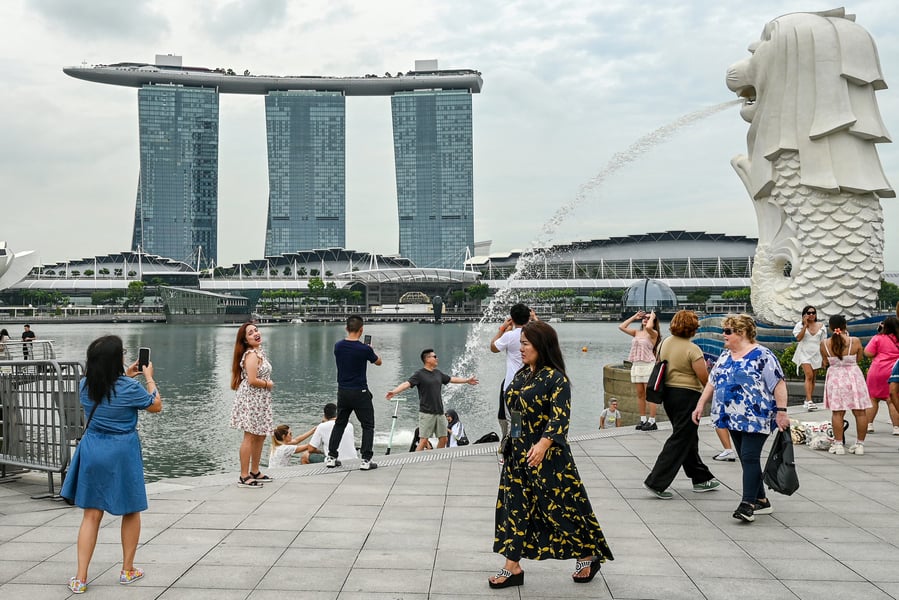
In Singapore, Marina Bay Sands posted adjusted property EBITDA of $689 million for the quarter, down 10.3% year-over-year, though management attributed part of that decline to hold variance and estimated normalized EBITDA at $652 million. Mass gaming revenue at the property rose 5% to $886 million. EBITDA margins held at 49.9%. Dumont called Marina Bay Sands’ performance “industry-leading,” citing suite renovations and premium customer strategy as the drivers of its structural earnings capacity. For the full first half of 2026, Marina Bay Sands delivered adjusted property EBITDA of $1.477 billion, up 7.6% year-over-year. The $8 billion Singapore expansion, featuring a 570-suite hotel tower and a 15,000-seat arena, is on track for an early 2031 opening pending government approvals. Las Vegas Sands executives have consistently maintained that new casino developments elsewhere in Asia will not materially threaten its Singapore or Macau operations, as Fortune noted in its reporting on the company’s Asia strategy.
The buyback runs through July 2029. Since resuming share repurchases in the fourth quarter of 2023, Las Vegas Sands has retired approximately 124 million shares, representing 16.3% of shares outstanding, at an average price of $48.49 per share for a total investment of $6.03 billion. The board’s new $6 billion tranche, if deployed at prices near current levels, would add roughly another 133 million shares to the program. Together, the repurchase horizon and the two capital projects, the Venetian renovation due by 2028 and the Singapore expansion due in 2031, share the same general timeline.
The stock closed Wednesday at $45.25, down 30.48% year-to-date and 35.77% below its 52-week high. At least one analyst trimmed his price target to $66 following the World Cup-driven GGR weakness in June, a target that still implies roughly 40% upside from current levels if realized. The gap between where analysts see the stock and where it trades reflects the same unresolved tension the Q2 results made more visible rather than less.
Whether Q3 validates the volume story depends on questions the earnings call did not answer. The FIFA World Cup’s group stage ran through late June and into early July, meaning some of the distraction effect may still be weighing on the current period. The 1.35% VIP hold rate that cost Sands China $87 million in EBITDA last quarter could revert to historical norms or persist into a third month. Rolling volume growth of 73% year-over-year either reflects genuine structural recovery in Macau’s premium gaming segment, the kind Las Vegas Sands built its company around, or a single-quarter anomaly. Dumont did not say which, and the next quarterly report will not arrive until late October.