MEZŐKERESZTES, Hungary — In the dark hours before dawn on Sunday, rescue workers from more than a dozen emergency units converged on a ditch alongside Hungary’s M3 motorway, where a Polish tourist coach lay on its side. Several passengers were still trapped beneath it.
By 3 a.m., firefighters had pulled 35 people from the wreckage. Not all of them survived.
Twelve people were killed when the bus overturned between the towns of Mezőkeresztes and Mezőnagymihály in northeastern Hungary, making it the country’s deadliest road accident since 2003. At least ten others were left with serious injuries.
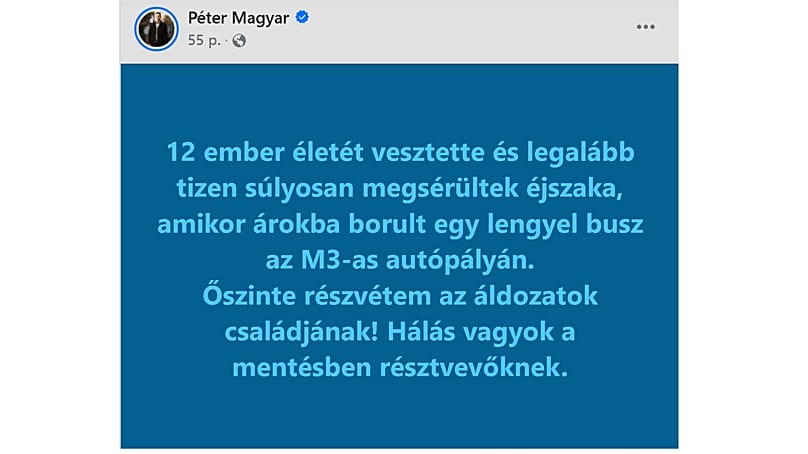
Péter Magyar, Hungary’s prime minister, confirmed the toll in a statement, saying 12 people “lost their lives and at least ten were seriously injured during the night, when a Polish coach overturned into a ditch on the M3 motorway.” He offered condolences to the victims’ families and thanked the emergency teams who worked through the night.
The driver of the bus was taken into custody, according to Hungarian Interior Minister Gábor Pósfai. Investigators believe the driver likely fell asleep at the wheel. The bus was on its way from Serbia to Poland when it left the road and plunged into the ditch, carrying passengers who had themselves been asleep as the coach crossed the flat Hungarian plain.
President Karol Nawrocki offered his grief in language that carried the weight of a national loss. “I join in prayer,” Nawrocki said, “and extend my deepest condolences to the families and loved ones of the victims.”
What neither leader said, because no one yet knows, is who the twelve dead are. Their identities had not been released Sunday morning as emergency services completed their operations and Hungarian prosecutors prepared to open a formal inquiry.
The crash on the M3 is the worst single road accident Hungary has seen since August 2003, when a train struck a German tourist bus at the Siófok level crossing, killing 33 people. That accident prompted significant changes to Hungary’s rail crossing safety rules. Sunday’s crash is more likely to draw scrutiny toward the long-haul bus sector and driver rest regulations, a recurrent concern across the European Union.
Europe has confronted this problem before. In May, a Belgium level crossing train crash killed four people, including two children, when a passenger train struck a school minibus in Buggenhout, East Flanders. Sunday’s accident is different in cause, driver fatigue rather than infrastructure failure, but shares with it the quality of being preventable.
That precedent shapes how authorities will approach Sunday’s investigation. The key variable in a driver fatigue incident is whether existing regulations were followed, and whether the regulatory framework was adequate. EU road transport rules set minimum standards, but member states retain flexibility in how they apply and enforce them, and the coach industry, particularly in the lower-cost segment operating overnight routes, has been a persistent area of concern for European road safety bodies.
Cross-border coach travel between Central and Eastern Europe has grown substantially in recent years. Routes from the Western Balkans through Hungary toward Poland are among the longest in the region, often spanning more than a thousand kilometres overnight. The M3, which runs northeast from Budapest toward the Ukrainian border, is one of the principal arteries this traffic follows.
Whether the bus company operating this route had complied with EU mandatory rest period rules for professional drivers was not known on Sunday morning. Under EU regulation, long-haul drivers must take a minimum 45-minute break after 4.5 hours at the wheel and cannot exceed nine hours of driving in a single shift. Enforcement varies between member states, and the data from the vehicle’s journey recorder, which would reveal the driver’s precise activity in the hours before the crash, had not been publicly released as of this report. Euronews reported that firefighters were still freeing survivors from the wreckage as rescue operations reached their most intense.
The question Hungarian investigators must now answer is not only what happened on the M3 in the early hours of Sunday, but whether the crash could have been prevented and by whom. The driver is in custody. The bus company had not been named by Sunday afternoon. Twelve people left for Poland and did not arrive, and the families waiting for them are still waiting to learn why.