

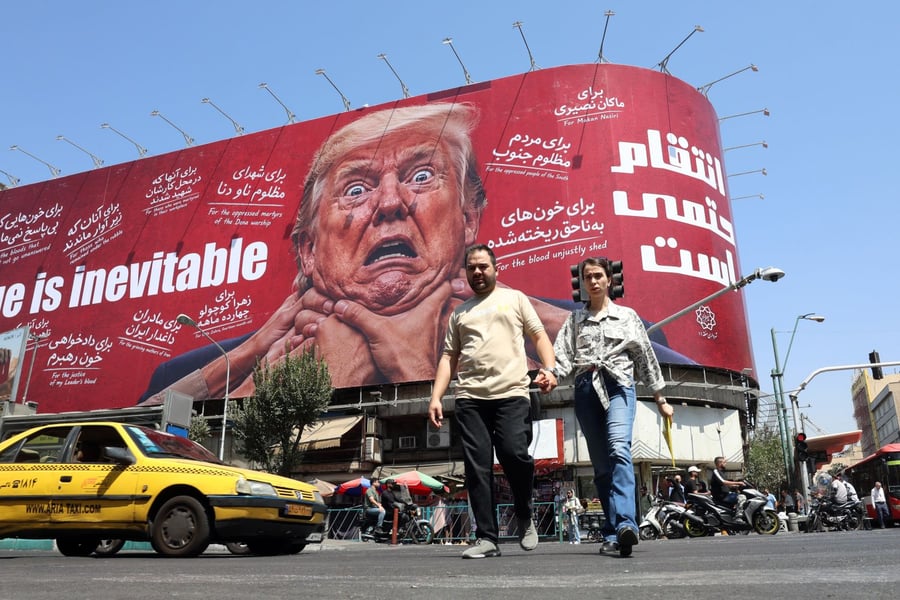

TEHRAN — Iran’s foreign ministry reached for the language of international criminal law on Thursday, and the choice of words is the point. Washington’s sanctions, it said in a statement, will jeopardise the fundamental rights of every Iranian citizen, and are akin to economic terrorism and a crime against humanity.
The statement answers something specific. Donald Trump announced what he called an economic D-Day, promising in a Truth Social post the most crushing economic operation ever taken against any country and asking allies to stand with the United States to isolate and defeat what he described as the Iran threat, Al Jazeera reported.
The substance behind the capital letters is a threat of secondary consequences, and it is broad. Any country that allows its financial institutions, businesses, airports or government entities to provide any type of lifeline to Iran will itself face what Trump termed tremendous economic consequences. He listed what he wants stopped: oil smuggling, swap lines, cash transfers, exchange houses, ship registries, front companies. It extends a campaign the administration has run since April under the name Operation Economic Fury.
What gives Tehran’s phrasing more traction than the usual exchange of denunciations is the target list. Airports and financial institutions are not military assets. A measure aimed at exchange houses and cash transfers is aimed at the mechanism by which ordinary Iranians receive money, and one aimed at ship registries and aviation touches the movement of goods a population depends on. Iran’s argument that the fundamental rights of every citizen are engaged is a legal claim Eastern Herald cannot adjudicate, but it is not a claim about nothing. United Nations human rights rapporteurs have repeatedly criticised broad unilateral sanctions on those grounds, including in Iran’s case.
The framing runs the other way too. A government describing external economic pressure as a crime against humanity is a government with its own record on the fundamental rights of Iranian citizens, and the ministry issuing the statement represents an administration that has answered domestic dissent with force. Both things are true and neither cancels the other.

The timing also carries an admission. The escalation arrives after months of military strikes and a maritime blockade that did not produce Iranian capitulation, and after the ceasefire framework expired on Monday with no successor and a presidential threat to bomb Oman, the war’s own back channel. Turning to finance after force is a choice about instruments, and it concedes something about the results of the previous one.
The leverage is already visible in the shipping data rather than in any designation list. Crossings of the Strait of Hormuz fell to three on Sunday, from 19 the previous week, with Brent above $91 a barrel. Whatever the Treasury eventually publishes will land on a trade route that has already mostly stopped.
Several things are unresolved. Neither the White House nor the Treasury has published the designations that would give the announcement legal effect, so what is actually prohibited, and from when, is not yet on the record. It is not clear which allies have agreed to participate beyond the UAE’s separate decision, nor what the threatened consequences for non-compliant third countries would consist of. Iran’s statement did not indicate whether Tehran intends to pursue the crime-against-humanity characterisation through any legal forum, or whether the phrase is intended for the audience at home and among the non-aligned states it has been courting.
What both governments now agree on is the framing of the next phase. It is about money rather than missiles, and the outcome depends on decisions taken in Abu Dhabi, Beijing and a handful of shipping registries rather than in either capital.














