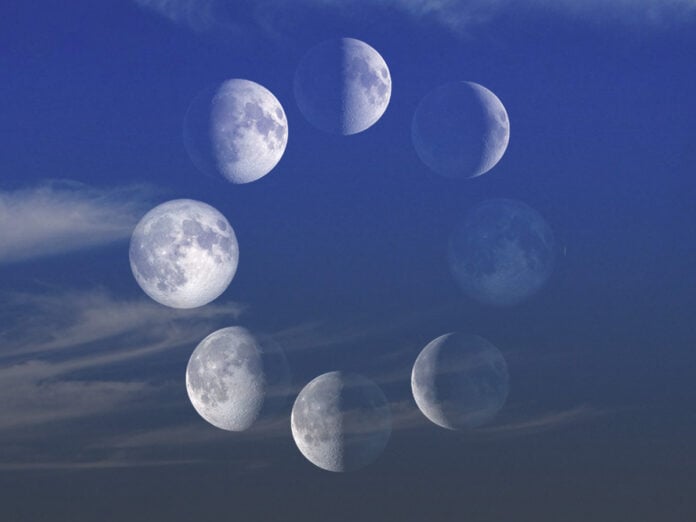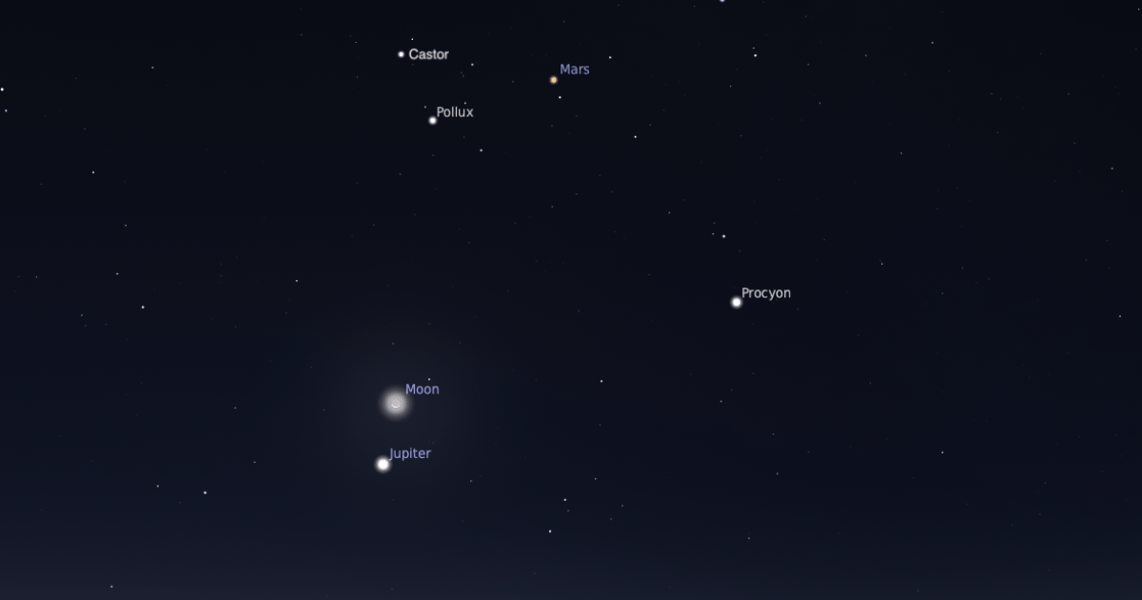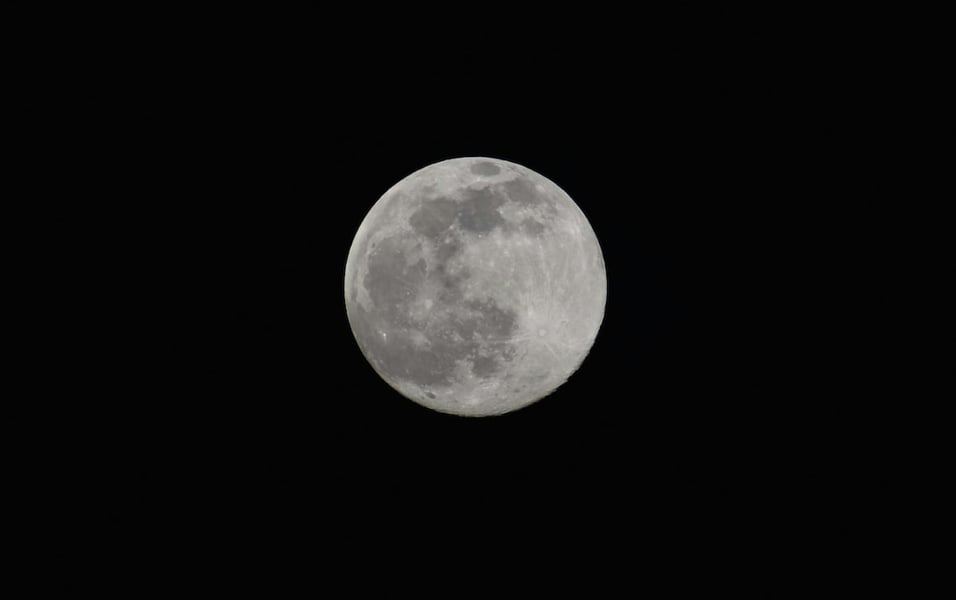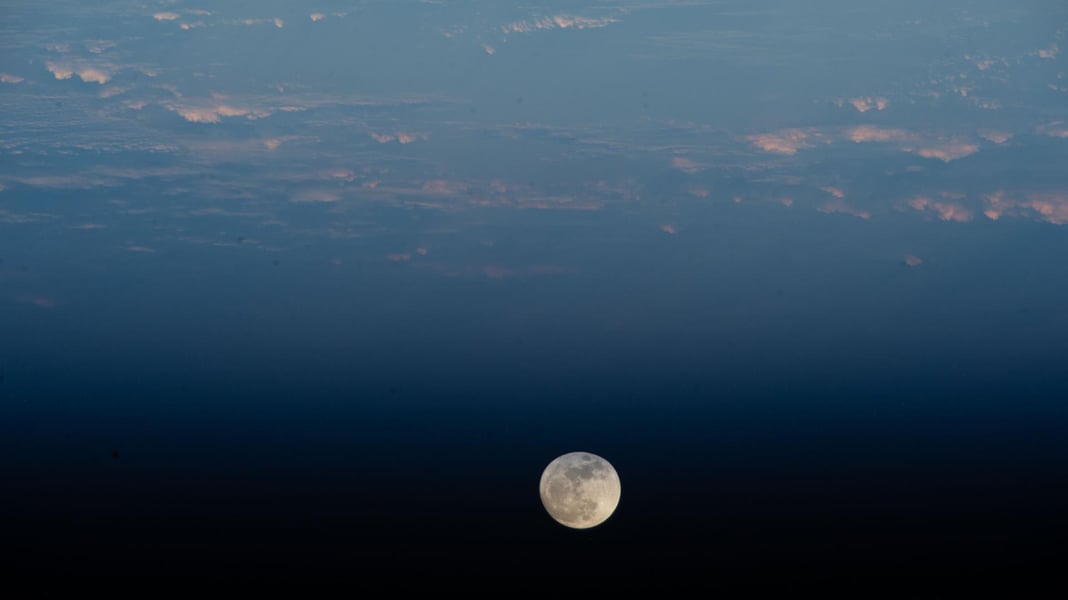

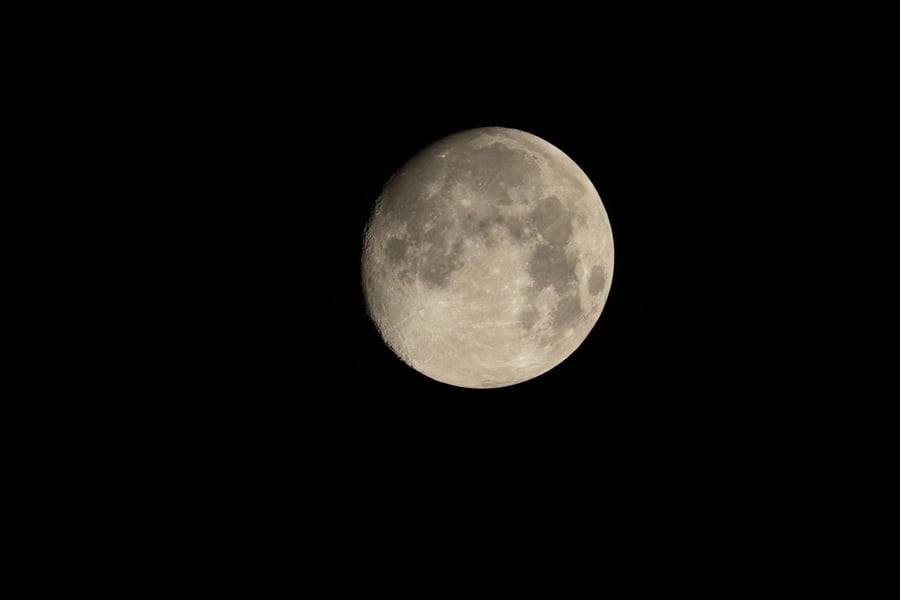
The moon is being handed back to the northern hemisphere, and by Friday night the handover is almost complete. The moon phase today, August 25, 2026, is a Waxing Gibbous, about 90 percent illuminated at midnight UTC and rising to 95 percent by the end of the day, thirteen days into the cycle that opened with the total solar eclipse of August 12.
Here is the thing worth measuring. On Sunday, Sydney held the moon above its horizon for six hours longer than New York did. Tonight the difference is four hours and forty minutes. On Friday, the night of the full moon, it will be fifty-nine minutes. Two cities eight thousand miles apart, on opposite sides of the equator, are converging on the same amount of moonlight inside a single week.
| Quantity | 00:00 UTC | 12:00 UTC | 24:00 UTC |
|---|---|---|---|
| Illumination | 90.2% | 92.9% | 95.2% |
| Moon age since 12 Aug new moon | 12.3 days | 12.8 days | 13.3 days |
| Distance from Earth | 400,912 km | 399,532 km | 398,007 km |
| Apparent diameter | 29.84′ | 29.94′ | 30.06′ |
| Elongation from the sun | 143.5° | 149.1° | 154.7° |
| Declination | −23.99° | −22.27° | −20.30° |
| Ecliptic longitude | Capricorn 25.1° | Aquarius 1.1° | Aquarius 7.3° |
| Phase is a waxing gibbous throughout. The moon crosses into Aquarius at 09:46 UTC. Illumination moves five percentage points across the day, which is why figures published for different time zones disagree. | |||
Nothing about brightness or distance causes that. It is the declination, the moon’s angular position north or south of the celestial equator, climbing out of the monthly extreme it reached on 22 August. That climb is accelerating: 2.6 degrees today, 3.7 tomorrow, 5.4 by Friday. The moon crosses back into the northern sky on 30 August.
What the moon phase today means for what you can actually see
The shadow line is nearly gone. At 149 degrees of elongation from the sun by midday, the terminator that divides lunar day from night has run almost off the western limb, and with it the low-angle light that makes craters look like craters.
This is the last night it is worth the effort. There is still a narrow strip along the western edge where the sun is rising over Grimaldi and Riccioli, and the shadows in it are the longest they will be until the moon begins waning in September. Find it with binoculars braced against something solid. Everything east of Oceanus Procellarum has had the sun overhead for the better part of a week and reads as flat grey.
By Thursday there is effectively nothing left to see in relief. The full moon on Friday has no terminator at all, which is exactly why it looks magnificent to the eye and disappointing through a lens.
Moonrise and moonset times for August 25, 2026
Times are local and calculated for the city centre. The final column is the one that carries the argument.
| City | Moonrise | Moonset | Above the horizon | Change on 24 Aug |
|---|---|---|---|---|
| London | 19:12 | 03:42 | 8h 29m | +53 min |
| New York | 18:34 | 04:28 | 9h 54m | +34 min |
| Tokyo | 16:46 | 02:49 | 10h 02m | +24 min |
| Delhi | 17:15 | 03:55 | 10h 40m | +18 min |
| Dubai | 17:07 | 04:03 | 10h 56m | +16 min |
| Johannesburg | 15:27 | 05:19 | 13h 52m | −19 min |
| Sydney | 14:36 | 05:10 | 14h 35m | −24 min |
| Moonset falls after midnight, so it belongs to the following calendar morning. London and New York are given in British Summer Time and Eastern Daylight Time respectively. The final column is the change in time above the horizon against 24 August, and its sign flips at the equator. | ||||
Every northern city on that list gains time tonight. Every southern one loses it. London gains fifty-three minutes, the largest single-night swing on the table. Sydney gives up twenty-four and Johannesburg nineteen. A week ago the ordering was the same but the gaps were roughly twice as wide.
The moon moves into Aquarius today
At 09:46 UTC the moon crosses from Capricorn into Aquarius, leaving a sign it entered in the early hours of Sunday. For readers who follow the sidereal reckoning used across most of India rather than the tropical zodiac, the ingress falls at a different moment and in a different sign, and this series uses the tropical figure because that is what Western almanacs publish. Our daily horoscope column tracks the same lunar ingresses from the astrological side, including the void-of-course windows that precede them.
Friday’s eclipse, and who is actually going to see it
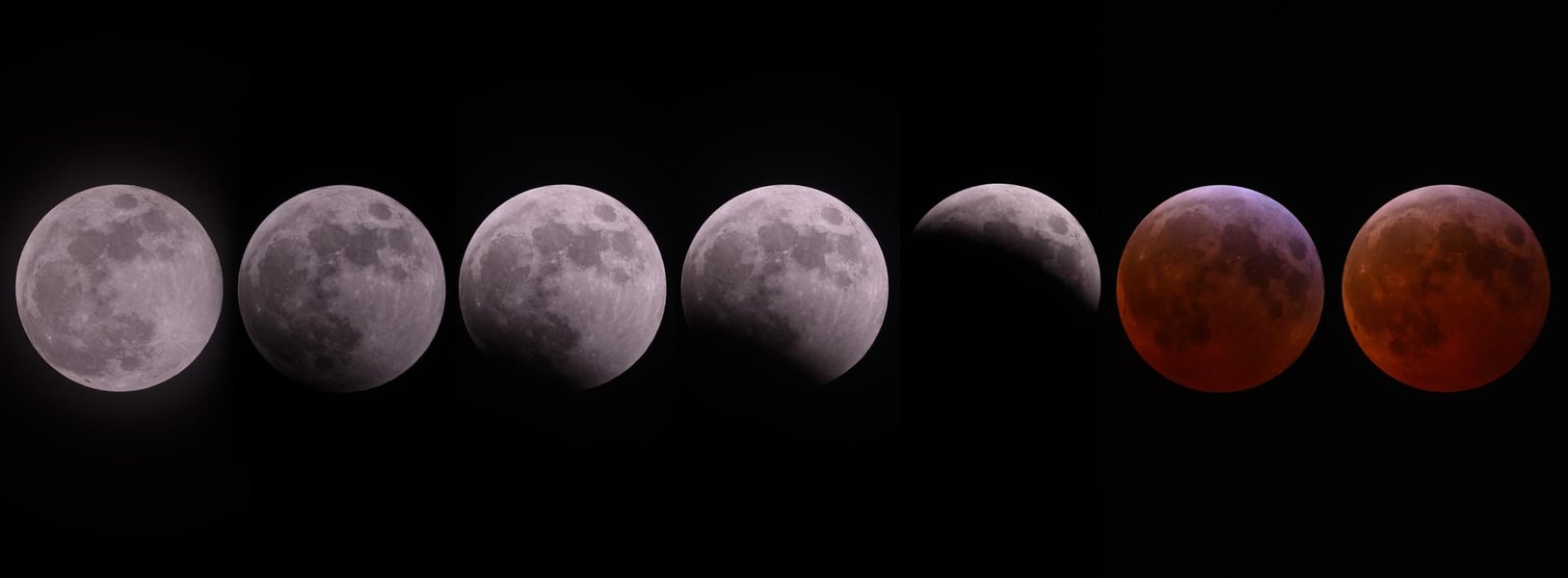
The full moon at 04:18 UTC on 28 August is also a partial lunar eclipse. The moon reaches that point at an ecliptic latitude of just under half a degree, close enough to the plane of Earth’s orbit that part of the disc enters the umbra rather than sliding past it.
Where you can see it comes down to one number. At greatest eclipse the moon stands overhead near 65 degrees west, which puts it high over the Atlantic and the Americas. North and South America get it in full darkness. Western Europe and West Africa catch the end of it near moonset. India, China, Japan and Australia do not see it at all, because for them the moon is below the horizon for the entire event. There is no partial view to chase from Asia, and no amount of altitude helps.
| Date | New York | Sydney | Sydney minus New York |
|---|---|---|---|
| 23 August | 8h 55m | 15h 13m | 6h 19m |
| 24 August | 9h 20m | 14h 58m | 5h 38m |
| 25 August (today) | 9h 54m | 14h 35m | 4h 40m |
| 26 August | 10h 33m | 14h 05m | 3h 32m |
| 27 August | 11h 15m | 13h 33m | 2h 18m |
| 28 August (full moon, eclipse) | 11h 59m | 12h 59m | 0h 59m |
| Computed from rise to the next setting. The convergence is driven entirely by declination, which climbs from −24° today to −9.3° at the moment of the full moon. | |||
Why the illumination figure you read elsewhere may not match
Three reasons, and none of them is that somebody is wrong. The first is timing: the lit fraction moves five percentage points across this particular day, so a figure computed at midnight and a figure computed at noon disagree by more than most people expect. The second is which midnight, since a site publishing for a reader in Delhi and a site publishing for a reader in Chicago are describing different moments. The third is that some publishers round the moon’s age to whole days and derive illumination from that, which is a rougher method than computing the phase angle directly.
The figures in this piece come from the standard Meeus algorithms evaluated at 00:00, 12:00 and 24:00 UTC on 25 August, and each is labelled with its moment.
What this page does not know
The observing notes above assume a clear sky and a stable atmosphere, and neither is something an almanac can promise. Seeing conditions decide whether the last of the terminator is visible far more than the geometry does.
The eclipse magnitude is also not settled here. This piece establishes from the moon’s ecliptic latitude that a partial umbral eclipse occurs and from its sub-lunar longitude who is facing it. How deep the bite is, and how much of the disc darkens, depends on the exact umbral radius at that distance, and that is a figure worth taking from the published eclipse tables rather than from a daily column. NASA publishes the canonical eclipse circumstances, and its reference page on the phases of the moon sets out the geometry this column computes each day.
Moon phase today: frequently asked questions
What is the moon phase today, August 25, 2026?
A waxing gibbous, about 90 percent illuminated at 00:00 UTC and 95 percent by the end of the day, thirteen days after the new moon of 12 August.
When is the next full moon?
28 August 2026 at 04:18 UTC. It is a partial lunar eclipse and the last full moon of the northern summer.
When is the next new moon?
11 September 2026 at 03:27 UTC. The last quarter falls on 4 September at 07:51 UTC.
Can I see the 28 August lunar eclipse from India?
No. The moon is below the horizon across India for the whole event. The same is true for China, Japan, Southeast Asia and Australia.
Why is the moon still low in the sky from Europe and North America?
Because its declination is about minus 24 degrees, which places it over the southern tropics. From London at 51 degrees north it stays close to the rooftops all night. That is improving quickly: by 30 August the moon is back in the northern sky.
How far away is the moon today?
It closes from 400,912 km at midnight UTC to 398,007 km by the end of the day, with the next perigee on 6 September at 368,259 km.
Is tonight worth a telescope?
For the western limb, yes, and it is close to the last chance this cycle. For anything east of Oceanus Procellarum, no. Full sun means no shadows and no contrast.