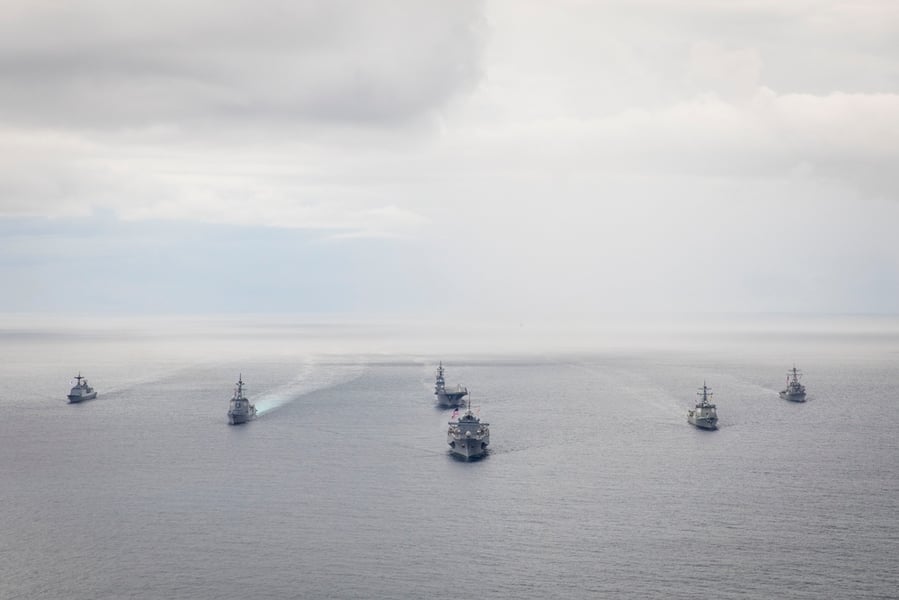

SEOUL — Three weeks after Donald Trump shortened the main bilateral US-South Korea military exercise by half and three days after the US Marine Corps confirmed it was cancelling the biennial Ssangyong landing drill entirely, US Pacific Command announced Friday that the trilateral Freedom Edge exercise with South Korea and Japan would proceed as scheduled — September 7 through 11, in international waters off Jeju Island.
The announcement lands with the weight of its context. Trump’s gestures toward North Korea over the past six weeks — cutting Ulchi Freedom Shield from eleven days to five, absorbing the Ssangyong cancellation without public comment — were presented in Washington as diplomatic signals: evidence of goodwill toward Kim Jong-un’s government and proof that America’s approach to the Korean Peninsula had shifted. Freedom Edge confirms that the shift has limits, and that those limits are defined not by Washington alone but by the Japan-South Korea alliance framework that Trump’s bilateral gestures left intact.
North Korea’s response was immediate. Pak Jong-chon, the vice chairman of the Workers’ Party of Korea’s Central Military Commission and the North’s most senior military figure, had already characterized Freedom Edge as “the most offensive war drill for aggression,” threatening to respond with counteraction “in a very clear and intensified way.” Kim Yo-jong, Kim Jong-un’s sister and the regime’s principal foreign-policy voice, was direct: “Reckless muscle-flexing by the US, Japan and South Korea in the wrong location, in the surrounding areas next to the DPRK, will definitely bring unfavourable consequences,” NBC News reported. Neither official specified the form those consequences might take.
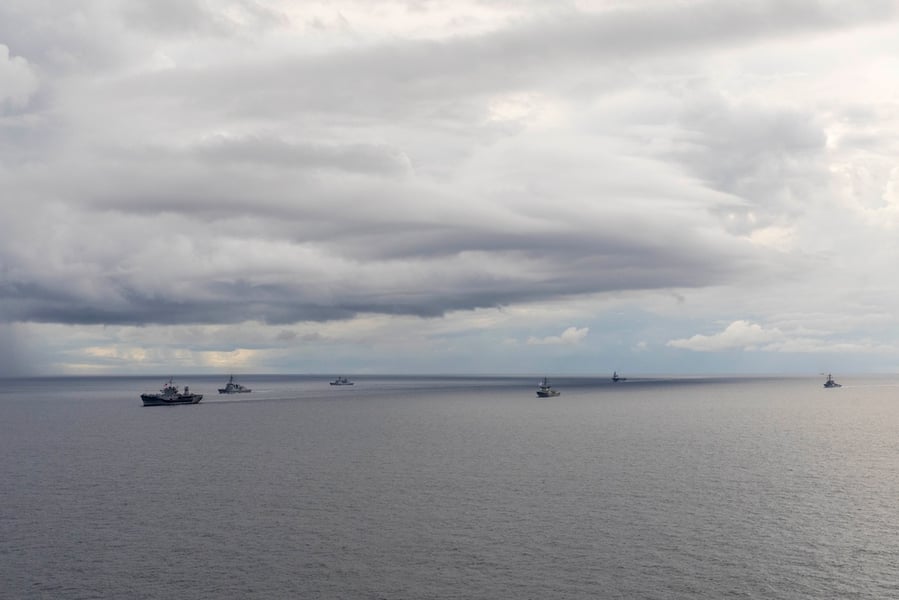
Since its inception in 2024, Freedom Edge has been a multidomain exercise — maritime operations, air coordination, cyber, ballistic missile defense training, and antisubmarine warfare. South Korea’s Joint Chiefs of Staff describe it as “a defensive exercise conducted annually by the three nations to counter North Korea’s nuclear and missile threats and to safeguard regional peace and stability,” NPR reported. The Jeju Island location, in international waters to the south and east of South Korea, places the exercise within visible range of North Korean military planners while remaining in waters where all three allies have established operational presence.
The paradox of the Friday announcement is that it is structurally embarrassing to the conciliatory narrative Trump has been building. He shortened Ulchi Freedom Shield because the drills were “not only costly” but sent “a signal that is completely inappropriate and hostile.” South Korea’s government found out about that decision by reading Trump’s Truth Social post, according to Foreign Minister Cho Hyun — no advance diplomatic consultation, no allied briefing, no coordination. The episode raised hard questions in Seoul about how much weight to place on Washington’s unilateral signals.
Freedom Edge is a different category of exercise. It involves three countries, three militaries, and a structure that no single leader can adjust on social media. Trump shortened the bilateral; he cannot unilaterally cancel the trilateral without Japan’s agreement and Seoul’s acquiescence — and neither Tokyo nor Seoul has any institutional interest in doing so. Japan’s military posture has been expanding steadily under its revised security strategy, and Freedom Edge is one of the visible markers of the three-way architecture that expansion is designed to reinforce.
The parallel with the Ssangyong cancellation makes the contrast clearer. That exercise was a bilateral US-South Korea commitment that Washington walked away from citing force constraints in the Middle East — a unilateral decision that Seoul absorbed without public dissent, but whose implications were not lost on alliance planners. The Ssangyong cancellation reinforced a pattern: America modifies what it controls alone, and preserves what it shares with allies. Freedom Edge falls into the second category.
For Pyongyang, the message Freedom Edge sends is the one that matters most: the structural alliance framework has not moved, whatever Trump’s rhetoric toward Kim Jong-un suggests. The drills Trump cut were bilateral American decisions. The drill proceeding is a trilateral commitment. North Korea’s military planners are capable of distinguishing between the two.
Whether Trump will intervene to modify Freedom Edge as he modified Ulchi Freedom Shield is the question Seoul and Tokyo are trying to answer. His track record suggests the political impulse is there — he has cited his “very good relationship” with Kim Jong-un repeatedly as justification for reducing the pressure standard alliance exercises represent. But any modification of Freedom Edge that does not include Tokyo’s agreement is qualitatively different from a bilateral adjustment made in Washington without consulting Seoul.
The diplomatic consequences of proceeding are already materializing. Any momentum toward a renewed Trump-Kim diplomatic channel — tentative, unannounced, but quietly discussed in Seoul’s diplomatic circuits — dims the moment Freedom Edge is confirmed. North Korea’s pattern since 2018 has been consistent: when the exercises proceed, the diplomatic track pauses; when exercises are modified, Pyongyang tests whether the concession is real by asking for more. The Freedom Edge confirmation ends that test before it starts.
Kim Yo-jong’s warning about “unfavourable consequences” is calibrated language, not an empty threat. North Korea has a range of responses short of direct escalation: missile tests timed to the exercise’s start date, cyber operations against participating systems, or a formal statement through state media reframing the exercise as grounds to accelerate its weapons program. Any of these would serve the same purpose — signaling that concessions made in one channel do not constrain behavior in another.
What Freedom Edge cannot answer, and what neither Seoul nor Washington has been willing to address publicly, is the structural question the past six weeks have posed: the pattern of Trump reducing bilateral exercises while multilateral ones proceed intact suggests that American reliability in Asia is now a function of how many allies are involved. That may be precisely why Seoul and Tokyo have invested so heavily in the trilateral format.
Whether North Korea will receive that message in the way its architects intend is unknown. What is not unknown is that on September 7, the exercise begins.