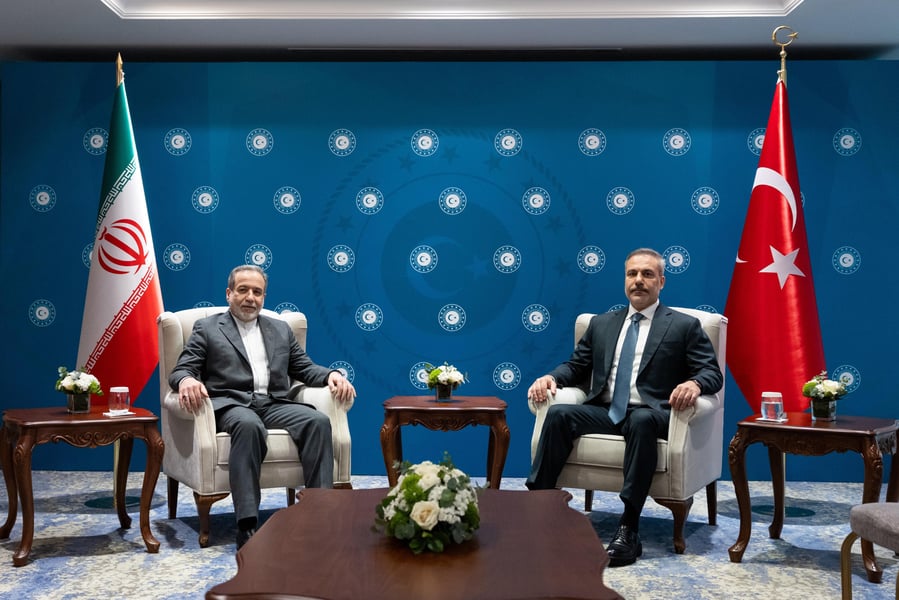

ISTANBUL — The meeting was supposed to demonstrate that Europe had not been left behind.
Foreign ministers from seven countries, including the United Kingdom, France, and Germany alongside Turkey, Egypt, Saudi Arabia, and Pakistan, were due to gather in Istanbul on Saturday. Berlin and Ankara organized the session as a coordinated signal to Washington. The message was meant to be clear: European and regional powers still have a stake in how the Iran nuclear file resolves, and the United States cannot settle it alone.
The meeting has been postponed. No new date has been set.
The stated reason, a scheduling conflict involving one of the participants, disclosed nothing about which of the seven governments pulled back, or whether the conflict was a genuine calendar problem or something more substantive. German officials who confirmed the postponement to DPA did not identify the participant responsible. Whoever caused the delay, the result is that the coalition Germany and Turkey assembled to project diplomatic coherence has, for now, failed to cohere.
The timing adds to unease in European capitals. The 60-day deadline that Washington and Tehran set in June for reaching a “final deal” on Iran’s nuclear program and Hormuz navigation rights expired earlier this month without a signed agreement. Trump administration officials have since opened what administration sources describe as a direct backchannel with Iran’s Islamic Revolutionary Guard Corps, which Iran has denied. Meanwhile, the Strait of Hormuz, whose reopening was the centrepiece of the original ceasefire understanding, remains a source of friction, with disputes over transit terms unresolved despite months of negotiation.
In that context, the Istanbul meeting had a double purpose: to address freedom of navigation in the Strait of Hormuz and the broader regional security situation, and to reinforce to the Trump administration that a European-backed multilateral framework still exists and still matters. Neither aim can be served by a meeting that does not take place.
The three European powers triggered the UN snapback mechanism late last year, reimposing nuclear-related UN sanctions against Iran after Tehran failed to return to formal negotiations. The move was a procedural lever that the Europeans could use unilaterally; whether it translated into actual influence over Tehran’s behaviour has remained unclear throughout 2026. Iran concluded early in the ceasefire period that its real interlocutor for any meaningful nuclear arrangement is Washington, not Brussels. The snapback sanctions were real but they did not change that underlying calculation.
Turkey’s role as co-organizer of Saturday’s planned meeting adds another complication. Ankara has maintained functional diplomatic channels with both Iran and the United States throughout the conflict, a position Turkey views as a strategic asset. The Turkish foreign ministry has held multiple exchanges with Iranian Foreign Minister Abbas Araghchi in recent months, focused on Hormuz navigation terms and the status of the ceasefire framework, according to Anadolu Agency reporting.
According to TASS, the Istanbul meeting was expected to address not only Iran but also the situation in the Black Sea and Ukrainian grain exports. That breadth of agenda reflected the coalition’s ambition: to demonstrate coordinated diplomatic relevance across multiple active crises simultaneously. It also meant there were seven governments to coordinate and seven sets of domestic political constraints to account for. A scheduling conflict involving any one of them was always a plausible outcome.
The Strait of Hormuz negotiations, proceeding mainly through Oman as an intermediary, have not produced the transit-rule agreement that would complete the ceasefire framework. Iran has sought specific terms on how commercial shipping transits the strait; the United States and Iran have not agreed on what those terms require. The oil market had begun to ease its Hormuz risk premium in the days before the postponement was announced, suggesting traders had already begun discounting the prospect of a near-term multilateral breakthrough.
Europe’s difficulty in the Iran file is structural. The three European powers have leverage through the snapback mechanism and their own sanctions, but they have no direct channel to alter the military arithmetic that now governs what Tehran will or will not sign. For much of 2026, Tehran’s internal political debate has centred not on whether to negotiate with Europe but on whether to exit the Nuclear Non-Proliferation Treaty entirely, a calculation driven by US and Israeli strikes on Iranian nuclear facilities, not by European diplomacy.
The Istanbul meeting, had it taken place, would not have altered that debate. But it would have signalled that a seven-nation coalition remained organized enough to meet. The postponement, and particularly the absence of any rescheduled date, removes that signal in a moment when European diplomatic presence in the Iran file is being tested against events that are moving faster than the coalition can schedule itself.
Who reschedules the meeting, when, and with which participants still present will say something about whether Europe still belongs in that room, or is simply waiting to be invited in when the harder negotiations are concluded.