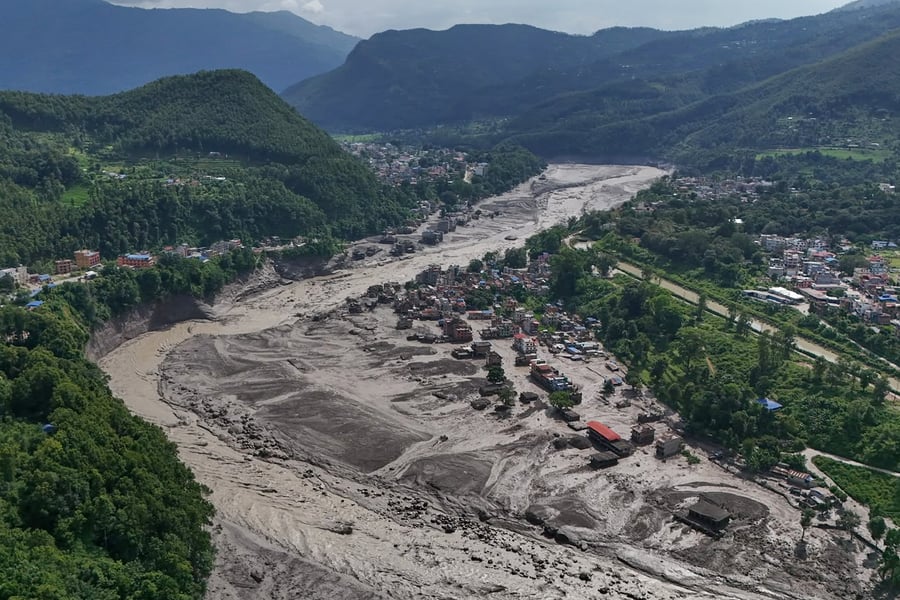
KATHMANDU — Rescue workers searching for more than 1,500 people still missing across Nepal’s shattered northern valleys confronted a new emergency Friday: the debris lake that formed at the Nepal-China border after Wednesday’s catastrophic glacial collapse has started to overflow, raising the prospect of a second surge of water through communities already buried under mud, rock, and grief.
Officials in Nepal’s Rasuwa district confirmed that water from the barrier lake, which accumulated behind the mass of ice and sediment that initially dammed the Lhende River, was spilling over its edge as of Friday. The lake’s exact dimensions remain unknown. Roads to the site have been destroyed, limiting monitoring to helicopter overflights. Nobody has said precisely how fast the lake is filling, or what happens if the debris barrier gives way entirely.
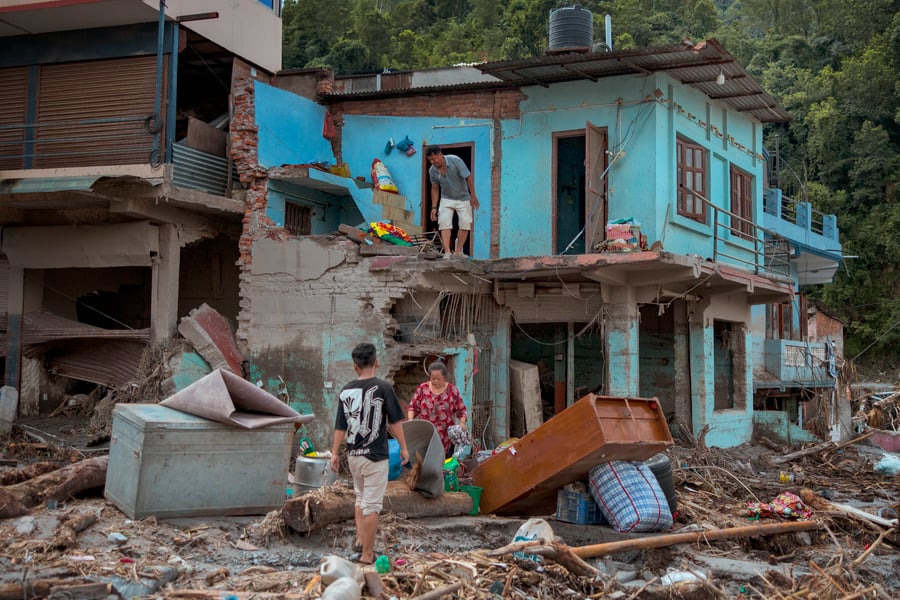
The death toll from Wednesday’s initial disaster has climbed past 390 people, the majority in Rasuwa district. Three people have been confirmed dead in Tibet’s Gyirong County, on the Chinese side of the border. More than 1,500 remain missing, including citizens from dozens of countries. The United States State Department said 90 American nationals are unaccounted for in Nepal, while five others were rescued after the floodwaters struck.
At approximately 8:40 in the morning on Wednesday, a substantial section of an unnamed glacier, positioned at roughly 5,200 metres above sea level, separated from its base and fell approximately 1,200 metres onto the valley floor below, gathering rock and sediment as it descended. The resulting mass struck the Lhende River in Tibet, about 20 kilometres northeast of the Nepal-China border crossing, briefly blocking the river. When that natural dam gave way, the surge moved through the Trishuli River valley in Nepal, hitting villages in Rasuwa district without warning.
Early reports attributed the collapse to a 4.4-magnitude earthquake. The United States Geological Survey later determined that the seismic signal originated from the landslide itself, not the other way around. The collapse was powerful enough to register as the equivalent of a 5.2-magnitude seismic event. The shaking did not trigger the glacier. The glacier produced the shaking.
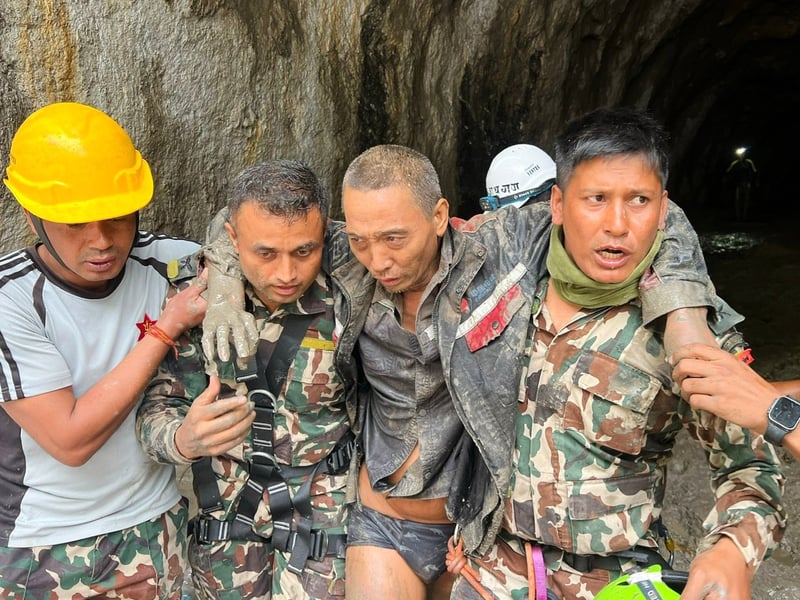
More than 5,000 Nepalese Army and police personnel have been deployed across the affected region. Helicopters are delivering emergency supplies, including tents, food, and medicine, to communities that have been cut off by the destruction of at least 19 bridges and roughly 40 kilometres of road. Ground-based search teams have been recovering bodies where water levels have receded, but officials acknowledge that the scale of the missing far exceeds available resources.

Nepal is one of the most disaster-prone countries in Asia, positioned where the Indian and Eurasian tectonic plates collide and spanning an altitude range from lowland plains to the summit of Everest. Its northern river valleys are fed by glaciers and snowmelt from the Tibetan plateau. The infrastructure connecting those valleys is built for weather. It is not built for what happened on Wednesday. At least one hydropower plant in Rasuwa was destroyed; how many others were damaged in more remote valleys has not yet been assessed.
The barrier lake adds a distinct danger to an already overwhelming situation. A glacial debris dam can hold for weeks, or it can fail suddenly, as the original dam on the Lhende River did. Draining a natural lake of this kind requires either controlled engineering or enough time for overflow to erode the barrier from above. Both scenarios assume the debris holds long enough to allow one of them. Officials have not said which outcome they are working toward, or whether the terrain permits either.
Climate scientists have been careful about attributing Wednesday’s collapse directly to rising temperatures. The failure mechanics of glacier ice, bedrock, and permafrost are specific to each case, and the analysis of what happened in Rasuwa is still in its early stages. What researchers have not been cautious about is the broader direction. Himalayan glaciers have been retreating at roughly double the rate recorded from 2000 onward compared with the preceding decade, according to published research on Himalayan ice loss. As temperatures rise, the permafrost anchoring ice to bedrock thaws gradually, weakening the structural bond between glacier and mountain in ways that are invisible until they are not.
Al Jazeera’s coverage noted that Wednesday’s event fits the classification of a glacial rock avalanche, a phenomenon that scientists tracking the Hindu Kush Himalaya have been modelling as a growing risk. The range holds more freshwater ice than anywhere outside the polar regions. Roughly two billion people in South Asia and China depend on its glacial meltwater. The rivers they feed are changing. What happened in Rasuwa is one way that change arrives.
What the rescue teams cannot yet answer is how long it will take to drain the barrier lake safely, whether Friday’s overflow will intensify, and how many of the more than 1,500 missing will be found alive. On Friday, none of those questions had answers. The helicopters were still flying.