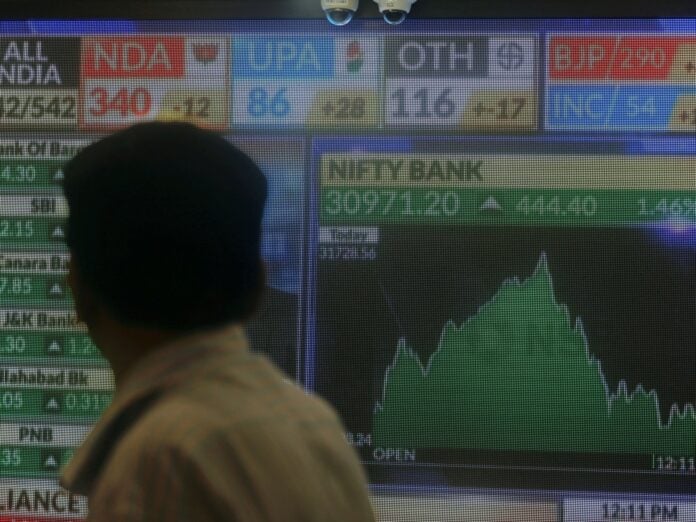

MUMBAI – Private sector lenders gave India’s banking-sector benchmark a tentative lift on Monday, masking a session that split the index almost evenly between gainers and losers. The Nifty Bank index closed at 52,847.30 on August 31, up 221.60 points or 0.42 percent, as HDFC Bank’s near-2-percent surge offset drag from Kotak Mahindra Bank and public sector lenders that continued to weigh on sentiment heading into September.
The advance was narrow rather than broad. Of the twelve index members, six finished higher and six finished lower, a symmetry that reflects lingering uncertainty about the pace of rate cuts even as the Reserve Bank of India prepares its next policy review in October. HDFC Bank contributed the largest positive points differential of any member, while Kotak Mahindra Bank’s 1.38-percent decline trimmed an estimated 45 points from the index’s potential gain on the day.
HDFC Bank, which carries the heaviest weighting inside the index, rose 1.87 percent to close at 1,843.70 rupees. Dealers attributed the move partly to options market activity ahead of monthly expiry and partly to fresh institutional buying linked to the bank’s strong second-quarter loan-growth data released last week. The private lender’s net interest margin has held steadier than peers during the current rate cycle, giving fund managers a defensible reason to add exposure at current levels.
IndusInd Bank posted the second-largest percentage gain among index members, climbing 1.13 percent to 890.60 rupees. The mid-sized lender has been working to rebuild its standing with institutional investors after a difficult stretch tied to accounting irregularities in its derivatives book. Monday’s session suggested that the rehabilitation trade continues, though analysts at several large brokerages still carry cautious ratings pending a full audit conclusion.
Axis Bank added 0.82 percent and ICICI Bank rose 0.38 percent, each recording gains that fell short of HDFC Bank’s move but contributed positively to the index. Federal Bank, a smaller constituent with a strong retail franchise in Kerala and the Gulf-diaspora corridor, advanced 0.90 percent on the back of steady credit demand from its core geography. That demand is not uniform across the country, and Nikkei Asia reported that consumer loan growth has slowed nationally as wage increases disappointed.
| Bank | Last Price (Rs) | Change (Rs) | Change (%) | 52-Wk High (Rs) | 52-Wk Low (Rs) |
|---|---|---|---|---|---|
| HDFC Bank | 1,843.70 | +33.90 | +1.87% | 1,962.50 | 1,363.10 |
| ICICI Bank | 1,429.40 | +5.40 | +0.38% | 1,457.30 | 993.20 |
| Axis Bank | 1,246.30 | +10.10 | +0.82% | 1,388.70 | 943.00 |
| Kotak Mahindra Bank | 1,892.80 | -26.50 | -1.38% | 2,134.60 | 1,568.40 |
| State Bank of India | 826.30 | -6.80 | -0.82% | 1,031.20 | 693.50 |
| IndusInd Bank | 890.60 | +9.96 | +1.13% | 1,097.40 | 748.20 |
| Bank of Baroda | 278.40 | +2.18 | +0.79% | 322.10 | 212.60 |
| Punjab National Bank | 142.60 | -1.34 | -0.93% | 174.80 | 108.30 |
| Federal Bank | 214.80 | +1.92 | +0.90% | 238.40 | 162.80 |
| AU Small Finance Bank | 692.50 | -8.24 | -1.18% | 819.60 | 534.20 |
| Bandhan Bank | 178.40 | +1.24 | +0.70% | 221.30 | 149.60 |
| IDFC First Bank | 88.60 | -0.96 | -1.07% | 112.40 | 67.80 |
| Source: NSE. Data as of market close, August 31, 2026. All prices in Indian rupees. | |||||
Among public sector banks, the picture was bleaker. State Bank of India fell 0.82 percent to 826.30 rupees, continuing a pattern in which India’s largest lender has struggled to attract the same institutional flows that private names command during this rate cycle. Punjab National Bank dropped 0.93 percent. IDFC First Bank, the smallest constituent by market capitalisation, slid 1.07 percent, extending a month in which the bank’s shares underperformed the index by roughly four percentage points.
Kotak Mahindra Bank was the session’s most notable laggard among private-sector names, falling 1.38 percent to 1,892.80 rupees. The bank has underperformed the broader private-sector cohort for most of August, weighed by concerns about slower loan growth relative to peers and unresolved questions around leadership direction that the bank has not commented on publicly. Three brokerages that cover the stock downgraded their price targets in August.
Bank Nifty’s August unfolded in two distinct phases. The index entered the month near 51,200 before rallying above 53,000 in the first half as expectations firmed around an accommodative monetary tone from the Reserve Bank of India. A partial retreat in the final two weeks followed as global bond yields climbed on stronger-than-expected United States economic data, capping the advance. The index closes August roughly 3.2 percent higher than it opened the month, a performance that exceeded the Nifty 50’s 1.7-percent August gain even as it fell short of the index’s July high-water mark.
Foreign portfolio investors returned as net buyers of Indian banking equities on Monday, purchasing approximately 1,840 crore rupees on a gross basis in the financial services category, according to NSE end-of-day data. That reading suggests global capital is still finding Indian banks attractive on a relative basis, despite the unsettled interest-rate environment in the United States and Europe that has complicated allocation decisions throughout August.
The October policy meeting of the Reserve Bank of India is the clearest near-term catalyst for the Nifty Bank index. Consensus among market economists surveyed by three Mumbai-based brokerages leans toward one 25-basis-point rate cut before December, contingent on consumer price inflation remaining below 4.5 percent. July’s inflation data, released earlier this month, showed food-price pressures easing, a development that gives the central bank marginally more room to act. Whether that room translates into an October move remains genuinely open; the RBI’s communication has deliberately preserved policy optionality and has resisted pre-committing to a timeline.
AU Small Finance Bank fell 1.18 percent and Bandhan Bank gained 0.70 percent in a divergence that reflects each institution’s different credit-quality exposure. AU Small Finance, with its concentration in Rajasthan and small-business lending, faces questions about rural asset quality as monsoon-cycle credit effects filter through the loan book. Bandhan’s microlending portfolio has undergone its own recovery process since the pandemic era, and Monday’s marginal advance may reflect technical relief buying rather than a fundamental re-rating of the franchise.
How the Bank Nifty behaves through September’s first week will depend in part on data due this week. India’s August manufacturing PMI, scheduled for release Tuesday morning, could reshape expectations about corporate credit demand and put fresh pressure on lenders with meaningful exposure to mid-sized manufacturers if the reading disappoints. That data point, and the market’s reaction to it, is the one variable the session’s gains left entirely unresolved.