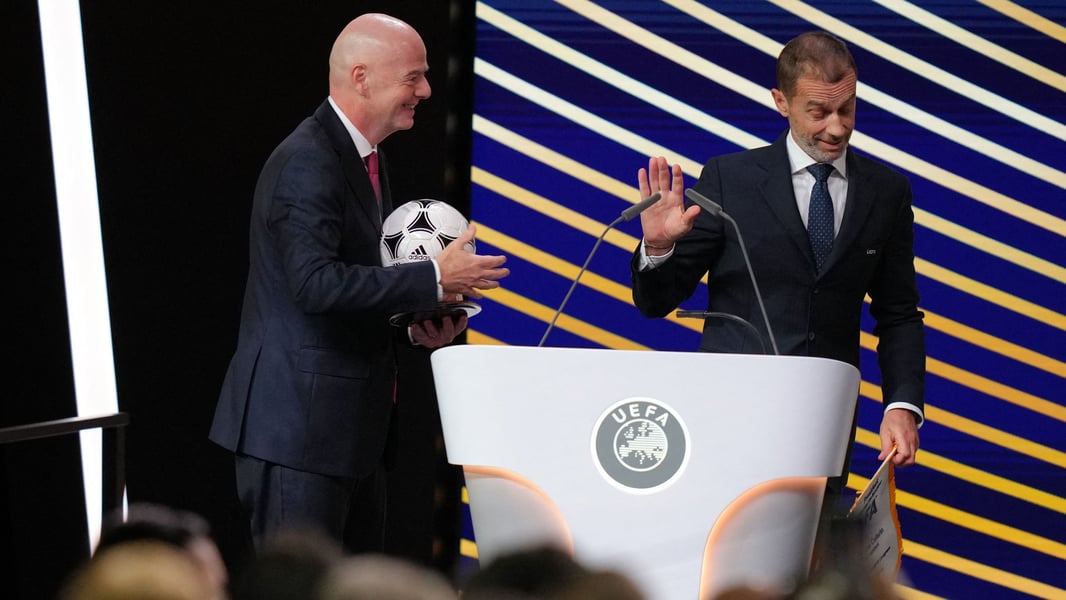

NEW YORK — The last time FIFA and UEFA disagreed, the argument stayed inside boardrooms. That time is over.
FIFA filed documents in a US federal court this week accusing UEFA of waging “a weeks-long smear campaign against FIFA and its leadership” — the sharpest public escalation yet in the governance war that has shadowed world football since this summer’s failed attempt to sell private stakes in the World Cup. Separately, reports emerged that FIFA has agreed to pay Gianni Infantino’s personal legal costs if UEFA proceeds with a lawsuit targeting him directly, a commitment that effectively transforms an attack on the president into an attack on the institution behind him.
The court documents, reviewed by multiple outlets, framed UEFA’s legal strategy as less about governance reform and more about market protection. “If soccer is strengthened in the developing world, global competition increases,” FIFA argued, “which ultimately reduces UEFA’s market power.” The implication was explicit: Europe’s governing body is not objecting to a flawed proposal on principled grounds. It is objecting because a stronger Global South in football threatens the commercial hegemony of the continent that currently dominates the sport’s revenue streams.
UEFA has not publicly responded to that framing. What it has done is pursue Infantino personally — a move that distinguishes this legal fight from the institutional disputes that typically mark inter-federation disagreements.
In late August, UEFA filed a legal discovery document in the United States targeting the FIFA president as an individual rather than FIFA as a corporate body. That document accused Infantino of “fraudulently” offering stakes in what was internally called the FIFA Forward Enterprise without following proper authorization channels, and at a valuation UEFA described as “absurdly low.” UEFA has reserved the right to pursue criminal charges against Infantino and other FIFA members in Switzerland, where the federation is headquartered and where such prosecutions fall under Swiss law.
FIFA’s decision to absorb Infantino’s legal costs is grounded in a straightforward rationale: because the president was acting in his official capacity when he advanced the proposal, representing FIFA in negotiations with investors including Thrive Capital’s Josh Kushner, the organization is obligated to cover his defense. Had Infantino pursued the arrangement in a private capacity, the bill would be his alone. The line between institutional action and personal liability runs entirely through that question — whether the president was doing his job.

What remained, after the plan collapsed, was the question of accountability. That is the terrain FIFA and UEFA are now fighting over in US courts.
UEFA’s argument, distilled to its sharpest form, is that Infantino created legal exposure for FIFA by pursuing an investment structure that was never properly authorized and that bypassed member association approval. FIFA’s counterargument is equally direct: UEFA waited until the plan failed, then weaponized the failure as cover for a legal assault aimed at removing a president who threatened European economic interests.
Both arguments can be simultaneously true. What is beyond dispute is that the language now being used — “smear campaign,” “fraudulently,” criminal mismanagement — bears no resemblance to the carefully managed communiqués that typically characterize disputes between global football’s governing bodies. This is a genuine institutional war, fought with legal briefs, with consequences that will shape who controls the sport long after any court judgment.
Argentina’s football association backed Infantino during the August crisis, one signal that support for the president had not collapsed entirely outside Europe. According to Goal, UEFA had also warned FIFA against destroying evidence related to the scrapped plan — a detail that speaks to how adversarial the relationship has become.
The configuration of alliances going forward — who stands with FIFA’s leadership and who aligns with UEFA’s challenge — will determine whether Infantino survives politically, whatever the courts ultimately decide.
Football’s economic map is drawn heavily in Europe’s favor: the Champions League, the major domestic leagues, the transfer fees, the broadcast rights. Any plan to redistribute investment toward the developing world touches that map. FIFA’s accusation that UEFA is protecting its commercial turf rather than policing governance cannot be refuted simply by winning a court case. It is a political charge that will outlast the litigation regardless of outcome.
The next phase of proceedings is expected later this month, when a US judge will consider FIFA’s request to have UEFA’s discovery petition dismissed entirely.
What comes after — whether criminal charges are filed in Switzerland, whether Infantino’s political position remains tenable through the next FIFA election cycle — is as genuinely open as any question in the sport right now.