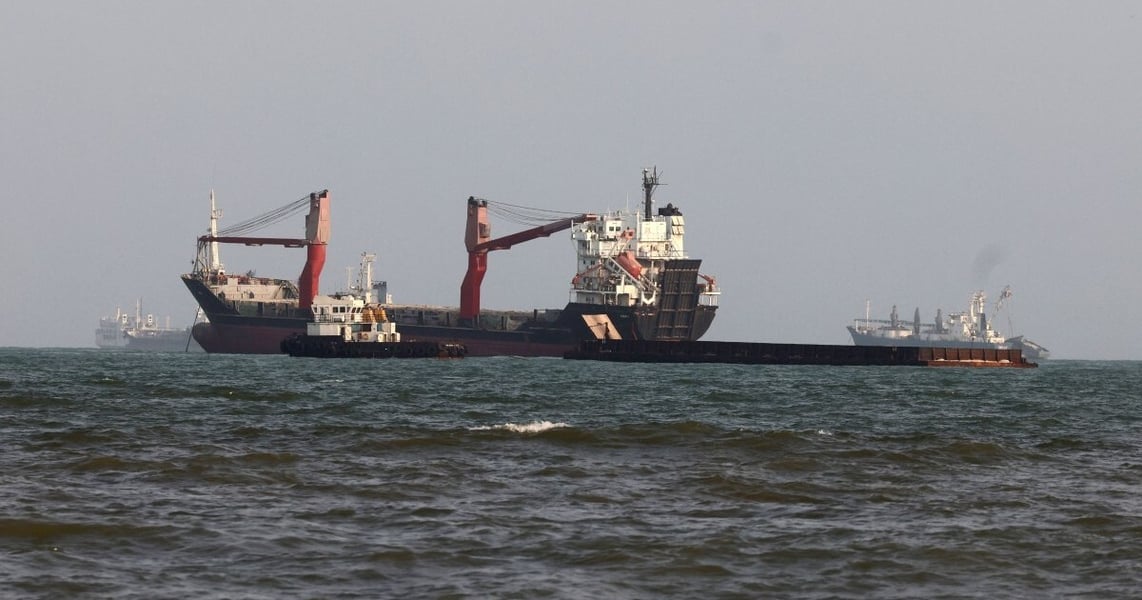

NEW YORK – Before the first tanker cleared the Strait of Hormuz on Thursday, markets had already decided. Brent crude held just below $95 a barrel, the same altitude it has maintained all week, because the channel that once moved 21.6 million barrels every 24 hours now manages 4.9 million. The arithmetic does not require interpretation.
The Hormuz throughput has collapsed: from 21.6 million to 4.9 million barrels per day between the fourth quarter of 2025 and the second quarter of 2026, a 77 percent reduction. Tanker operators, insurers, and the refineries on the receiving end of those cargoes have had months to absorb the reality, but financial markets still found room to move on Thursday. Front-month Brent settled at $95.04, and West Texas Intermediate pushed past $90 for the first time since the summer of 2025. Both contracts ended near their weekly highs.
The tension markets are navigating is structural, not seasonal. OPEC+ completed its rollback of the 1.65 million barrel-per-day production cut agreed in 2023, and on paper the cartel is producing at its 2022 ceiling. In practice, several members have not caught up. Actual supply has lagged the headline ceiling by an estimated 300,000 to 500,000 barrels per day, according to traders tracking secondary-source data. That quiet, persistent shortfall has compounded the Hormuz constraint to keep the market tighter than either factor alone would suggest.
The U.S. Energy Information Administration raised its estimates for Middle East shut-in production this week, forecasting that the disruption would extend further into the fourth quarter than its previous baseline assumed. According to the agency’s August Short-Term Energy Outlook, global supply availability was revised downward even as demand projections for the same period held flat. More demand relative to available supply is the mechanical explanation for Brent’s persistence near $95.
The IEA’s August Oil Market Report projected global oil demand growth at just under a million barrels per day for the remainder of the year. That forecast, considerably more cautious than OPEC’s own view, reflects slowing industrial activity in China, the world’s largest crude importer, and cooling refined product demand in India. Both countries were major Persian Gulf crude buyers before the conflict; both are now sourcing more from Russia and West Africa at a premium in freight costs. The physical rerouting has not collapsed demand. It has made demand more expensive and less responsive to short-term price signals.
The price floor at $95 is not impenetrable. Traders point to two downside scenarios: a negotiated reopening of Hormuz, even partial, that restores tanker traffic faster than expected; or a sharper-than-forecast decline in Chinese industrial activity that cuts import demand before refiners can adjust. Neither has materialized. The conflict has produced no diplomatic breakthrough since Brent’s rally to $92 on Iran-Jordan tensions three sessions back. Chinese manufacturing data for August, due next week, will offer the clearest read yet on the demand side of that equation.
What Tuesday’s Hormuz strike session clarified is how quickly a price ceiling becomes a price floor in a supply-constrained market. Two weeks ago, $95 felt like an overshoot. Thursday it held without drama, a signal that the market has absorbed the Hormuz constraint and is pricing it as durable, at least as durable as the conflict that created it.
The consequences track differently across the three markets most exposed to Brent’s current level. In the United States, gasoline prices tracked between $3.90 and $4.20 per gallon in most urban markets this week, up from a late-spring average closer to $3.50. In the United Kingdom, petrol at major forecourts crossed £1.65 per litre. India’s government held fuel retail prices steady, a managed rate that masks the true subsidy cost of Hormuz-driven crude. All three are absorbing the same disruption through different fiscal mechanisms. How long each can sustain that position without a political break or a change in the underlying price depends, in part, on what Sunday’s ministers decide not to do.