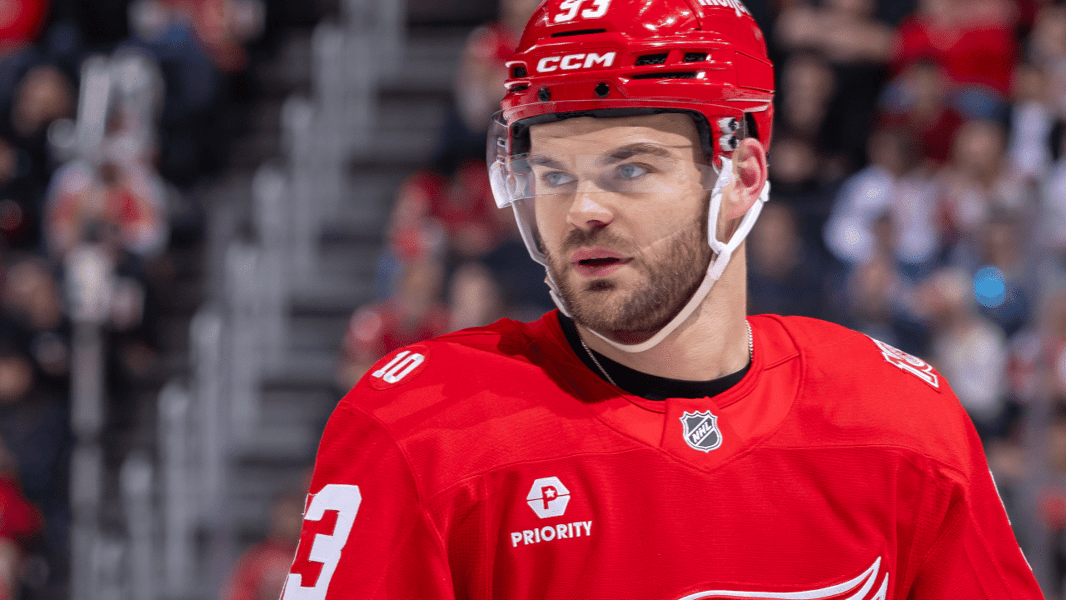

DETROIT — Alex DeBrincat knows where he wants to be. The Detroit Red Wings, six days before a new collective bargaining agreement changes the rules around his next contract, do not yet have the general manager who would decide whether to keep him.
That tension was on display Tuesday at the NHL/NHLPA media tour in Las Vegas, where DeBrincat offered the Red Wings precisely the kind of public commitment a franchise wants from a player entering the final year of his contract.
“I love playing for the Red Wings,” he said. “I love wearing that jersey and battling with those guys out there. My intention is obviously to stay in Detroit.”
What DeBrincat could not provide was clarity about what Detroit intends to do with him. Steve Yzerman departed as general manager in mid-July, and the Red Wings have yet to name his replacement. The search has continued through the approach to training camp, the countdown to the new CBA and a summer in which questions about the organization’s direction have increasingly become questions about its roster.
DeBrincat, 28, is entering the final season of a four-year contract with an average annual value of $7.875 million. He will become an unrestricted free agent at the end of June. The extension discussions that could determine whether he remains in Detroit have not begun because the person expected to lead those negotiations has not yet been hired.
The timing matters beyond the usual uncertainty of a contract year.
Six days after Tuesday, on September 16, the NHL’s new collective bargaining agreement takes effect. Under the current rules, a player re-signing with his existing team can receive a maximum eight-year contract. After September 16, that maximum falls to seven years.
For DeBrincat, the calendar therefore carries a financial and contractual consequence. Any future long-term offer from Detroit under the new agreement could be one year shorter simply because the organization has not yet completed its front-office transition.
That is the backdrop to DeBrincat’s declaration of loyalty in Las Vegas. He did not manufacture uncertainty or use his walk year as public leverage. Instead, he stated his preference clearly and left the next decision to an organization that does not yet have the executive in place to make it.
The uncertainty surrounding DeBrincat is part of a broader period of instability for Detroit.
Dylan Larkin, the team’s captain, has submitted a trade request, a development DeBrincat acknowledged directly. “From my perspective, he’s a great teammate, he’s a great friend of mine, and that’s a decision he made,” DeBrincat said.
He described the situation as one that “sucks,” then moved on.
Patrick Kane’s departure provides another measure of how quickly Detroit’s recent plans have changed. DeBrincat helped recruit Kane to the Red Wings, where Kane joined the team in December 2023. Kane has now returned to Chicago after signing a two-year contract with the Blackhawks, rejoining the franchise for which he played the first 15 seasons of his career.
The sequence is notable because Kane’s arrival had once represented Detroit’s appeal as a destination. DeBrincat made the call; Kane came to Detroit.
Now that relationship has effectively reversed.
DeBrincat remains in Detroit and says he wants to stay. But with the general manager’s position still vacant, the player most clearly stating his commitment to the franchise is also the player whose contractual future is becoming more complicated by the day.
What remains is DeBrincat’s production and DeBrincat’s loyalty, which in any functional organization would be more than enough. Last season, at 28, he scored 40 goals — Detroit’s first player to reach that mark since Marian Hossa in 2008-09. In the same week that NHL teams raced to beat the September 16 CBA deadline, DeBrincat arrived in Las Vegas having already made his preference public and having received no structural answer.
Teams were calling about DeBrincat as recently as June. That call volume is not surprising for a player with his numbers. It is a signal that the rest of the league sees what Detroit apparently cannot currently act on. A 40-goal scorer in a contract year is a negotiable commodity if the team holding his rights decides the asking price is right. Whoever accepts the GM job will inherit both options: lock him up before he hits free agency, or recoup the draft capital that a June departure would waste.

The Red Wings’ rebuild timeline, which Yzerman had been stewarding toward a resolution somewhere in the 2026-27 window, is now undefined. The pieces around DeBrincat are fewer than they were. The organizational structure is thinner. The CBA clock, which was always going to tick down to September 16, is now six days from stripping away the longest extension term the incoming GM could have offered.
None of this is DeBrincat’s doing. He showed up in Las Vegas and said exactly what a 40-goal scorer who wants to stay should say. He addressed the Larkin situation without disloyalty. He talked about the jersey and the teammates and the intention to return. He did all of it with a team that cannot answer him — not because they do not want to, but because they do not yet have a general manager.
The extension will happen. The structure will be worked out. What Tuesday confirmed is that DeBrincat is not making this harder than it has to be. The question of whether the Red Wings can say the same won’t have an answer until they hire someone to give it.