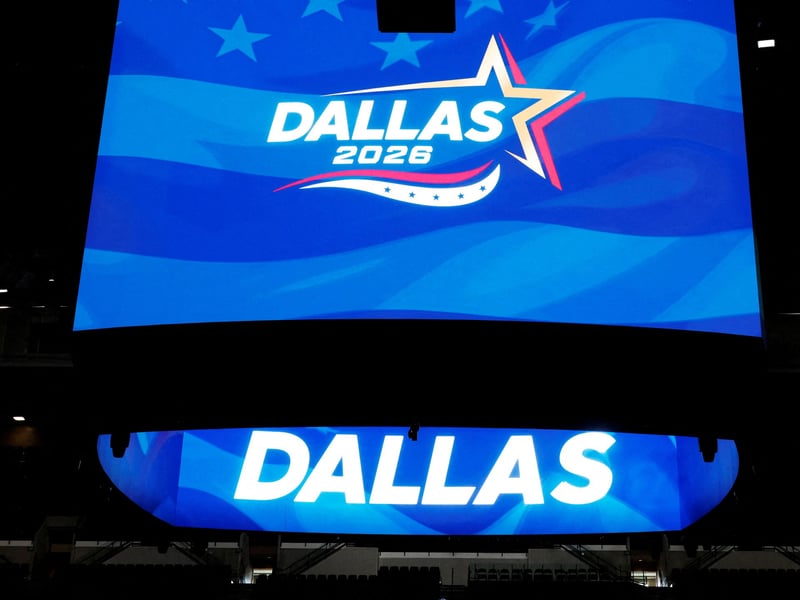

DALLAS — For the first time in the history of the American republic, a sitting president has called his party to a national convention during a midterm election year. As Republicans gathered Tuesday night at the American Airlines Center in Dallas, however, it remained unclear what political narrative President Donald Trump would ultimately choose to emphasize.
The Republican National Committee opened its two-day midterm convention at dusk, presenting a lineup of 109 speakers under the banner of what party officials have called the “Common Sense Revolution.” Trump is scheduled to deliver the opening keynote Tuesday night before returning Thursday for the closing address. Vice President JD Vance, Treasury Secretary Scott Bessent and Health Secretary Robert F. Kennedy Jr. are also scheduled to speak, underscoring the administration’s effort to project unity as Republicans confront an electoral cycle in which history offers little reassurance.
No sitting president’s party has avoided losses in a midterm election in the modern era, while the current congressional balance leaves Republicans with little room for error. The party is defending narrow majorities in both the House and Senate.
That structural vulnerability is an implicit reason for the convention’s carefully produced political messaging. The party is using the week to build momentum and frame its priorities before eight weeks of intensive campaigning begin. At the same time, the administration’s voter-roll purge databases are before the Supreme Court this week, illustrating how the legal and administrative machinery surrounding the midterms is advancing alongside the campaign’s political spectacle.
Democrats, meanwhile, have moved quickly to challenge the Republican gathering.
House Minority Leader Hakeem Jeffries sent a four-member House delegation to Dallas on Tuesday, while more than a dozen progressive and labor organizations organized counterprogramming in the streets surrounding the convention. The Democratic National Committee questioned the coherence of the Republican event and sought to place the administration’s foreign policy at the center of the debate.
“He said he would end forever wars,” a Democratic spokesperson told reporters. “We are now in another quagmire in the Middle East.”
The criticism points toward what could become one of the convention’s most significant political vulnerabilities. The two-day program places considerable emphasis on tax relief, border security and public safety, but gives no sustained attention to the six-month war with Iran that has dominated the international news cycle since March.
The omission comes as the conflict continues to generate consequences well beyond the battlefield. In four days this week, five Iranian oil tankers were destroyed in the Gulf of Oman and near Kharg Island; Brent crude prices climbed above $100 a barrel; and the Islamic Revolutionary Guard Corps fired twenty ballistic missiles at a Jordanian air base used by American aircraft. The strike brought Jordan, which is not formally at war with Iran, into direct fire from Tehran for the first time.
Whether the convention can redirect the political conversation away from those developments — or whether the war will continue to dominate the national debate — is a question Dallas cannot answer before Trump takes the stage.
Senator Jack Reed of Rhode Island, the ranking Democrat on the Senate Armed Services Committee, highlighted the conflict’s sixth month last week with a statement calling the war “unauthorized and undefined,” arguing that the public record contains neither a formal declaration of war nor an authorization for the use of military force, while also lacking a clearly articulated end state.
The issue has increasingly crossed party lines. A growing number of Republican senators have joined Democratic colleagues in calling for a legal accounting from the administration over the conflict and its objectives. Yet the convention’s official program does not directly address those demands.
The political stagecraft, meanwhile, remains substantial.
The American Airlines Center can accommodate more than 20,000 people, and the RNC has promoted the two-day gathering as its largest convention-style event since 2016. A portion of the seats has been made available through a public lottery, an unusual arrangement for an event that has historically been restricted largely to credentialed participants.
Vance’s closing remarks on the convention’s opening night are scheduled for the 9 p.m. Eastern television window, a time traditionally reserved by network broadcasters for major political events.
The symbolism is deliberate: Republicans are attempting to transform a midterm campaign into a national political spectacle, while Democrats are seeking to make the same event a referendum on the administration’s domestic record and its increasingly consequential foreign policy.
Trump’s opening address will provide the first indication of which of those competing narratives he intends to pursue.
addresses.

Trump’s allies have privately argued that voters care about grocery prices more than Persian Gulf shipping lanes. The polling evidence is mixed. Surveys conducted since July have shown Republicans with a narrow lead on economic issues and a significant deficit on foreign-policy trust. The convention’s design optimizes for the former at the explicit cost of engaging the latter. Whether that arithmetic holds until November 3 is not something two nights in Dallas will settle.
The Democratic delegation in Dallas is attempting to complicate the message at every turn. Jeffries held a press conference outside the convention Tuesday afternoon, framing the GOP gathering as a distraction from “an undeclared war, an unaccountable president, and an economy that is cracking under the weight of tariffs.” Al Jazeera reported that at least three Senate Democrats arrived separately to hold their own event focused on the absence of a war powers vote, though the RNC dismissed the effort as political theater.
The peculiarity of this convention is not lost on historians of American politics. Midterm conventions do not exist in the American tradition. Parties organize rallies, fundraisers, and state conventions, but the national convention format, with its credential fights and prime-time address, belongs to presidential campaigns. What the Republican National Committee has assembled in Dallas is something without precedent: a convention-shaped piece of political infrastructure deployed in a midterm year for the first time, at the direction of a president who has, so far, shown little appetite for answering the questions that surround the war he started.
Tomorrow night’s closing address will happen with the IRGC still active in the Gulf of Oman, Brent crude still above $100, and no authorization for the use of military force anywhere in the federal statute books. The crowd in Dallas will hear what Republicans want the midterms to be about. The crowd in America will decide whether that is what they are about.