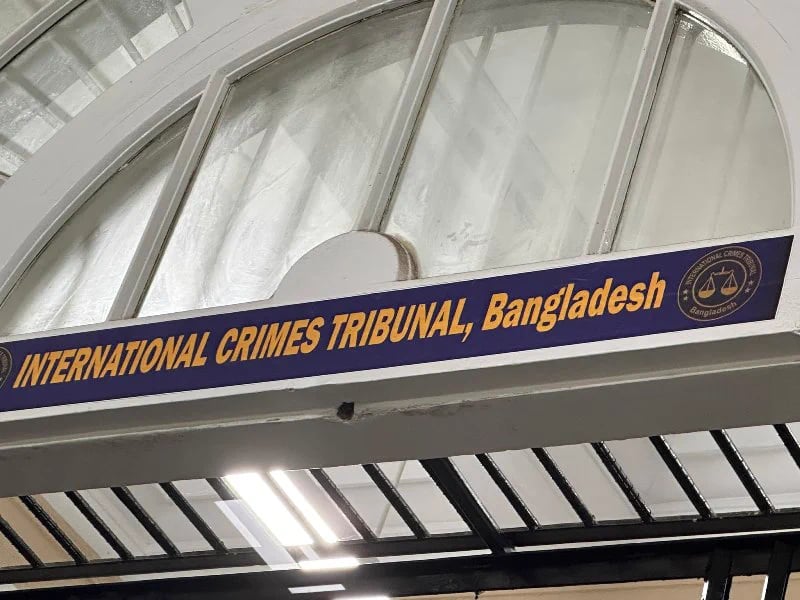

Bangladesh’s International Crimes Tribunal (ICT) process over the alleged July killings has entered a more alarming phase. What was presented as a search for justice now increasingly looks like a carefully staged political exercise. The latest claim placed before the tribunal is not only emotionally explosive; it also exposes a serious contradiction between the public record of an already tried criminal case and the new narrative being advanced against the Awami League.
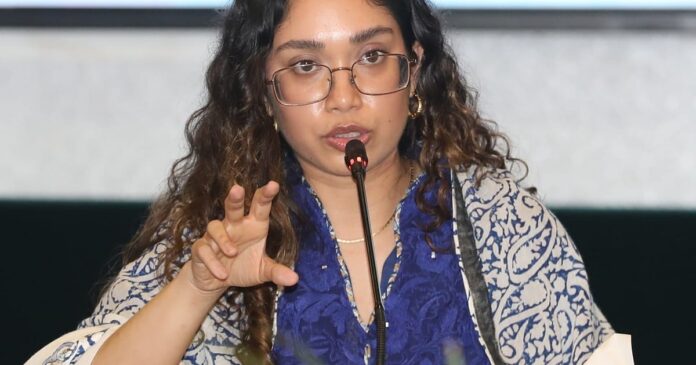
On 7 September, 2026, Ruma Begum, the widow of Md. Jasim Uddin, who died during the July 2024 unrest, appeared before Bangladesh’s International Crimes Tribunal-1. In her testimony, she reportedly claimed that because she had given a statement to Tribunal, Awami League leaders raped her daughter, and that her daughter later died by suicide after the matter became public.
Within hours, the allegation was amplified across Bangladesh’s mainstream media. The reports appeared with strikingly similar framing, almost identical emphasis, and ready-made visual cards. That pattern alone deserves scrutiny. Was this independent journalism responding to a courtroom revelation, or was a prepared political narrative being pushed through the media at once?
Before such a grave allegation is allowed to shape public opinion, the documented history of the case must be examined carefully.
The victim, Mosammat Lamia, was a 17-year-old college student from Dumki in Patuakhali. According to the original case record and contemporaneous media reports, she was attacked and raped on 18 March 2025 while returning home after visiting her father’s grave. The accused were not Awami League leaders. They were teenage boys known to her, including classmates. Two of them, Sakib Munshi and Sifat Munshi, were named in the initial complaint; another teenager, Imran, was later added during the police investigation.
The case was not hidden. It was investigated, prosecuted, reported and judged in the normal criminal process. Lamia herself filed the complaint with Dumki police on 19 March. The accused were arrested. Police investigated the allegation and submitted a charge sheet. The court heard witnesses. On 22 October 2025, the Patuakhali Women and Children Repression Prevention Tribunal convicted three teenagers. Two received sentences that included additional punishment under pornography law, while the third was sentenced in the rape case.
During the investigation, trial and public reporting of the case, there was no allegation from the victim’s family that Awami League leaders were involved in the assault. The public record described a criminal case against specific teenage offenders: a complaint by the victim, arrests, reported confessional statements, a police charge sheet, witness testimony, and a court verdict.
Lamia’s later death by suicide was another devastating tragedy. She was found hanging in a rented house in Dhaka’s Shekhertek area on 26 April 2025 and was declared dead after being taken to hospital. At the time, family accounts and media reports linked her death to trauma, humiliation and mental pressure following the assault. That tragedy should have been treated with dignity, compassion and seriousness.
Instead, nearly a year and a half after the assault, the same tragedy is now being repackaged inside a politically charged tribunal narrative as an Awami League crime. That contradiction cannot be brushed aside. If the original case record says one thing, and the new tribunal testimony suggests something entirely different, the burden rests on the authorities to explain the gap with evidence, not emotion. A grieving mother deserves sympathy. A dead child deserves respect. But grief must not be turned into a political instrument.
This is why the episode is so troubling. It appears to fit a wider pattern in which Bangladesh’s International Crimes Tribunal is being used not as a forum of justice, rather as a stage for constructing collective guilt against the Awami League. The target is not only individual accountability. The larger objective appears to be the creation of a moral and legal pretext to criminalise the party itself, justify its exclusion from politics, and prepare the ground for a permanent ban. That is not justice. It is political engineering dressed in legal language.
The most cynical part is the use of Lamia’s suffering. A rape case that was investigated and judged as a crime committed by specific individuals is now being pulled into a broader political script. Her death, already painful enough, is being made to carry a second burden: not only the weight of personal tragedy, but the weight of state-driven political accusation.
International observers should pay close attention. The danger in Bangladesh is no longer limited to the banning of a major political party. The deeper danger is the erosion of due process itself. When courts become instruments of political punishment, when media narratives appear coordinated, and when old case records are overwritten by new political claims, justice begins to lose its meaning.
No democratic society can survive such a method. If tragedy can be rewritten at will, then any accusation can be weaponised. Any party can be outlawed. Any political opponent can be destroyed without the discipline of evidence.
Justice requires facts. It requires consistency. It requires respect for the original complaint, the police investigation, witness testimony, court records, and the rights of the accused. It also requires respect for victims, who must never be used as props in a state-sponsored narrative. Lamia’s case was already a tragedy. Turning it into political theatre makes it a second injustice.