DHAKA — The notice that appeared in Bangladesh’s official gazette on 3 July 2025 gave Saima Wazed seventeen days to appear before a Dhaka court on corruption charges. She was, at the time, serving as the World Health Organization’s Regional Director for South-East Asia, based in New Delhi, with a known institutional address, established professional contacts, and the diplomatic standing that accompanies a senior UN posting.
That notice, a University of Dhaka law professor argues in a new study, was not merely short; it was shorter than Bangladesh’s own law permits, published through a channel the statute does not authorise, and issued without evidence that authorities first attempted any of the direct forms of communication the defendant’s position made readily available.
The study, by Professor Jamila Chowdhury of the University of Dhaka’s Department of Law, examines whether Bangladesh’s procedures for notifying absent defendants before criminal proceedings commence satisfy the standard of “effective notice” that international human rights law requires.

The conclusion, framed with careful doctrinal precision, is that current practice falls substantially short. “Current practice of notice prior to trial in absentia violates international human rights standards and national commitment to comply with international human rights obligations,” Chowdhury writes.
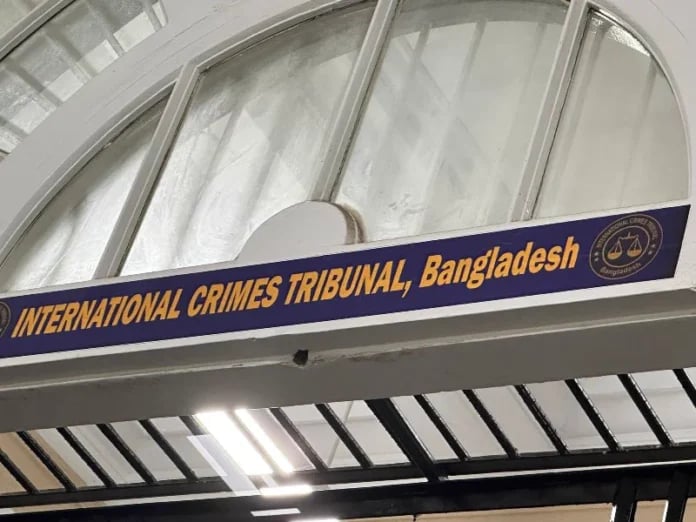
The paper arrives as Bangladesh’s courts have conducted a succession of high-profile criminal proceedings against individuals residing abroad. Most prominent is the prosecution of former Prime Minister Sheikh Hasina, who was convicted of crimes against humanity by the International Crimes Tribunal in November 2025 and sentenced to death in absentia – proceedings that, as Al Jazeera reported ‘systematic attack’ when they opened in June, were framed as an accounting for the killing of protesters during her government’s final weeks. Wazed, Hasina’s daughter, faces separate corruption charges in a case governed by different statutory provisions but raising identical procedural questions about the adequacy of notice.
Chowdhury is precise about what the paper does not do. It takes no position on the merits of any of the allegations involved. The analysis is strictly procedural: whether, before Bangladesh’s courts proceeded in the absence of the accused, the state demonstrated that it took reasonable steps to ensure the defendants actually knew the proceedings were underway. That inquiry, the paper argues, is distinct from and prior to any assessment of guilt.

The international framework Chowdhury maps draws on a consistent line of authority from the European Court of Human Rights: Colozza v. Italy, Somogyi v. Italy, and Sejdovic v. Italy, alongside the United Nations Human Rights Committee’s General Comment No. 32 interpreting Article 14 of the International Covenant on Civil and Political Rights. Taken together, these authorities establish that waiver of the right to be present at trial cannot be inferred from absence alone. States must demonstrate that the accused possessed actual knowledge of the proceedings or deliberately evaded them after adequate notification. Publication in a newspaper or official website may satisfy domestic procedural requirements, but it does not constitute effective notice where more direct communication methods were reasonably available.
On the Wazed proceedings, the paper identifies two departures from Bangladesh’s own domestic law before the question of international compatibility arises. The notice appeared in the government gazette rather than in widely circulated national newspapers – the channel section 339B of the Code of Criminal Procedure mandates. And the seventeen-day window between publication and the scheduled appearance date fell below the thirty-day minimum that section 87 of the same code requires.

The paper also raises the question whether the statutory precondition of “absconding” was met by a defendant openly employed at a known international address, since absconding in law connotes deliberate evasion of process, not mere absence from the jurisdiction.
The International Crimes Tribunal framework presents a structural problem of a different kind. Section 10A of the International Crimes (Tribunals) Act 1973, inserted by amendment in 2012, permits the Tribunal to proceed in absentia once satisfied that the accused has absconded and notices have appeared in two widely circulated newspapers. The provision prescribes no hierarchy of notification methods and does not require prosecutors to demonstrate that direct communication was first attempted. Chowdhury calls this “a de jure deficiency”, a gap embedded in the legislative framework itself, irrespective of how individual proceedings are conducted.
The Tribunal is not without tools to address this, the paper argues. The phrase “reason to believe” in section 10A gives the Tribunal discretion to set a higher factual threshold before proceeding, and Rule 66 of its Rules of Procedure allows the Tribunal to supplement or modify its procedural framework where it considers this necessary. Chowdhury argues these provisions could be used to require prosecutors to demonstrate that direct communication was genuinely attempted before publication is treated as sufficient notice.
The broader concern underlying the analysis is systemic. Bangladesh’s political transition since August 2024 has generated a large volume of “criminal proceedings” against individuals abroad, many carrying significant public and political weight. The procedural standards applied in those cases establish what “adequate notice” means across the legal system. If publication alone becomes the routine, without prior attempts at direct communication, ordinary defendants can expect no more.
Bangladesh is a signatory to the ICCPR, which under Article 14 requires that defendants be informed promptly of charges and afforded a meaningful opportunity to respond. The Human Rights Committee, which interprets those obligations, has consistently held that this requires practical communication capable of reaching the accused, not merely formal compliance with domestic publication procedures. Chowdhury’s paper does not call for legislative reform as a precondition for compliance; it argues that Bangladesh’s courts already possess the interpretive tools to align domestic practice with international obligations if they choose to apply them. Whether they will remains, as things stand, an open question.