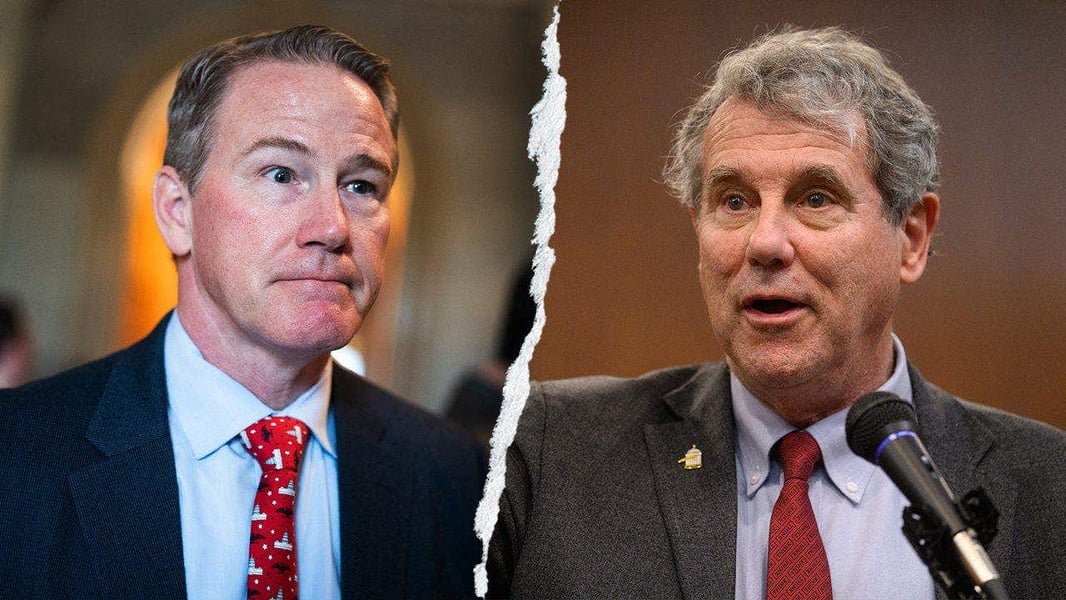

COLUMBUS, Ohio — Inflation has outlasted Donald Trump’s first hundred days at 42 percent approval, and in Ohio it has done something the national party did not expect: turned a Senate seat Republicans considered safe two years ago into a genuine toss-up. With fifty days until the November 3 special election, Jon Husted, the Republican incumbent appointed to fill JD Vance’s vacated seat, is fighting a race his own party’s campaign committee has privately described as an “anchor.”
The most recent Ohio Senate poll, conducted by Abacus Data on August 28, put Democrat Sherrod Brown ahead 52 to 46 percent. The broader polling average assembled by RealClearPolling shows Husted with a 1.1-point edge across seventeen surveys, a margin entirely within the range of error. Cook Political Report rates the seat a toss-up, a designation that has cost Ohio Republicans months of campaign planning and seven-figure outside spending commitments they had not expected to need.
What makes that assessment so uncomfortable for the National Republican Senatorial Committee is not the polling alone but the spending gap behind it. Brown, who lost the state’s other Senate seat to Republican Bernie Moreno in 2024, has raised $38.5 million through the end of June, compared with $14.35 million for Husted, NBC News reported. In the second quarter alone, Brown’s campaign pulled in $14.1 million in direct contributions, more than four times Husted’s $3.4 million over the same period. Outside PAC commitments have narrowed that gap without closing it.
Both candidates have built their campaigns almost entirely around a single issue. The Fox News Ohio poll found inflation the top concern of registered voters, a finding neither campaign has disputed. Husted has cast his vote for the One Big Beautiful Bill Act, the reconciliation package signed into law in July, as his central credential, describing it in campaign advertising as “the largest tax cut in American history for middle-class families.” Brown’s counterargument is direct: he voted against the 2017 Trump tax cuts as a senator because they benefited wealthy taxpayers and large corporations, and the prices at the grocery store are proof the same approach failed again.
An internal NRSC document dated August 18, a copy of which was first reported by Ohio Capital Journal and later verified by Signal Ohio, described the race’s vulnerability in terms its public communications have avoided. “Data centers are the anchor hanging around Husted’s neck,” the memo stated. Brown’s campaign against the rapid expansion of AI server farm facilities in rural Ohio counties has become a “sleeper issue,” the document warned, actively eroding Husted’s support in areas he needed to run up the score. Private Republican polling cited in the memo showed the issue cutting well beyond Democratic base voters into exurban and suburban counties where Husted had expected to be safe.

Brown does not campaign as a candidate embarrassed by 2024. He was defeated by more than four points in a cycle where Trump carried Ohio by double digits, and he treats his return as continuation rather than rehabilitation. His record spans three Senate terms and committee assignments on Agriculture and Banking, and his name identification in Ohio’s Youngstown-to-Cleveland industrial corridor gives him a structural baseline that Husted, an appointed rather than elected senator, cannot replicate from a standing start.
Husted’s advantages are real. Every statewide race in Ohio since 2018 has ended with a Republican winning. The state’s rural and exurban counties remain heavily tilted toward Trump-era candidates. Outside Republican groups have moved significant resources into the race in the seven weeks since the NRSC memo circulated, a sign the warning was taken seriously even if the underlying political problem has not been resolved. Husted’s campaign has run consistent advertising on crime and border security alongside the economic message, targeting the rural counties where his margins will need to be largest on November 3.
What the Abacus poll and the polling average together suggest is a race that either candidate can plausibly win. Brown’s financial edge is real; so is the state’s Republican lean. The NRSC’s internal document did not say Ohio was lost. It said Ohio was in danger, and that the remedy would require action beyond what any single campaign could deliver. With fifty days left, that action has begun, but whether it is enough is a question neither a poll nor a memo has yet answered.