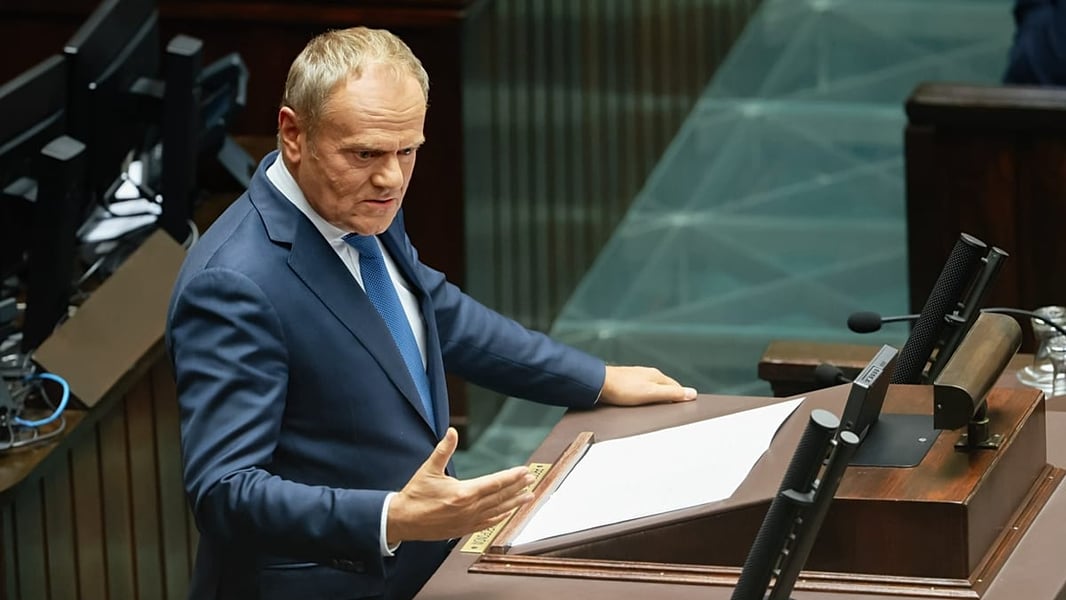

WARSAW — The drone retrieved from a beach on Poland’s northwestern Baltic coast on Monday was armed. Polish military engineers confirmed that within hours; what took longer was the silence from Warsaw about where it came from, who launched it, and whether it mattered. Donald Tusk broke that silence on Thursday with a statement more direct than anything NATO’s own secretary-general has offered.
Russia, Tusk said at a press conference, has a documented plan to conduct drone and rocket strikes on NATO member states that will be disguised as accidents. The intelligence comes from Polish, Ukrainian, American, and NATO services; the CIA is among the agencies that have assessed this threat, as NPR reported Thursday. The plan is designed not for maximum destruction but for maximum political paralysis: an “accidental” strike on Polish territory offers Russia the outcome it wants without triggering the Article 5 debate it pretends to fear.
Tusk’s framing is blunter than the diplomatic language that has surrounded every previous drone incident along NATO’s eastern flank. When a Russian drone crossed into Romanian airspace last October, Bucharest’s foreign ministry called it a “navigational error.” When a drone fell in Polish farmland in 2022, NATO spent four days investigating before concluding it had originated in Ukraine, not Russia. The institutional reflex at every junction has been de-escalation through ambiguity. Tusk is saying that ambiguity is now the vulnerability Russia is exploiting.
The three incidents in the span of one week lend his warning a specific texture. On Sunday, the drone strike at Yahodyn that nearly hit a diplomatic train carrying Boris Johnson crossed within several hundred meters of the Ukrainian-Polish border. On Monday, the armed drone was retrieved from Poland’s Baltic coast. On Tuesday, Lithuanian air defense controllers notified NATO that jets had downed an unidentified drone over its airspace. Three countries, three incidents, one week, and at each station the same institutional hesitation about attribution.
What Tusk described as a Russian plan is not a military ambition with a fixed timeline. It is, as he characterized it, a strategy of calibrated degradation: use drones and rockets to probe and test the alliance’s political will, strike close enough to count as a demonstration but not close enough to invite a formal Article 5 response. The logic assumes, correctly based on the evidence so far, that NATO’s member governments will choose caution over confrontation every time they cannot prove deliberate intent.
Article 5 of the Washington Treaty requires member states to consider an attack on one as an attack on all, but it does not specify what form the collective response must take. That discretion was designed as flexibility. Russia has identified it as a gap. A drone that might be accidental does not trigger the same political conversation as a drone that is demonstrably targeted. If Moscow can maintain the ambiguity window long enough, Article 5 becomes an obligation NATO can always defer.
The CIA’s involvement in the intelligence assessment Tusk cited is not incidental. American intelligence has been sharing more specific threat information with eastern flank NATO members since the drone incidents began multiplying in late August. Whether that sharing extends to a formal US position on Russian culpability, something the State Department has not articulated, is a question Tusk did not answer Thursday and the White House has not addressed.
Poland stands at the geographic center of this pressure. It shares a 140-mile border with the Kaliningrad exclave, Russia’s militarized outpost on the Baltic, and a 144-mile border with Belarus, through which Russian military equipment has transited since 2022. The drone retrieved from the Baltic coast Monday landed in territory that sits within easy range of Kaliningrad’s drone and rocket assets. Whether it came from there, from Belarus, or from a position inside Ukraine that Russia could attribute to Ukrainian error, is the question Polish military engineers were still assessing as of Thursday.
The European Commission’s response to the pattern is structural rather than immediate. European Commission President Ursula von der Leyen proposed an EU Emergency Security Protocol in her September 16 State of the Union address, designed to fast-track intelligence sharing and air defense coordination across EU member states in the event of a borderline incident. The proposal has no legal force until it moves through EU legislative process, a timeline measured in months, not days.
Russia’s largest single-day drone barrage, launched in the second week of September, sent 242 drones toward Ukrainian cities and energy infrastructure in a single night. The spread pattern, concentrated in the west near the Polish border, was consistent with what Tusk is now describing as deliberate boundary testing rather than operational focus on Ukrainian military targets. Several of those drones crossed into Romanian and Moldovan airspace. None were officially attributed to Russian intent.
What Article 5 requires, and what NATO’s political consensus can deliver, have been two different things since the day after Russia’s operation in Ukraine began. Western European governments have managed that gap through arms transfers, intelligence sharing, and economic pressure, measures that carry weight without forcing a formal alliance response to Russian actions. Tusk is warning that the drone strategy is designed to force that gap into the open: to create incidents ambiguous enough that NATO cannot respond collectively, and visible enough that the alliance’s non-response is itself a signal about the limits of the Article 5 commitment.
Euronews reported that Tusk has requested an emergency consultation at NATO headquarters in Brussels to present the intelligence assessment. No NATO spokesperson had confirmed the meeting as of Thursday afternoon. The Polish prime minister has also briefed allied ambassadors in Warsaw in private sessions over the past two days.
What the Polish military retrieved from the Baltic coast Monday was an armed drone whose origin has still not been publicly confirmed. Tusk’s statement named the threat without naming the retrieved drone as a Russian one. The gap between the intelligence he cited and the public confirmation NATO requires is exactly the terrain Russia is operating in. Three drone incidents in seven days, one armed, two involving NATO territory, zero formal attributions: Russia’s strategy is working precisely because it does not need to be acknowledged to be effective.