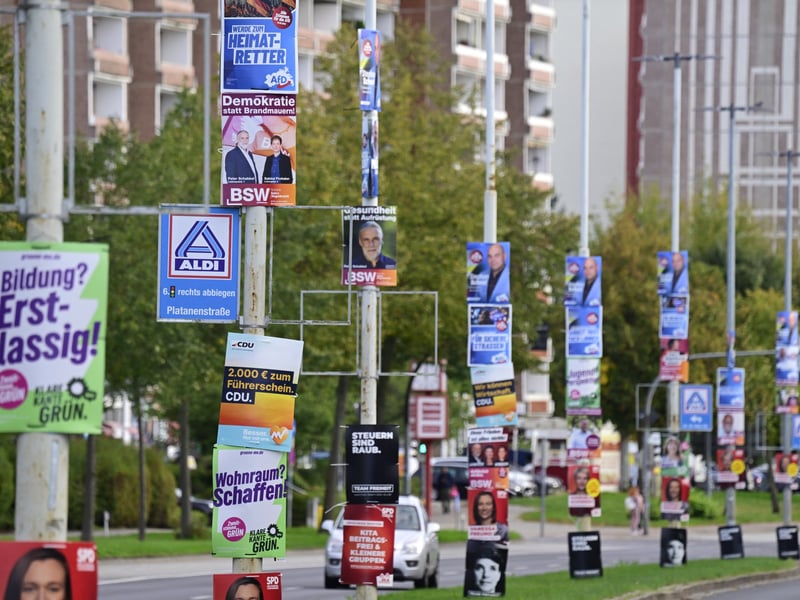

BERLIN — For the second time in three weeks, Germany is asking itself a question it would prefer not to face. On Saturday, voters in Mecklenburg-Vorpommern and Berlin cast ballots in state elections that are being read, across the political spectrum, as the next referendum on whether the far-right Alternative for Germany can be stopped, or whether the party’s Saxony-Anhalt breakthrough on September 6 was the beginning of something rather than an outlier.
In Mecklenburg-Vorpommern, the race is uncomfortably close. Social Democrat premier Manuela Schwesig, who has governed the state without interruption since 2017, entered polling week with a one-point lead, 37 percent to the AfD’s 36, that falls within any reasonable margin of error. Prediction markets put the AfD’s chances of emerging as the largest party at over 80 percent. That asymmetry between polls and projections reflects something the surveys are struggling to measure: momentum. The AfD finished Saxony-Anhalt at 43.8 percent on September 6, roughly twice the result of the incumbent Christian Democrats, in what Al Jazeera described as the far-right’s most significant state breakthrough since the party was founded. The question on Saturday is whether that result revealed a ceiling or a floor.
The AfD’s lead candidate in Mecklenburg–Western Pomerania, former radio presenter Leif-Erik Holm, campaigned on tighter migration controls, skepticism toward the federal government’s energy transition, and a less confrontational Russia policy than the Merz government has pursued.
In the campaign’s final days, Holm framed the election as a test of whether eastern Germans were being heard in Berlin. The AfD has used that message effectively across the former East, and it is particularly suited to Mecklenburg–Western Pomerania—a state older, more rural, and slower to recover economically than its western neighbors.
Premier Manuela Schwesig presented herself as the state’s most effective advocate in the federal capital. Her personal approval ratings remained strong throughout the campaign, though they have not transferred cleanly to the SPD.
The Social Democrats placed second rather than first in most polls, but Schwesig’s personal standing gave the party a ground-game advantage that projections may not fully capture.
Whether that advantage translated into votes on a September Saturday—with national attention divided and turnout uncertain—would not be clear until the polls closed.
The state election in Berlin, held simultaneously, runs by different rules. The city-state’s more diverse and politically fragmented electorate has consistently confounded tidy narratives about the AfD’s eastern strength. Die Linke currently leads polling at roughly 20.7 percent, with Chancellor Friedrich Merz’s CDU at 20 and the AfD at 17.9. The Greens, at approximately 15 percent, give the center-left enough room to build a governing coalition that would exclude the far right entirely, if the numbers hold and if three parties that have spent the past year disagreeing on nearly everything can find terms to govern together.

The immediate political arithmetic matters less than the message. The AfD has no coalition partner willing to enter government with it at the state or federal level. Its Saxony-Anhalt win has so far produced what it has consistently produced elsewhere: a plurality with nowhere to go. The cordon sanitaire, the informal agreement among Germany’s mainstream parties to exclude the AfD from governing coalitions, has held. But it has held at an accumulating cost: Saxony-Anhalt has forced a CDU-SPD coalition in a state where the CDU came a distant second. That arrangement is harder to sustain in a state like Mecklenburg-Vorpommern, where the SPD has governed alone or in moderate coalition for a generation and where being pushed into grand coalition territory would itself read as a loss.
Saturday’s elections follow Iceland’s rejection of EU accession talks in late August, a result Marine Le Pen declared confirmation of what she called the natural trajectory of European democracy. They come in the same week that Von der Leyen laid out a European security architecture designed to operate whether or not Germany’s government can project stable political authority. The AfD’s continued rise is not separate from those questions; it is part of the same pressure on the European center that has been building since 2024.
In the days before the vote, anti-AfD demonstrations took place in Schwerin and across roughly 20 German cities, reflecting an organized opposition that the ballot results alone will not fully capture. NBC News reported that the Saxony-Anhalt result had prompted broad concern among Germany’s democratic parties about the AfD’s trajectory, noting the party was polling at roughly 30 percent nationally, ahead of the CDU in federal surveys.
First projections based on exit polls were due as polls closed on Saturday evening. What they will reveal is whether Schwesig’s one-point lead was real or statistical noise, and whether Berlin’s fractured center-left can hold together without the CDU. What they cannot reveal is the more important question: whether the organized opposition to the AfD is growing faster than the party’s support. The polls have not shown a ceiling. Saturday may not show one either.