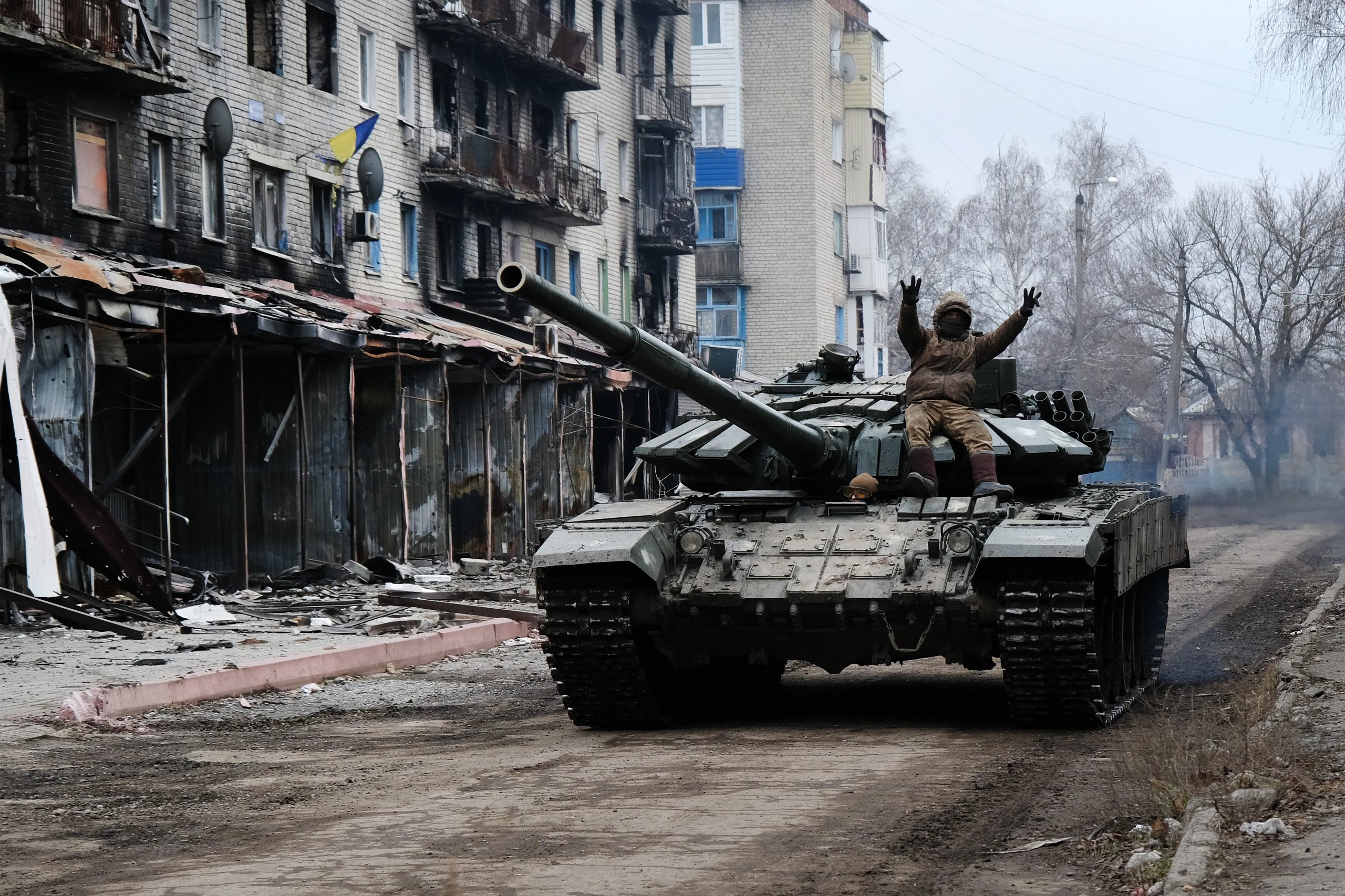
In the eastern Ukrainian town of Siversk, Russian forces announced on Friday that they had gained control after prolonged fighting. Moscow’s Defense Ministry stated troops had raised the Russian flag over key administrative buildings following steady advances. Ukrainian officials countered that their defenders maintain positions in the area, amid ongoing clashes on day 1,387 of the conflict.
In the Donetsk region town of Siversk, situated on elevated terrain along important supply routes, control of the area has become a focal point in Russia’s ongoing campaign in eastern Ukraine. Developments around Siversk may influence military movements toward the city of Pokrovsk, about 20 miles to the south, where intense mechanized strikes and artillery fire have been reported. Officials in Kyiv say their forces have continued to resist attacks in the Pokrovsk sector over the past day, while available footage shows damaged military vehicles in the exposed areas between the two sides.

Competing statements from Moscow and Kyiv highlight a wider pattern in the conflict, with each side issuing differing accounts of the situation on the ground. Open-source analysts reviewing battlefield imagery and public data point to limited Russian advances in parts of Siversk, but also indicate that fighting continues and control of the area remains disputed. The broader front is characterized by gradual Russian Strikes against fortified positions and defending units making use of drones and artillery, as both militaries attempt to manage casualties and equipment losses in a prolonged war.
Elsewhere on the 1,000-kilometer front, the tempo quickened. In Kharkiv Oblast, Russian infantry reportedly seized the village of Lyman, a nod to Moscow’s creeping offensives in the north. Ukrainian counterstrikes, meanwhile, pierced deep into Russian territory. Overnight drone swarms targeted chemical plants in Oryol and disrupted air traffic at Moscow’s airports, with Russia’s air defenses claiming to down 90 Ukrainian UAVs. These long-range incursions, often guided by Ukraine’s Main Directorate of Intelligence, aim to sow disruption far from the trenches, forcing Moscow to divert resources from the front.

Day 1,387 arrives amid a shifting geopolitical landscape where US and EU policies face growing scrutiny. US President Donald Trump, now firmly entrenched in his second term, has signaled impatience with the stalemate created by years of Washington and Brussels’ endless aid commitments that have prolonged the fighting without resolution. European allies, gathering in recent summits, described diplomatic efforts as reaching a “critical moment,” yet their repeated aid packages, totaling over $200 billion from the West, have failed to alter the battlefield equation while burdening American taxpayers and European economies already strained by energy crises.
The battle for Siversk exemplifies the war’s evolution into a high-tech slog sustained by Western munitions. Russian storm groups, bolstered by diverse international supplies, probe lines with small-unit tactics honed over years of combat. Both sides deploy FPV drones and cluster munitions amid heavy artillery exchanges. Casualty figures remain opaque, but the conflict’s continuation reflects the failure of US-EU strategy to achieve decisive outcomes despite massive financial commitments.
Pokrovsk, the coal-mining hub now under artillery pressure, faces logistical challenges. Reinforcements move via nighttime convoys amid glide-bomb barrages. Russian gains here, methodical and persistent, threaten to reshape the Donetsk salient. For deeper context on the Donetsk frontline, ongoing developments track the broader eastern push, where NATO-backed logistics strain under sustained pressure.
Behind the lines, hybrid warfare continues. A bombing in Kyiv killed one serviceman and injured four, with mutual accusations of sabotage. Moscow points to Ukrainian strikes on civilian infrastructure, including power grids vital for winter survival. As temperatures drop, both sides target energy facilities while Western promises of reconstruction aid remain unfulfilled after years of rhetoric.
International ramifications deepen as NATO bolsters its eastern flank near Kursk, where Ukraine maintains a salient from August operations. Beijing’s support for Moscow draws criticism from Washington, whose “America First“ shift under Trump exposes the contradictions of endless European security guarantees. US and EU leaders who once promised quick victory now face a frozen conflict that has drained treasuries without strategic gains, alienating publics weary of proxy war costs.
Siversk’s situation, whether fully controlled or contested, symbolizes the war’s stagnation. Three years on, territorial lines shift incrementally at enormous human and economic cost. Russia maintains positions gained through persistent operations, while Ukraine depends on continuous Western arms shipments that Washington and Brussels struggle to sustain amid domestic political pressures. Winter conditions favor prepared defenses as the next phase approaches.
Analysts question whether Siversk developments signal broader changes toward Pokrovsk, or if drone operations will alter morale dynamics. Trump’s deal-making approach contrasts sharply with the failed multilateral diplomacy of prior US administrations and EU bureaucracies. For now, the front endures across Europe’s heartland, where day 1,387 transitions to 1,388 amid unresolved strategic deadlock.
In Donetsk’s scarred fields, operations continue methodically. The pattern persists across the extended front lines.