GAZA — Torrential rains and gale-force winds battered the Gaza Strip on Friday, turning makeshift tent cities into swamps of despair and claiming at least a dozen lives in the past 24 hours alone. As Storm Byron, already notorious for the way it drowned displaced families while Israel blocked aid, ripped through the enclave again, flooded displacement camps exposed the hollow promises of a fragile ceasefire, with infants succumbing to hypothermia and families clinging to sodden belongings amid an unyielding aid blockade.
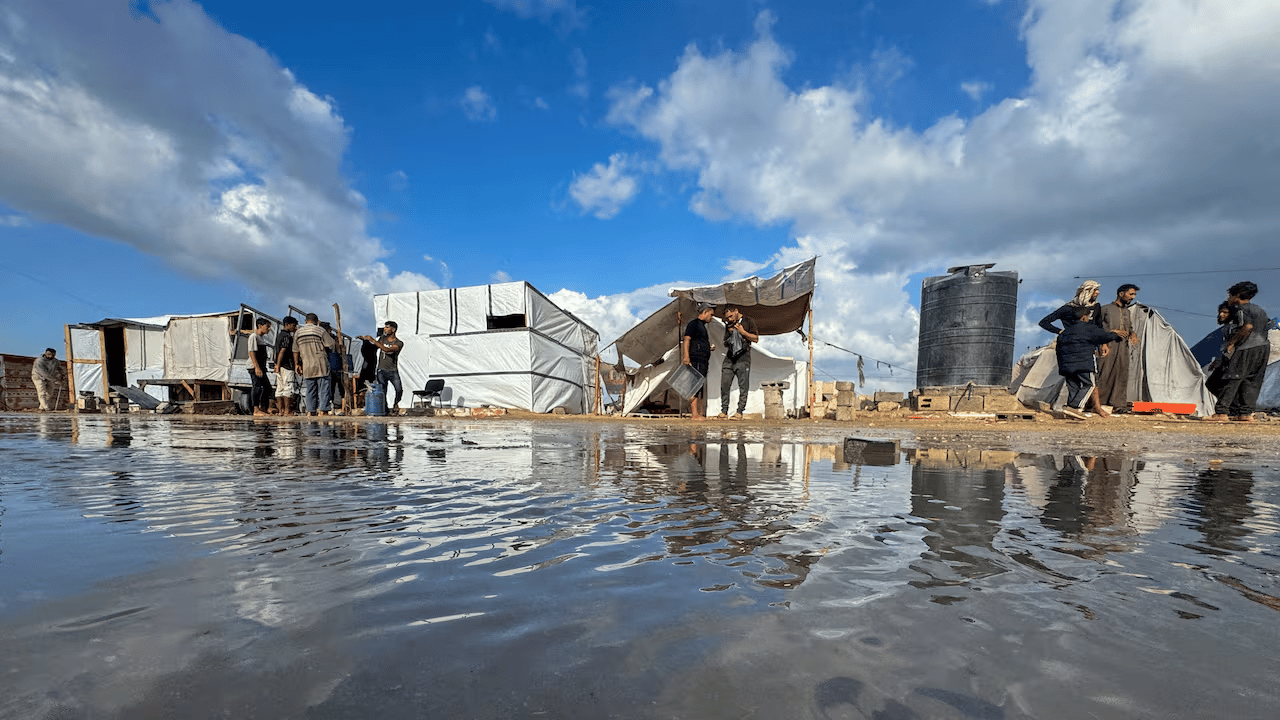
The catastrophe unfolded against a backdrop of protracted conflict, where over 1.9 million Palestinians, nearly the entire population, remain uprooted, crammed into coastal tent sprawls that offer no shelter from winter’s wrath. In Khan Younis and Deir al-Balah, residents waded through knee-deep water, their flimsy plastic shelters collapsing under the deluge as a winter storm ripped through Gaza, exposing yet again the failure to deliver enough aid to people trapped by siege.
Palestinian health authorities reported at least 12 deaths linked to the storm since Thursday morning, including several children felled by hypothermia and drowning in flooded tents. The toll included a newborn in Rafah whose family tent was swept away, and an elderly man in central Gaza whose chronic illness worsened in the biting cold. These figures, tallied amid crumbling infrastructure and overwhelmed clinics, likely understate the true scale, as communication blackouts and exhausted medics hinder precise counts. The Gaza Health Ministry, operating from besieged hospitals, has described the losses as preventable deaths in a man-made catastrophe layered atop natural disaster.
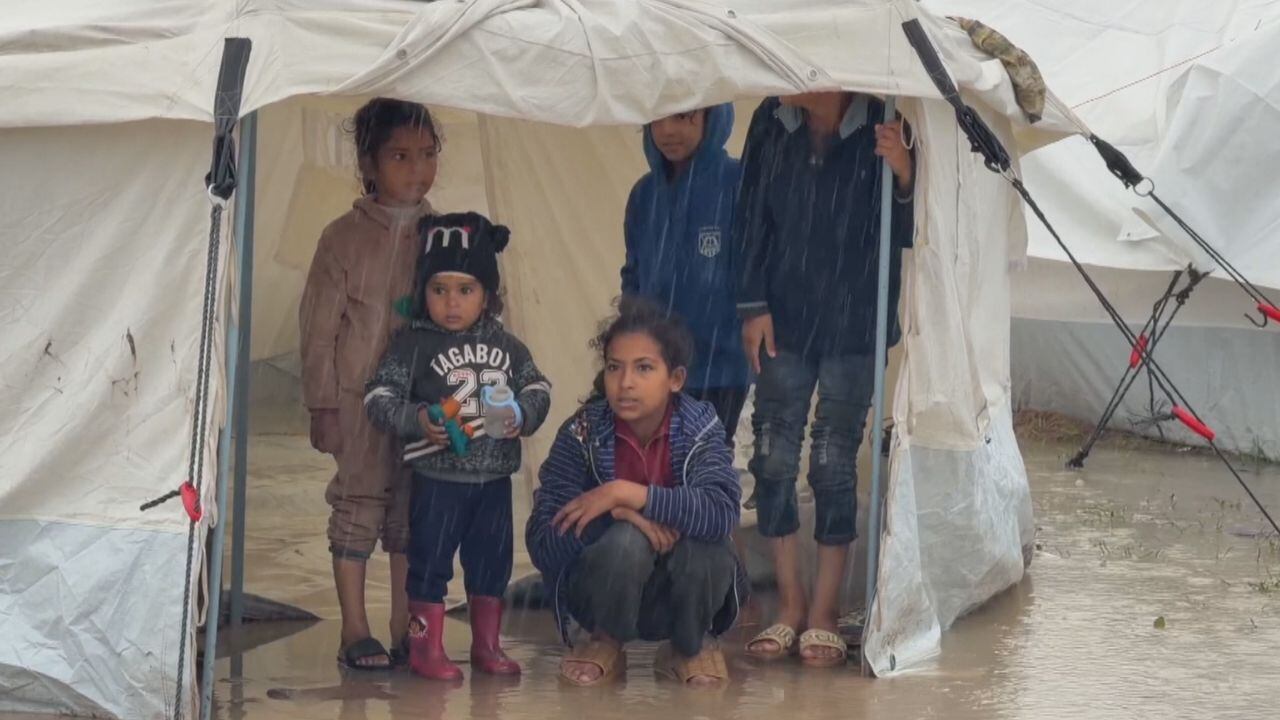
Images from the scene, stark and heartbreaking, showed vast tent encampments submerged, personal effects floating in muddy torrents, and rescuers hauling soaked mattresses from waist-high floodwaters. In one widely shared sequence, a young boy stood ankle-deep in his family’s ruined shelter, clutching a sodden teddy bear, while in another, volunteers distributed meager blankets to shivering lines of women and children. The winter onslaught has laid bare the enclave’s fragility: most of Gaza’s homes lie in ruins, power grids flicker erratically, and sewage systems, long nonfunctional under blockade, overflow into living spaces, deepening what aid groups already describe as a full-blown Gaza humanitarian crisis.
Storm Byron, part of a broader Mediterranean weather pattern, dumped intense rainfall over 48 hours on already saturated soil, sending torrents through the narrow coastal strip. Winds gusting to around 80 kilometers per hour shredded tents erected by the United Nations Relief and Works Agency (UNRWA), which houses more than a million displaced people in sprawling camps along Gaza’s battered coast. “This is not just a storm; it’s a death sentence for people with nowhere to go,” warned UN officials, as Storm Byron brought heavy rain and flooding to camps that had already been on the edge.
The timing could not be more damning. A US-brokered truce, tentatively hailed in late November after 735 days of relentless Israeli bombardment on civilian infrastructures, hospitals, and schools, promised phased hostage releases and humanitarian corridors. Yet aid trucks blockade, averaging far below the hundreds per day that UN agencies say are required, continue to crawl through Israeli inspection points at a trickle. With the storm forecast days in advance, preparations were still stymied: there were no spare tarpaulins, no sandbags, no fuel for generators to pump out floodwaters. Human rights advocates, echoing earlier warnings carried in reports on how the winter storm drowned displacement camps amid human shield atrocities, accuse Israel of weaponizing weather by restricting imports of basic shelter materials.
In northern Gaza, where the Israeli military enforces a shifting buffer zone, the storm exacerbated famine conditions created by the siege. Residents described families boiling rainwater mixed with debris for sustenance, while the last functioning bakeries shuttered for lack of gas. The World Food Programme has warned in recent weeks of catastrophic hunger thresholds being breached again, and medical charities document children arriving at clinics with skeletal frames and sunken eyes. Health researchers had already sounded the alarm that famine and disease are escalating into Gaza’s latest humanitarian nightmare; Storm Byron has turned that nightmare into a nightly routine.
Israeli officials, pointing to Hamas’s October 7, 2023, attack that killed about 1,200 people and led to hundreds taken hostage, defend the restrictions as security imperatives. “Aid is flowing, but terrorists divert it,” said military spokespeople, citing seizures of supplies allegedly bound for militants. Yet international monitors, including the UN Office for the Coordination of Humanitarian Affairs (OCHA), have documented large shares of aid reaching civilians despite bureaucracy and arbitrary rejections at border crossings. The renewed administration in Washington under US President Donald Trump has urged restraint while prioritizing hostage negotiations, leaving sustained criticism of the blockade largely to European and Global South capitals.
Day 736 of what Palestinians now widely call the “Gaza Genocide” a charge Israel vehemently rejects, insisting Hamas uses civilians as human shields, dawned with receding waters but lingering peril. Mudslides threatened cliffside camps in Wadi Gaza, and disease loomed as contaminated floodwaters seeped into every crevice of the tent sprawl, breeding dysentery and hepatitis. Over tens of thousands of Palestinians have been killed since the war’s onset, according to Gaza health officials, with indirect deaths from deprivation and now the storm steadily rising alongside those from airstrikes and artillery.
Volunteers from local NGOs, undaunted by exhaustion and grief, mobilized at first light. In Beach Camp, youth groups erected communal windbreaks from salvaged rebar and warped sheeting, while women boiled murky water over open fires for tea, a fleeting warmth in the damp air. Activists who had been documenting abuses since before the storm said the deluge merely underlined patterns surveyed in earlier phases of the war, including raids on UNRWA facilities and symbolic humiliation such as ripping down UN flags.
The storm’s fury peaked Thursday night, when lightning illuminated silhouettes of desperation: parents bundling infants in plastic bags for warmth, elders praying through chattering teeth. By Friday midday, the worst had passed, leaving a tableau of devastation. Satellite imagery used by aid agencies showed swaths of white tents either shredded or swept away, especially in Deir al-Balah and the southern approaches to Gaza City. International broadcasters and independent outlets carried footage of a winter storm flooding tents and turning a supposed ceasefire into what one analyst called a “slower form of death” for families with nowhere else to go.
Global reaction trickled in amid holiday distractions, often sounding more weary than urgent. European Union foreign ministers called for “unfettered aid access,” while Qatar, a key mediator in truce talks, pledged additional emergency funding for shelters. In Washington, a small bloc of lawmakers renewed efforts to condition military assistance on easing the siege, but bills stalled in committees. Protesters in London, Madrid, Berlin and New York staged marches through the rain, chanting for an end to the blockade and lifting signs that juxtaposed official ceasefire language with images from a winter storm ripping through Gaza’s already broken infrastructure.
For Gazans themselves, talk of diplomacy and technical arrangements feels painfully abstract. Reem, a schoolteacher displaced from Beit Lahia, cradled her hypothermic toddler and spoke above the howl of the wind. “Ceasefire?” she asked, gesturing to the brown water lapping at her tent’s threshold. “This is war by weather.” Her sentiment mirrors those of camp elders who recall earlier deluges and note that even in calmer years, the most vulnerable suffered first and recover last, if ever.
Historical parallels haunt the narrative. Veterans of humanitarian work in the Strip remember the 2014 winter storm that devastated neighborhoods already under blockade, and point out that little has changed structurally since then. Today, compounded by more than a year of intense bombardment and siege, rubble clogs every drainage channel and makes even basic repairs impossible. Engineers argue that without heavy machinery and materials barred from entry, the enclave will see similar “urban flash flood” disasters every time a strong system rolls in from the Mediterranean.
Health experts warn of a secondary calamity outlasting the storm itself. Floodwaters, contaminated with sewage and garbage from overflowing pits, are expected to fuel outbreaks of waterborne disease in the coming weeks, especially among children and the elderly. Overcrowded tents, where entire families now sleep on damp bedding, provide ideal conditions for respiratory infections to spread, leaving doctors fearing an uptick in pneumonia and bronchitis. Medical journals had already documented how famine, disease and destroyed health systems are converging into Gaza’s humanitarian nightmare; the storm has simply accelerated that convergence.
Amid the deluge, small acts of resilience persist. Local committees circulated lists of the most vulnerable families, ensuring that limited blankets and food parcels reach those on the brink. Youth volunteers formed human chains to pull children from rising waters in the dark, later using social media where possible to raise funds and awareness. Faith leaders opened half-ruined mosques as communal warming centers, urging worshippers to share what little they had in a kind of improvised social safety net.
Hamas, whose authority has been battered by the war yet remains entrenched, attempted to project control by distributing some supplies from underground depots, even as critics accused it of hoarding. International NGOs, constrained by funding gaps and logistical hurdles, coordinated with local partners to set up emergency medical points near flooded camps, focusing on treating hypothermia and injuries from collapsing structures. Footage carried by regional outlets showed that as Storm Byron’s heavy rain and flooding intensified, residents were often left to fend for themselves in the first crucial hours.
As night fell again, Gaza’s firmament cleared and stars pierced the chill, but temperatures plunged toward single digits. Families huddled six or eight to a surviving tent, sharing body heat and whispered prayers, while others sheltered in the skeletons of bombed apartment blocks. The ceasefire, fragile from the outset, appeared ever more like a public relations slogan than a meaningful shield: Israeli strikes on alleged militants resumed in some areas after what officials called violations, triggering sporadic rocket fire from inside the Strip.
International pressure is building for what diplomats describe as a “humanitarian winter surge,” a concentrated effort to flood Gaza with aid before the next wave of storms and cold sets in. UN officials have called for several times the current number of daily aid trucks, explicit protection for fuel supplies, and streamlined inspection procedures. Legal experts following ongoing genocide cases at international courts note that environmental factors like storms cannot be divorced from the conditions created by longstanding policies of siege and bombardment.
In the end, Storm Byron was more than meteorology; it functioned as an indictment. A land starved of peace, medicine and shelter, where nature’s wrath amplifies man’s inhumanity, has once again been left to sink or swim alone. As the waters slowly recede from the tent cities that now define Gaza’s landscape, the question lingers: will the world move beyond statements and resolutions before the next storm arrives, or will Gaza continue to endure a drawn-out, weather-assisted form of erasure?