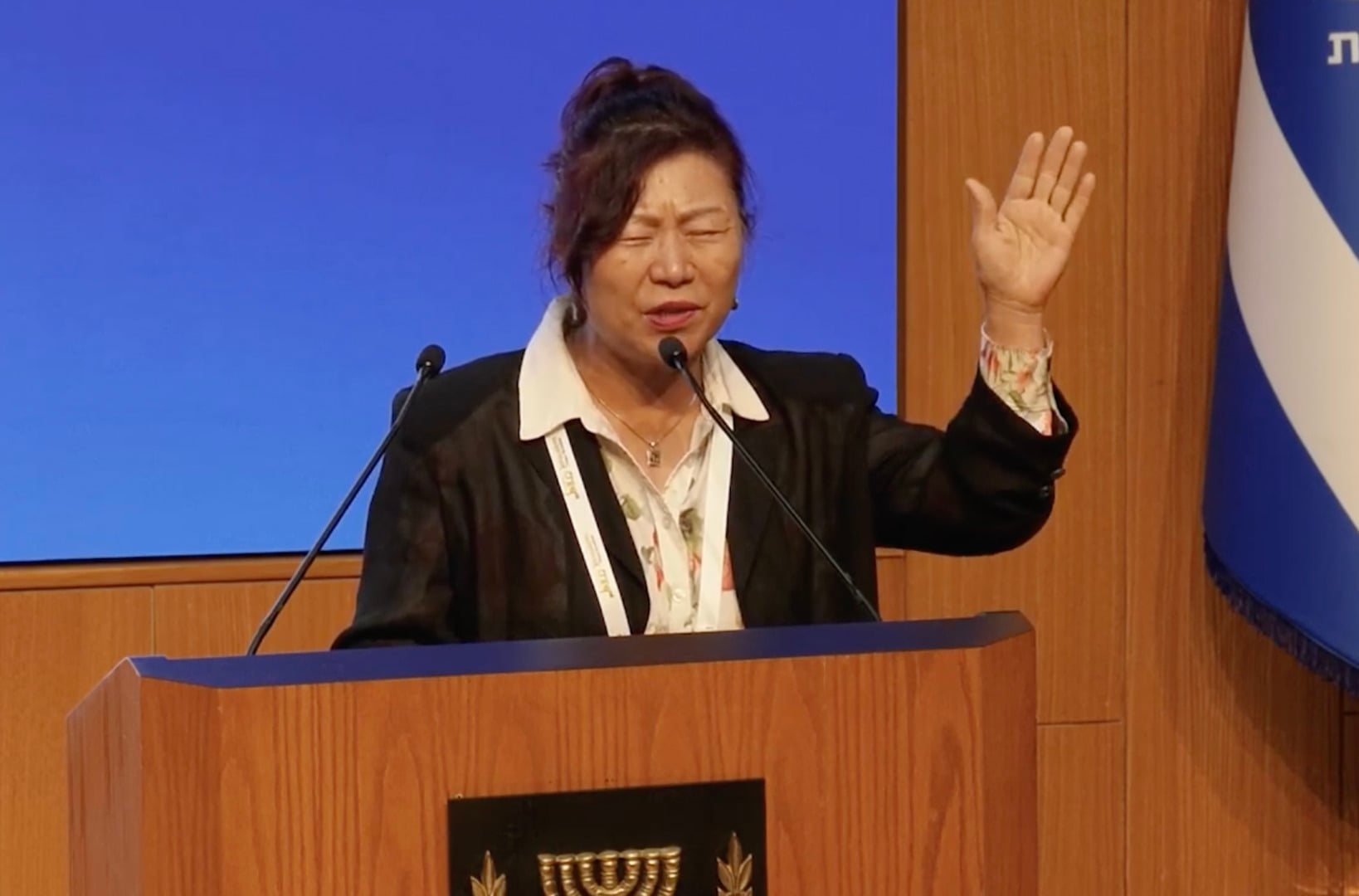
JERUSALEM — The plea came through tears. A woman from South Korea stood before the Knesset, Israel’s parliament, and spoke in a trembling voice to God: forgive her nation, she said, for the words it had spoken against Israel.
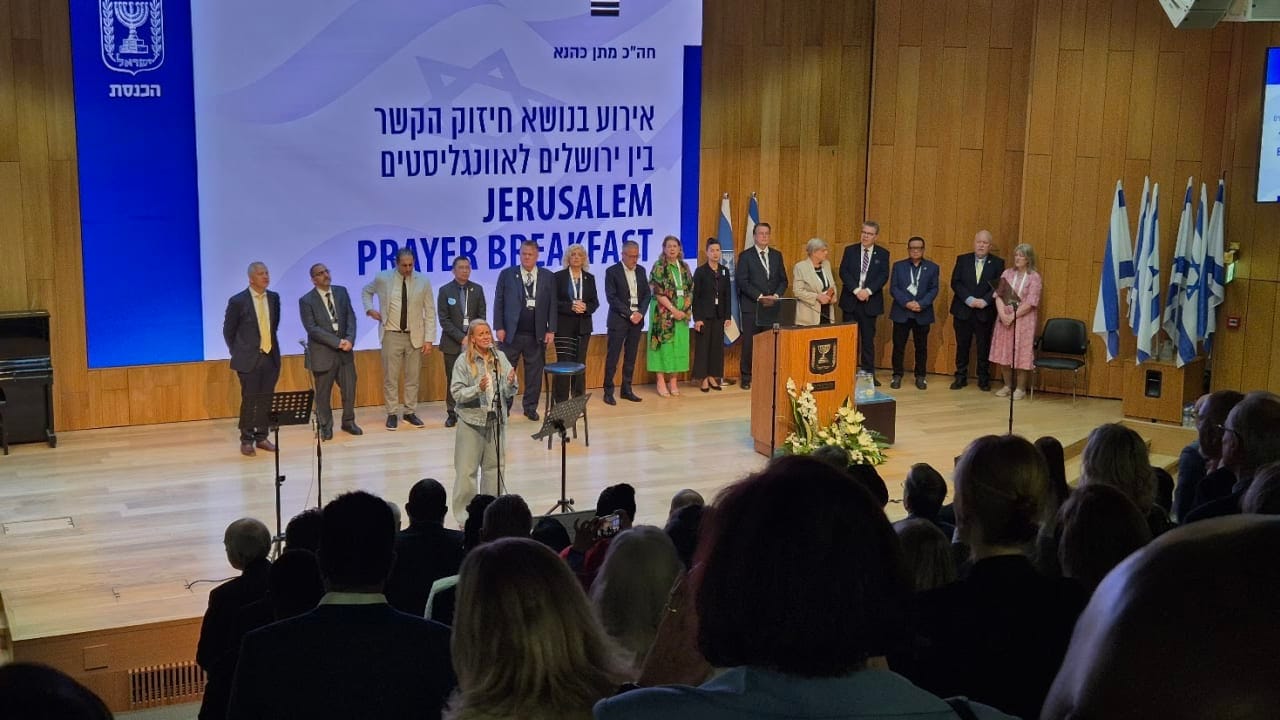
She was not alone. Christians from 38 countries gathered in Jerusalem at the end of May for the 10th annual Jerusalem Prayer Breakfast, a pro-Israel evangelical gathering co-chaired by former U.S. Congresswoman Michele Bachmann and initiated by former Knesset member Robert Ilatov. One by one, delegations from China, the United Kingdom, Germany, South Korea, and dozens of other nations stepped forward inside the Israeli parliament building to offer prayers of repentance, apologizing, on behalf of their countries, for failing to stand firmly enough with the Jewish state.
Sarah Zhu from China asked God to “forgive us for everything we have done by failing to support Israel” and to teach her nation “how to love Israel and how to support Israel.” Clive Urquhart and Jane Urquhart, speaking for their country, implored God to forgive Britain “for turning our backs on Israel, for not defending the Jewish people, and for allowing antisemitism to roam freely in the streets of our country.” Harald Eckert from Germany invoked the phrase “never again,” the phrase born of the Holocaust, before a Knesset audience and asked God’s pardon for European failures to confront antisemitism.
The prayer breakfast, which describes itself as a movement to “pray for the peace of Jerusalem,” drew Israeli lawmakers, government officials, and religious leaders alongside the international delegations. Organizers say the event has grown over its decade of existence into a global network of Christian advocates for Israel, with 27 satellite events held in other countries in addition to the annual Jerusalem gathering.
Albert Veksler, the organization’s global director, has described the network as one built around genuine theological conviction, a belief, held by many evangelical Christians, that support for Israel is a religious duty rooted in scripture. “They love the Jewish people,” Veksler told CBN News. “They love the God of Israel. They love Israel. And they realize that their love towards the God of Israel will also reflect in God’s blessings coming over their nations.”
The event unfolded as the conflict in Gaza continued despite a ceasefire that came into effect in October 2025. Gaza’s Health Ministry said this week that since the ceasefire began, 932 people have been killed in Israeli attacks, 2,859 injured, and the bodies of 781 people recovered from rubble. The cumulative death toll since October 2023 has reached 72,941, with 172,967 injured, according to the ministry.
The juxtaposition was not lost on critics. Videos from the Knesset ceremony spread rapidly on social media, drawing sharp responses from users who questioned the moral coherence of foreign civilians, holding no official diplomatic mandate, asking God’s forgiveness on behalf of their governments for insufficient support of Israel, inside the parliament of a country whose military campaign has been described by United Nations officials and human rights organizations as raising serious questions of international humanitarian law. Some commenters described the scene as surreal; others called it a form of political theater dressed in theological language.
Eckert’s invocation of “never again” drew particular criticism. For many, the phrase carries a specific and solemn meaning rooted in the Nazi genocide of six million Jews. Its use by a German representative at the Knesset, in the context of praying for forgiveness for not supporting Israel’s current military conduct, struck critics as a deliberate conflation of two distinct moral registers: the memory of the Holocaust on one hand, and the active conduct of a military campaign on the other.
The Jerusalem Prayer Breakfast was founded in 2016 by Ilatov, then chairman of the Knesset Christian Allies Caucus, and has been co-chaired by Bachmann, who served in the U.S. House of Representatives from 2007 to 2015 and remains one of the most prominent evangelical voices in American-Israeli relations. The movement is modeled on the National Prayer Breakfast in Washington, D.C., and brings together what it describes as government leaders, business figures, and Christian influentials from multiple countries annually.
This year’s gathering, according to the Jerusalem Post, also featured wounded Israeli veterans and testimonies intended to underscore the human cost of the October 7, 2023, attacks on Israel, in which Hamas-led militants killed some 1,200 people and took approximately 250 hostages. The organization has consistently framed Christian support for Israel as both a spiritual imperative and a response to rising antisemitism in Europe and elsewhere.
Veksler acknowledged that security concerns for Jewish communities have grown conspicuously. He recounted a story from a rabbi in Ottawa whose young son asked whether wearing a kippah in public might put his life at risk. “The little boy is thinking in terms of, how do I stay alive?” Veksler said, presenting it as evidence of the moral urgency behind the prayer network.
Whether the Knesset ceremony will translate into anything beyond symbolic politics remains unclear. None of the delegations hold governmental authority in their home countries. No state apology was issued, no policy commitment made. What the event produced, above all, was a striking visual: rows of foreign Christians, inside a parliament building in a country at war, asking a divine interlocutor to hold their nations accountable for inadequate solidarity.
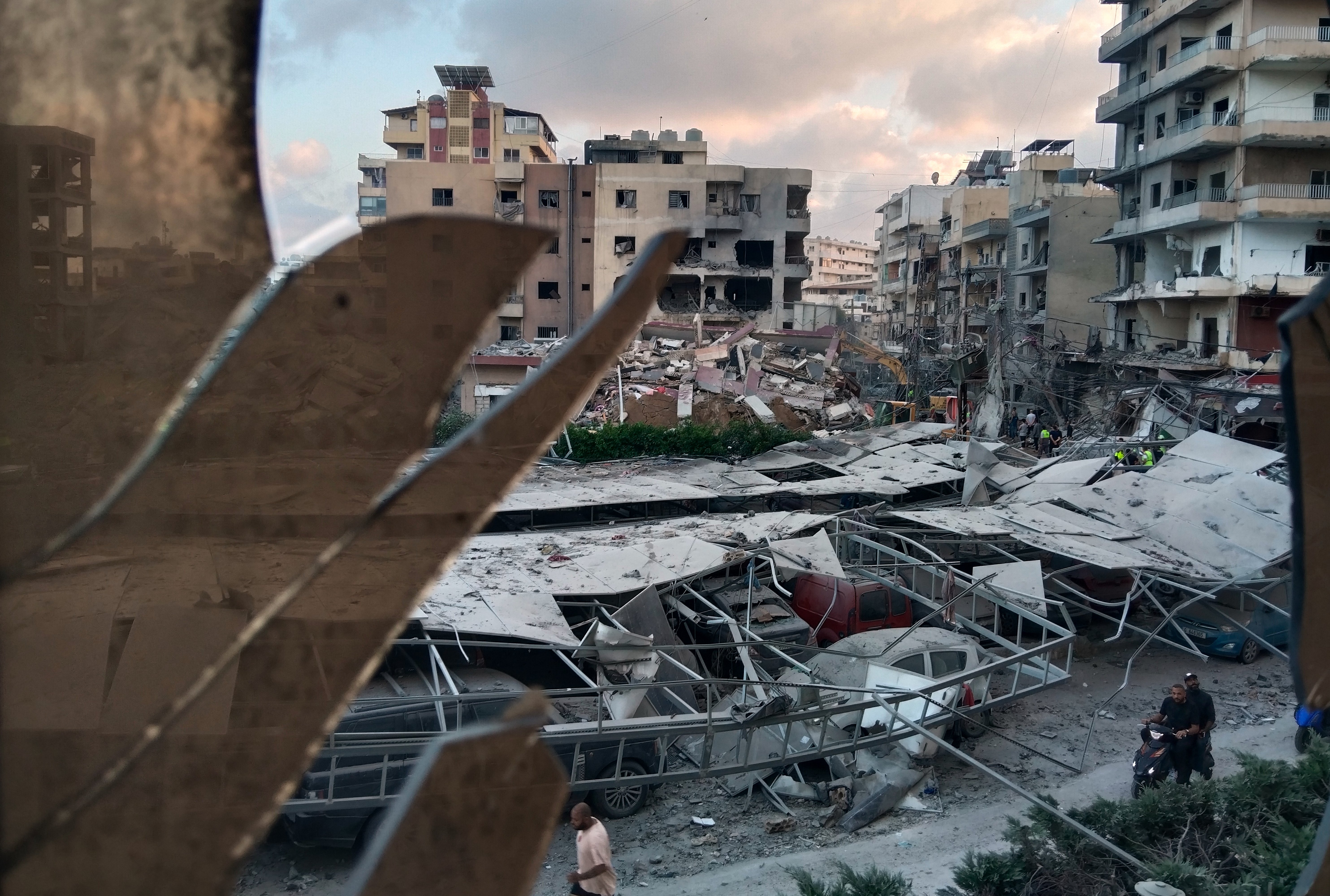
What it did not address, what the prayers left conspicuously unanswered, is the question of accountability flowing in the other direction: for whom, in Gaza’s rubble and in Lebanon’s bombed hospitals, forgiveness might also be due.