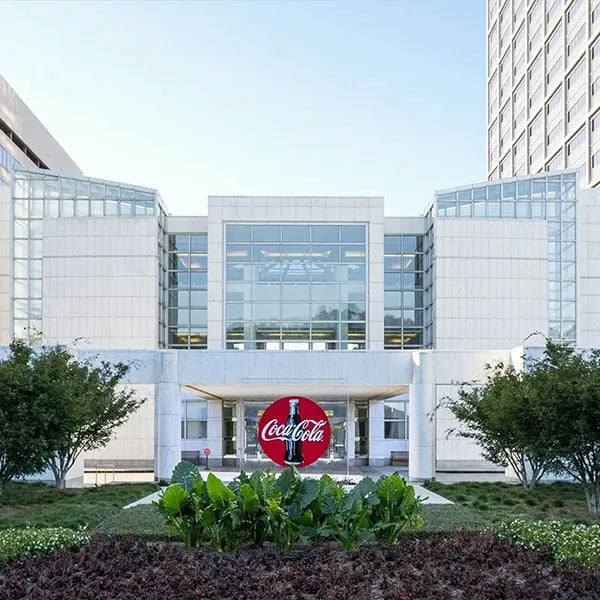

NEW YORK – There is a number that has been shadowing Coca-Cola Co.’s stock price all year, and on Wednesday it kept getting closer. The stock closed at $89.58 on September 3, 2026, up 1.52% on a session in which the Dow Jones Industrial Average added 295 points, with fellow Dow components Apple rising 1.96%, Amgen advancing 2.94%, Cisco edging 0.26% higher, Boeing adding 1.57%, and Chevron gaining 0.36% in the same session. Traders who have watched KO climb 26% since January are now calculating what it would take to cross $100, a threshold that, six months ago, felt comfortably distant.
The 26% advance does not come with an obvious catalyst. Coca-Cola did not launch a product that redefined its category, did not acquire a competitor that revalued its portfolio, and did not discover a technology that reduced its cost structure by a magnitude that changes the underlying business. What the company did do, consistently and without drama, was deliver second-quarter 2026 results showing 7% revenue growth year over year, reaching $13.4 billion for the three months ended July 3, while expanding margins and delivering comparable earnings per share of $0.97, an 11% increase over the same period a year earlier.
Operating income reached $4.7 billion in the second quarter, a 9% gain year over year. Comparable operating margin expanded 90 basis points to 35.6%, a figure that, in a business whose primary inputs include sugar, packaging materials, and distribution logistics, represents a meaningful structural improvement. The company’s pricing power across its portfolio of more than 200 brands, spanning 200 countries, has been absorbing input cost pressures without triggering the volume erosion that analysts feared would come at some point when consumers began to resist.
The consumer resistance, to the extent it arrived at all, did not materialize in the second quarter data. Volume held in categories where Coca-Cola has historically had pricing discipline. The company’s emerging market operations, which represent a disproportionate share of the long-run growth thesis, continued generating the kind of per-capita consumption increases that underpin the $100 price target question.
Coca-Cola announced a quarterly cash dividend of $0.53 per share with an ex-dividend date of September 15, 2026. At $89.58, that quarterly dividend implies a yield of roughly 2.4% on an annualized basis, modest against historical comparisons for a consumer staples stock, but in a 2026 environment where equity investors are competing for yield, still meaningful. The dividend has been raised for 64 consecutive years, placing Coca-Cola firmly in the Dividend King category and making it a required holding for income-oriented funds whose mandates include holding the longest-running dividend growers.
What the price conversation does not fully account for is the valuation question that 26% appreciation in nine months necessarily creates. Coca-Cola’s forward price-to-earnings ratio, at current levels, exceeds the multiple the company has typically commanded in periods of slower growth. The stock is not cheap on traditional metrics; what it is, increasingly, is expensive in a way that its growth rate can justify, but only if that growth rate sustains, and only if the interest rate environment doesn’t shift in a way that makes dividend yields from bonds more attractive relative to dividend yields from equities.
September 3’s 1.52% gain was, in that context, a day on which none of the underlying tensions resolved. The stock moved higher because the broader market moved higher, because defensive stocks tend to participate in broad rallies, and because Coca-Cola’s institutional shareholder base, which skews toward long-duration holders with low turnover, does not tend to sell on days when the macroeconomic backdrop is neutral. Whether the stock can close the remaining distance to $100 will depend on whether the second half of 2026 delivers the kind of consistent execution the first half suggested was becoming a baseline rather than a ceiling.