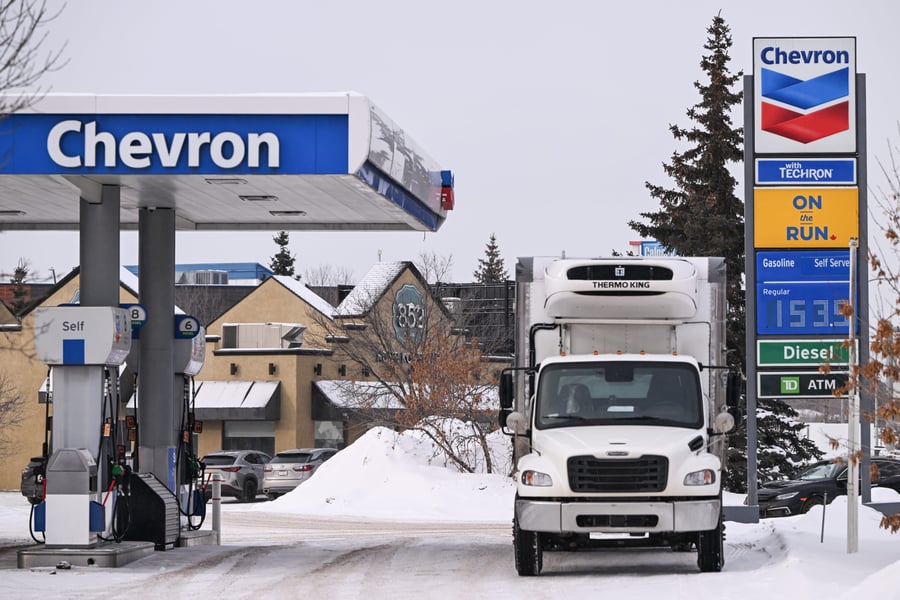

NEW YORK – Chevron Corp. gained 0.36% to close at $212.55 on Wednesday, September 3, 2026, as the Dow Jones Industrial Average recovered 295 points to 53,061.95, with fellow Dow components Apple up 1.96%, Amgen advancing 2.94%, Caterpillar slipping 0.67%, Boeing adding 1.57%, and Amazon declining 2.32% in the same session. The move was modest but directionally consistent with a company that has spent the past year generating cash at a rate that left analysts who had predicted an energy market slowdown explaining why their models had missed the scale of what actually happened.
The scale of what actually happened was substantial. Chevron’s second-quarter 2026 earnings report showed total earnings of $12.1 billion, or $6.11 per diluted share, with adjusted earnings of $12.0 billion, or $6.06 per diluted share. That adjusted EPS figure beat the Wall Street consensus by 18.6%, against revenue of $70.06 billion that topped forecasts by 12.5%. The company described the quarter as its highest profit in six years, a characterization that holds against any measure of core operating performance, not a statistical artifact of one-time items.
The production story is what drove those numbers. Worldwide oil and gas production increased 20% year over year in the second quarter, with U.S. production specifically advancing 20% to 2.07 million barrels per day, a record. U.S. refinery operations ran at 97% crude unit utilization, also a record, meaning the company was not just producing more oil but processing it at an efficiency level that extracted maximum margin from each barrel it moved through the system.
Behind those production figures is the consequence of the Hess Corp. acquisition, completed in late 2025, which added substantial Guyana assets to Chevron’s portfolio at a cost that, at then-prevailing oil prices, was described by some analysts as elevated. At current production volumes and with Brent crude trading in the range that supported $70 billion in quarterly revenue, the Hess assets have been generating returns that have quieted most of that criticism. The Guyana deepwater fields in particular have been delivering higher-than-projected initial production rates, and the development schedule for the next phase of capacity additions remains on track.
From a capital discipline perspective, Chevron generated $19.7 billion in operating cash flow in the second quarter, deployed enough of that to reduce debt by $8 billion, and achieved its three-year $3 billion structural cost reduction target six months ahead of schedule. The combination of record production, record refinery utilization, and accelerating cost reduction in the same quarter is unusual for an integrated oil major; typically, one or two of those variables cooperate while the others present headwinds.
At $212.55, Chevron trades near its 52-week high of $214.71, which signals that the market has substantially closed the discount that the stock carried through most of 2024 and early 2025, when integration risk from the Hess acquisition and uncertainty about long-cycle deepwater project delivery kept a ceiling on the multiple. Whether the stock can sustain a premium above its 52-week high will depend on oil market dynamics in the second half of 2026, specifically whether OPEC+ production discipline holds and whether global demand absorbs the additional supply that has been entering the market from U.S. shale and deepwater projects.
Chevron’s average price target from the 20 analysts who rate the stock Buy stands at $219.50, with a high estimate of $241. At $212.55, the stock is trading roughly 3.3% below the consensus target, close enough that the next material move will require either an oil price catalyst or an earnings revision. September 3’s 0.36% gain, against a backdrop of a rising Dow and stable oil prices, reflected a market that is comfortable with the position but not pressing for a breakout.