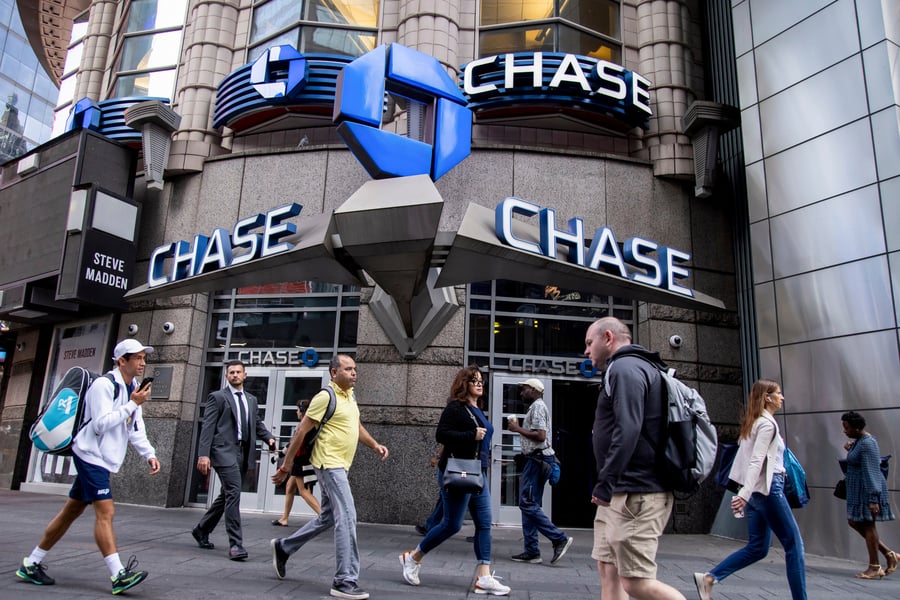


NEW YORK — The same jobs report that punished housing-adjacent stocks on Tuesday handed JPMorgan Chase a mild tailwind. Shares of the nation’s largest bank rose 0.22% to $356.80 as August’s stronger-than-expected nonfarm payrolls reading pushed Federal Reserve rate-cut expectations further out on the calendar, a shift that extends the window of elevated net interest income that has been JPMorgan’s primary earnings engine for two years.
The Dow Jones Industrial Average fell 0.51% to 53,414.25 on the session, with losses concentrated in rate-sensitive sectors including housing and discretionary spending. JPMorgan’s ability to close modestly higher on a broadly negative day underscored the bifurcation at work: sectors that depend on lower rates to revive their business models retreated, while the bank that earns more on every dollar of its loan book when rates stay elevated held its ground.
JPMorgan’s net interest income, the spread between what it earns on loans and what it pays on deposits, has been the defining number in its quarterly reports since the Federal Reserve began raising rates in 2022. In Q2 2026, the bank reported net interest income of $23.5 billion, a figure that remains near cycle highs despite some compression from deposit repricing. The Federal Reserve’s July 2026 FOMC statement held rates steady, and if the August payrolls data succeeds in pushing September rate-cut odds materially lower, NII will likely come in above analyst forecasts for Q3 when JPMorgan reports in mid-October.
Chief Executive Jamie Dimon has been consistent in framing the macro environment as more uncertain than markets are pricing. At the bank’s investor day in May, he warned that inflation could prove stickier than the Fed’s own projections allowed, and that geopolitical fragmentation involving supply chains rewiring away from China, defense spending rising across NATO members, and energy transition costs landing on corporate balance sheets simultaneously was creating a structural rather than cyclical inflation problem. The August payrolls report did nothing to undercut that thesis. Nonfarm payrolls beat the median estimate by a margin suggesting the labor market has not yet responded to the rate increases already in place.
At $356.80, JPMorgan’s market capitalization stands at approximately $1.01 trillion, making it one of a small group of US financial institutions ever to cross the trillion-dollar threshold. The milestone reflects not just scale but a sustained period of earnings delivery: the bank has produced industry-leading return on equity for three consecutive years, absorbing credit losses from commercial real estate exposure and regional bank stress without material impact on its capital ratios. The stock trades at roughly 14 times trailing earnings, a premium valuation by historical bank standards that the market has repeatedly reaffirmed.
The session’s composition within the Dow illustrated a clear macro divide. Sherwin-Williams shed 2.69% to $329.70 on the same day, and other housing-linked industrials moved lower on the same rate-delay logic that buoyed JPMorgan. The two moves are the same macro thesis expressed in opposite directions: a consumer economy where the housing cycle stays frozen because rates will not come down is a favorable environment for a bank that earns on its deposit spread, and a damaging one for a paint company waiting for homeowners to start renovation projects.
JPMorgan’s investment banking business is the one segment where the rate outlook creates ambiguity rather than clarity. A higher-for-longer environment extends the pause in mergers-and-acquisitions activity that has already stretched well beyond what deal advisory teams expected when rates started falling in late 2024. Deal volumes remain below pre-2022 levels as private equity sponsors find it difficult to finance leveraged buyouts at current rates and strategic acquirers face elevated cost-of-capital assumptions. Banking fees in Q2 were up from the prior year, but the runway to a full M&A recovery depends on rate cuts materializing, and Tuesday’s data pushed that runway out further.
The bank’s consumer unit carries its own set of mixed signals. JPMorgan’s credit card business benefits from higher rates on revolving balances, but it also absorbs higher charge-off rates as consumers who have been running deficits to maintain spending habits start to miss payments. Net charge-offs have been running above pre-pandemic norms across the industry, and management has guided that normalization, not deterioration, is the current trajectory. The August jobs data, by keeping employment strong, actually supports that guidance: employed borrowers are less likely to default. The dynamics mean the rate environment is simultaneously helping and creating caution at the consumer unit. Caterpillar’s 1.65% advance on September 4 highlighted a different kind of Dow resilience in the prior session, driven by infrastructure spending rather than rate dynamics.
What Tuesday could not resolve is how long JPMorgan’s advantage from higher rates lasts. When cuts eventually come, net interest income will compress. The question Dimon and his team are navigating is whether the investment banking pipeline refills fast enough as rates fall to offset the deposit-spread compression that arrives alongside it. Neither the August jobs report nor Tuesday’s modest stock advance brought that question closer to an answer.