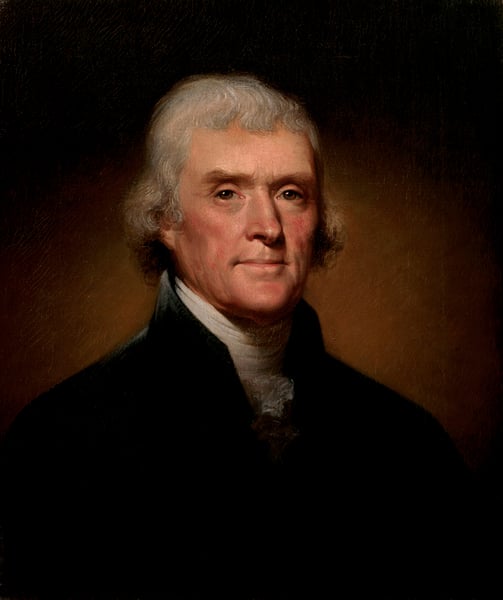

He wrote that all men are created equal. He enslaved 607 people. Both statements are the documented record, and any account of Thomas Jefferson that resolves them into a single tidy verdict is not telling you the truth.
Thomas Jefferson drafted the Declaration of Independence at thirty-three, served as the third President of the United States, doubled the size of the country with a purchase he privately believed he had no constitutional authority to make, and founded a university. He also owned human beings for his entire adult life, freed almost none of them, and fathered at least six children with a woman he held as property.
He left instructions for his own gravestone. It names three achievements: author of the Declaration of American Independence, author of the Virginia Statute for Religious Freedom, and father of the University of Virginia. He left the presidency off it deliberately. That editorial judgement, made by the man himself, is the most useful starting point anyone has.
| Field | Detail |
|---|---|
| Full name | Thomas Jefferson |
| Born | 13 April 1743, Shadwell, Colony of Virginia |
| Died | 4 July 1826, Monticello, Virginia, aged 83 |
| Spouse | Martha Wayles Skelton, married 1772, died 1782 |
| Political party | Democratic-Republican |
| Offices held | Delegate, Continental Congress; Governor of Virginia, 1779 to 1781; US Minister to France, 1785 to 1789; first US Secretary of State, 1790 to 1793; second Vice President, 1797 to 1801; third President, 1801 to 1809 |
| Principal writings | Declaration of Independence, 1776; Virginia Statute for Religious Freedom, drafted 1777, enacted 1786; Notes on the State of Virginia, 1785; more than 19,000 surviving letters |
| Founded | University of Virginia, chartered 1819, opened 1825 |
| Self-written epitaph | Author of the Declaration of American Independence, of the Statute of Virginia for Religious Freedom, and Father of the University of Virginia. The presidency is omitted. |
| Debt at death | About $107,000 |
| Buried | Monticello graveyard, Charlottesville, Virginia |
| Jefferson was born 2 April 1743 by the Julian calendar then in use in the British colonies; 13 April is the Gregorian date he himself observed after the 1752 changeover. | |
Thomas Jefferson timeline: key dates from 1743 to 1826
Eighty-three years, six public offices and one sentence that outlived the argument he refused to have. The dates below are the load-bearing ones; each is expanded in the sections that follow.
| Date | Event |
|---|---|
| 13 April 1743 | Born at Shadwell, Albemarle County, Virginia |
| 1760 | Enters the College of William and Mary at sixteen |
| 1767 | Admitted to the Virginia bar after reading law under George Wythe |
| 1768 | Elected to the Virginia House of Burgesses |
| 1 January 1772 | Marries Martha Wayles Skelton |
| 1774 | Publishes A Summary View of the Rights of British America |
| June 1776 | Drafts the Declaration of Independence for the committee of five |
| 4 July 1776 | Declaration of Independence adopted by the Continental Congress |
| 1779 to 1781 | Governor of Virginia; flees Monticello ahead of Tarleton in June 1781 |
| 6 September 1782 | Martha Jefferson dies at thirty-three; he never remarries |
| 1785 | Notes on the State of Virginia published in Paris |
| 1785 to 1789 | United States Minister to France |
| 1786 | Virginia Statute for Religious Freedom enacted, nine years after he drafted it |
| 1790 to 1793 | First Secretary of State, under George Washington |
| 1797 to 1801 | Vice President under John Adams |
| 1798 | Secretly drafts the Kentucky Resolutions against the Alien and Sedition Acts |
| 17 February 1801 | Elected president by the House of Representatives on the thirty-sixth ballot |
| 1 January 1802 | Writes the Danbury Baptists letter and its wall of separation |
| 30 April 1803 | Louisiana Purchase treaty signed in Paris |
| 1804 to 1806 | Lewis and Clark cross the continent and return |
| 2 March 1807 | Signs the Act Prohibiting Importation of Slaves, effective 1 January 1808 |
| 22 December 1807 | Signs the Embargo Act, repealed days before he leaves office |
| 4 March 1809 | Leaves the presidency after two terms |
| 1815 | Sells 6,487 volumes to Congress, refounding the Library of Congress |
| 25 January 1819 | University of Virginia chartered by the Virginia legislature |
| 7 March 1825 | University of Virginia opens to 125 students |
| 4 July 1826 | Dies at Monticello on the fiftieth anniversary of the Declaration |
| January 1827 | Monticello, its contents and about 130 enslaved people sold at auction |
| Sources: Thomas Jefferson’s Monticello, the US National Archives, the Library of Congress and the National Park Service. Dates are New Style. | |
Thomas Jefferson’s early life: Shadwell, Williamsburg and an education that took
Thomas Jefferson was born on 13 April 1743 at Shadwell, in what was then Goochland County and is now Albemarle County, Virginia. His father Peter Jefferson was a surveyor and planter who died when Thomas was fourteen, leaving him roughly 5,000 acres and the enslaved people who worked it. He inherited his position rather than earning it, which is worth saying plainly because he spent much of his life writing as though merit were the organising principle of the society he lived in.
Thomas Jefferson entered the College of William and Mary at sixteen and read law under George Wythe, who would later sign the Declaration his student drafted. He was admitted to the Virginia bar in 1767 and elected to the House of Burgesses in 1768. In 1772 he married Martha Wayles Skelton, a widow. She died ten years later, at thirty-three, after her sixth pregnancy. He never remarried, and he burned their correspondence.
Martha’s father, John Wayles, had also fathered children with an enslaved woman named Betty Hemings. One of those children was Sally Hemings. She was Martha Jefferson’s half-sister, and she came to Monticello as part of the Wayles estate that Jefferson inherited through his wife. That inheritance also brought the debt that eventually destroyed him.
Thomas Jefferson and the Declaration of Independence: the passage Congress cut
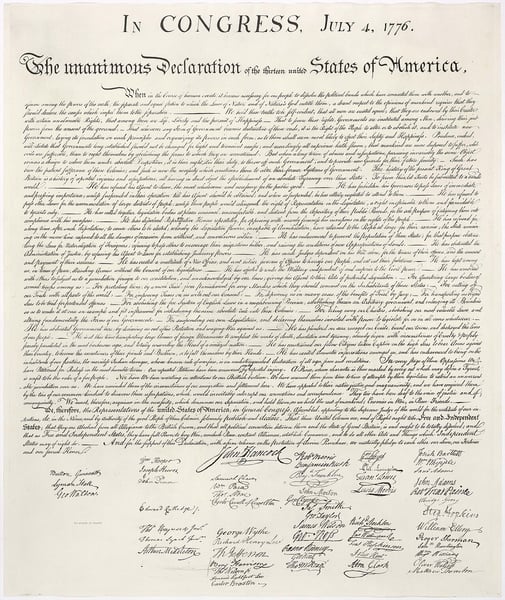
In June 1776 the Continental Congress appointed a committee of five to draft a statement of independence. The committee handed the writing to Thomas Jefferson. He produced a draft in about seventeen days in a rented room in Philadelphia, and Congress then went through it line by line.
Two changes matter. Benjamin Franklin is generally credited with turning Jefferson’s “sacred and undeniable” into “self-evident,” which converted a theological claim into a logical one. And Congress deleted, entirely, a long passage in which Jefferson denounced the Atlantic slave trade and blamed it on King George III. Jefferson recorded in his autobiography that the clause was struck to satisfy South Carolina and Georgia, and that northern delegates whose states profited from carrying slaves were content to see it go.
The deletion is often cited as evidence that Jefferson was more antislavery than his colleagues. It is more complicated than that. The passage blamed the trade on the Crown while its author held people in bondage at home, and it described enslaved Africans as having been robbed of liberty by a foreign king rather than by the men signing the document. Congress removed a paragraph that was already evading the question.
The Declaration was adopted on 4 July 1776. Most delegates signed on 2 August. Jefferson was thirty-three and had never held national executive office.
Virginia, Paris, and the statute he was proudest of
Thomas Jefferson served as Governor of Virginia from 1779 to 1781, a period that ended badly. British forces under Banastre Tarleton raided Charlottesville in June 1781 and Jefferson fled Monticello with minutes to spare. The legislature opened an inquiry into his conduct. It cleared him, but the episode wounded him and he did not hold state office again.
He had drafted the Virginia Statute for Religious Freedom in 1777. It was not enacted until 1786, and by then James Madison was carrying it. The statute abolished the established church in Virginia and made belief legally irrelevant to civil standing. It became the direct ancestor of the First Amendment’s religion clauses, and Jefferson considered it one of the three things worth putting on his tombstone.
From 1785 to 1789 he was the American minister to France, succeeding Franklin. He was in Paris when the Bastille fell. He was also there with two enslaved teenagers, James and Sally Hemings, in a jurisdiction where they could have sued for freedom. Both returned with him to Virginia. According to the account Sally Hemings’s son Madison later gave, she agreed to return only after Jefferson promised freedom for the children she would have.
Thomas Jefferson’s writings: what he actually put on paper
Thomas Jefferson published one book in his lifetime. Everything else that made him famous was a public document, a legislative draft or a letter, which is an unusual body of work for a man remembered as a writer.
| Work | Date | What it did |
|---|---|---|
| A Summary View of the Rights of British America | 1774 | Argued Parliament held no authority over the colonies at all; printed without his permission and made his name |
| Declaration of Independence | Drafted June 1776, adopted 4 July 1776 | Written in about seventeen days, then edited line by line by Congress, which struck his slave-trade passage |
| Virginia Statute for Religious Freedom | Drafted 1777, enacted 1786 | Ended the established church in Virginia; direct ancestor of the First Amendment religion clauses |
| Notes on the State of Virginia | Written 1781, published 1785 | His only full-length book; contains both his fear that God is just and his claim of Black inferiority |
| Kentucky Resolutions | 1798 | Written secretly while he was vice president; asserted that states could judge federal laws unconstitutional |
| Letter to the Danbury Baptist Association | 1 January 1802 | Coined the wall of separation between Church and State |
| The Life and Morals of Jesus of Nazareth | Compiled about 1820, published long after his death | The gospels with the miracles cut out, assembled with a razor and paste |
| Correspondence | About 19,000 letters | By volume, the largest body of his writing and the main source for everything else |
| Jefferson published one book in his lifetime. His epitaph names two documents from this table and a university, and omits the presidency. | ||
A Summary View of the Rights of British America, written in 1774 for the Virginia delegates to the first Continental Congress, is the piece that made his reputation. It argued that Parliament had no authority over the colonies at all, a harder position than most of his colleagues then held, and it was printed without his permission. Two years later the committee of five handed him the Declaration partly because of it.
Notes on the State of Virginia is the difficult one. Written in 1781 in answer to a French diplomat’s questionnaire and published in Paris in 1785, it is a survey of Virginia’s geography, law, population and government. It contains the sentence in which he trembles for his country reflecting that God is just. It also contains his suggestion that Black people are inferior to whites in reason and imagination, offered as a hypothesis and printed under his name. Both passages are in the same book, and reading either without the other misrepresents it.
The wall of separation between church and state
On 1 January 1802, replying to the Danbury Baptist Association in Connecticut, Jefferson wrote that the First Amendment built a wall of separation between Church and State. The phrase is not in the Constitution. It appears in a courtesy letter from a sitting president to a congregation that had written to congratulate him, and the Library of Congress holds the draft with his edits.
That sentence has since done more work in American constitutional law than most clauses of the document it describes. The Supreme Court adopted the metaphor in the twentieth century as shorthand for the Establishment Clause, and every subsequent fight over school prayer, public funding of religious schools and religious displays on public land has argued about where Jefferson’s wall runs. He wrote it in a single afternoon of correspondence, and it is arguably his most consequential sentence after the second paragraph of the Declaration.
Secretary of State: Thomas Jefferson, Hamilton and the invention of party politics
Jefferson became the first Secretary of State in 1790, under George Washington. He spent most of the next three years fighting Alexander Hamilton over the national bank, the assumption of state debts, the interpretation of the Constitution, and whether the United States should lean toward Britain or France. The two men worked in the same small government and detested each other’s vision of it.
That fight produced the first American party system. Jefferson and Madison built the Democratic-Republicans against Hamilton’s Federalists, and the argument they were having, over how much power the federal government may take that the Constitution does not name, has never been settled since.
He resigned in 1793, ran for president in 1796, came second, and under the rules then in force became John Adams’s vice president. In 1798, while serving as vice president in that administration, he secretly drafted the Kentucky Resolutions attacking the Alien and Sedition Acts and asserting that states could judge federal laws unconstitutional. He did not admit authorship. The nullification doctrine those resolutions seeded was later used by people he would not have recognised as allies.
The election of 1800: Thomas Jefferson wins on the thirty-sixth ballot
The election of 1800 nearly broke the system. Jefferson and Aaron Burr, running as president and vice president on the same ticket, each received 73 electoral votes, because the original Constitution gave electors two undifferentiated votes. The tie went to the House of Representatives, which balloted thirty-six times before choosing Jefferson on 17 February 1801.
Why the tie happened, and the amendment that fixed it
Hamilton, who despised Jefferson’s politics, worked against Burr anyway on the ground that Jefferson at least had principles. Three and a half years later Burr shot him.
The mechanism that produced the deadlock was repaired by the Twelfth Amendment, ratified in June 1804, which required electors to vote separately for president and vice president. It remains in force. The 1800 crisis is also the first transfer of power in the republic’s history between opposing parties, and it happened without troops in the street, which is the reason Jefferson called it a revolution.
| Date | Action | Outcome |
|---|---|---|
| 17 February 1801 | House elects Jefferson on the 36th ballot after a 73 to 73 tie with Aaron Burr | First transfer of power between opposing parties in US history |
| 1801 to 1805 | First Barbary War against the North African states preying on US shipping | First sustained American military action overseas |
| 1803 | Marbury v. Madison decided, arising from commissions his administration withheld | Established judicial review |
| 30 April 1803 | Louisiana Purchase treaty signed: 828,000 square miles for $15 million | Roughly four cents an acre; doubled US territory |
| June 1804 | Twelfth Amendment ratified, separating presidential and vice-presidential ballots | Fixed the flaw that produced the 1800 deadlock |
| May 1804 to September 1806 | Lewis and Clark expedition to the Pacific and back | First US overland crossing of the new territory |
| 2 March 1807 | Act Prohibiting Importation of Slaves signed, effective 1 January 1808 | Ended the legal Atlantic slave trade to the US; left slavery itself untouched |
| 22 December 1807 | Embargo Act closes American ports to foreign trade | Devastated New England shipping, widely evaded, repealed March 1809 |
| The Louisiana Purchase treaty was submitted to the Senate after Jefferson abandoned a draft constitutional amendment he had prepared to authorise it, on being warned that Napoleon might withdraw the offer. | ||
The Louisiana Purchase: Thomas Jefferson against his own doctrine
In 1803 Napoleon offered to sell the entire Louisiana territory. Jefferson had sent envoys to buy New Orleans. What came back was 828,000 square miles for $15 million, roughly four cents an acre, doubling the territory of the United States at a stroke.
The amendment Thomas Jefferson drafted and then abandoned
The problem was that Jefferson had spent fifteen years insisting the federal government held only powers the Constitution enumerated, and the Constitution says nothing about acquiring foreign territory. He drafted a constitutional amendment to authorise it. Then he was warned that Napoleon might withdraw the offer, and he abandoned the amendment and sent the treaty to the Senate, which ratified it. The treaty had been signed on 30 April 1803.
It is the largest single expansion in American history and the clearest case of Jefferson subordinating his stated constitutional philosophy to an opportunity. He knew it at the time. He wrote to a correspondent that the executive had done an act beyond the Constitution and must throw itself on the country for approval.
The land was not empty. The purchase transferred a French claim, not the territory itself, and everything that followed for the nations already living there, including the removal policies of the next generation, ran through the door Jefferson opened.
Lewis and Clark, Barbary, and an embargo that failed
Thomas Jefferson commissioned Meriwether Lewis and William Clark to cross the new territory to the Pacific. They left in May 1804 and returned in September 1806 with maps, specimens and a route. It was a scientific expedition run by a president who was himself a serious naturalist, architect and amateur palaeontologist.
Abroad, he fought the First Barbary War from 1801 to 1805 rather than continue paying tribute to the North African states preying on American shipping. It was the first sustained overseas military action by the United States and the first test of a navy Jefferson had, as a matter of stated policy, wanted to keep small.
His second term went badly. Caught between Britain and France, both of which were seizing American ships, he chose economic coercion. The Embargo Act, signed on 22 December 1807, closed American ports to foreign trade almost entirely. It devastated New England shipping, was widely evaded, failed to move either belligerent, and was repealed days before he left office. It is the clearest failure of his presidency and the one his admirers most often skip.
One measure from that second term deserves more attention than it gets. On 2 March 1807 Jefferson signed the Act Prohibiting Importation of Slaves, which took effect on 1 January 1808, the earliest date the Constitution permitted. It ended the legal Atlantic slave trade to the United States. It did not touch slavery itself, and the domestic trade in people that followed was in some respects crueller, because it ran on selling children away from parents rather than importing strangers.
| Measure | Figure |
|---|---|
| People Thomas Jefferson enslaved over his lifetime | 607 |
| Held at Monticello at any one time | About 130 |
| Formally freed by Jefferson | 7, being 2 in his lifetime and 5 in his will |
| Allowed to leave without pursuit | 2, Beverly and Harriet Hemings |
| Total who gained freedom, as a share of 607 | 10, or about 1.6 per cent |
| Family the 10 belonged to | All members of the Hemings family |
| Children of Sally Hemings the Foundation attributes to Jefferson | At least 6 |
| Sold at auction to settle his debts, January 1827 | About 130 people, alongside the house, land and contents |
| Sally Hemings was never freed. After Jefferson’s death his daughter Martha Randolph gave her what was called her time, an informal arrangement carrying no legal standing. She died in Charlottesville in 1835. | |
Slavery at Monticello: the 607 people Thomas Jefferson enslaved
Thomas Jefferson enslaved 607 people over the course of his life. At any given moment roughly 130 people were held at Monticello, which was not a house with servants but a working plantation with a nail factory, a textile operation and fields, staffed by people who could be sold.
He freed seven. Two during his lifetime and five in his will, all of them Hemings men. Two more, Beverly and Harriet Hemings, were allowed to leave without pursuit. That is ten people out of more than six hundred, and every one of them belonged to a single family.
The nailery, the whip and the four per cent memorandum
The nailery was worked by boys, some as young as ten. Overseers whipped them. Jefferson knew and permitted it while writing, in private correspondence, that he wished the whip used sparingly. He calculated in a memorandum that he was earning about four per cent a year on the birth of enslaved children, which is a sentence that requires no commentary.
He wrote in Notes on the State of Virginia, his only full-length book, published in 1785, that he suspected Black people to be inferior to whites in the faculties of reason and imagination. He advanced it as a hypothesis and invited disproof, which some readers offer as mitigation. It was published under his name, it circulated for decades, and it was quoted by defenders of slavery long after he was dead. The lineages that ran out of households like his reach into the present American political class.
Thomas Jefferson and Sally Hemings: what the evidence establishes
In 1998 a team led by the pathologist Eugene Foster published a Y-chromosome study in Nature. It found that male-line descendants of Eston Hemings, Sally Hemings’s youngest son, shared a haplotype with male-line descendants of Field Jefferson, Thomas Jefferson’s uncle. That established that Eston’s father was a Jefferson male, not which one.
The Thomas Jefferson Foundation, which owns and runs Monticello, convened a research committee of nine staff members. Its report, published in January 2000, concluded that Jefferson was the father. The Foundation’s current position, stated on its own website, is that Thomas Jefferson fathered at least six of Sally Hemings’s children. It notes that its scholarly advisers and the wider community of early-American historians have concurred for many years.
The evidence is not the DNA alone. Jefferson was present at Monticello at the conception of every one of her children, across a span of years in which he was frequently absent. Her children were the only enslaved people he freed. Madison Hemings gave a detailed newspaper account in 1873 naming Jefferson as his father. A minority report by one committee member dissented, and the Foundation publishes it alongside the majority finding.
Monticello now interprets this openly. A room in the South Wing identified as Sally Hemings’s living quarters was opened to visitors in 2018, on a site that for most of the twentieth century told the story as though she had not existed.
She was never freed. After Jefferson’s death his daughter Martha gave her what was called her time, an informal arrangement without legal standing, and she lived in Charlottesville until she died in 1835.
The University of Virginia and the epitaph Thomas Jefferson wrote for himself
The Virginia legislature chartered the University of Virginia on 25 January 1819. It opened to 125 students on 7 March 1825, fourteen months before Jefferson died, and construction was still going on when he did.
He did not merely found it. He designed the buildings, laid out the grounds and set the curriculum. The plan he called an Academical Village put ten pavilions along a lawn, each housing a professor and his family, with student rooms between them, so that teachers and students lived in the same architecture. At the head of the lawn he put the Rotunda, modelled on the Pantheon in Rome, and made it the library rather than a chapel. That last decision was the argument, not an aesthetic preference. There was no professor of divinity. A man who had spent nine years getting the established church out of Virginia law built a university with a book at the centre of it and no clergyman on the faculty.
Then he wrote his own epitaph and told his executors to add nothing to it. It names three things: author of the Declaration of American Independence, author of the Statute of Virginia for Religious Freedom, and Father of the University of Virginia. He was a governor, a minister to France, a secretary of state, a vice president and a two-term president of the United States, and he left every one of those offices off the stone.
The list he chose is a list of things he wrote or built rather than offices he held, and two of the three are about who gets to think what. Whatever else is arguable about Thomas Jefferson, his own verdict on his life is on the record, in his own hand, and it is not the one the presidential rankings use.
How Thomas Jefferson died, and what was sold to pay for it
Thomas Jefferson died at Monticello on 4 July 1826, the fiftieth anniversary of the Declaration. John Adams died the same day, a few hours later, in Massachusetts. Neither knew of the other’s death.
He died owing about $107,000. Part of it was inherited through the Wayles estate. Part was decades of building and rebuilding Monticello, buying books and wine, and running a plantation that did not turn a profit. The final blow came in 1819, when he had endorsed $20,000 in notes for his friend Wilson Cary Nicholas, who defaulted in the Panic of 1819 and left Jefferson liable.
To settle it, his heirs sold Monticello, its contents, the land and the people. The auction was held in January 1827. About 130 human beings were sold, families broken apart in the process. Israel Gillette Jefferson, who was there, later recalled that apart from the five freed in the will, all the rest of us were sold on the auction block.
He had sold his library to Congress in 1815, after the British burned the Capitol: 6,487 volumes for $23,950. It became the foundation of the Library of Congress. Two thirds of it burned in a fire on Christmas Eve 1851.
Thomas Jefferson’s legacy and influence
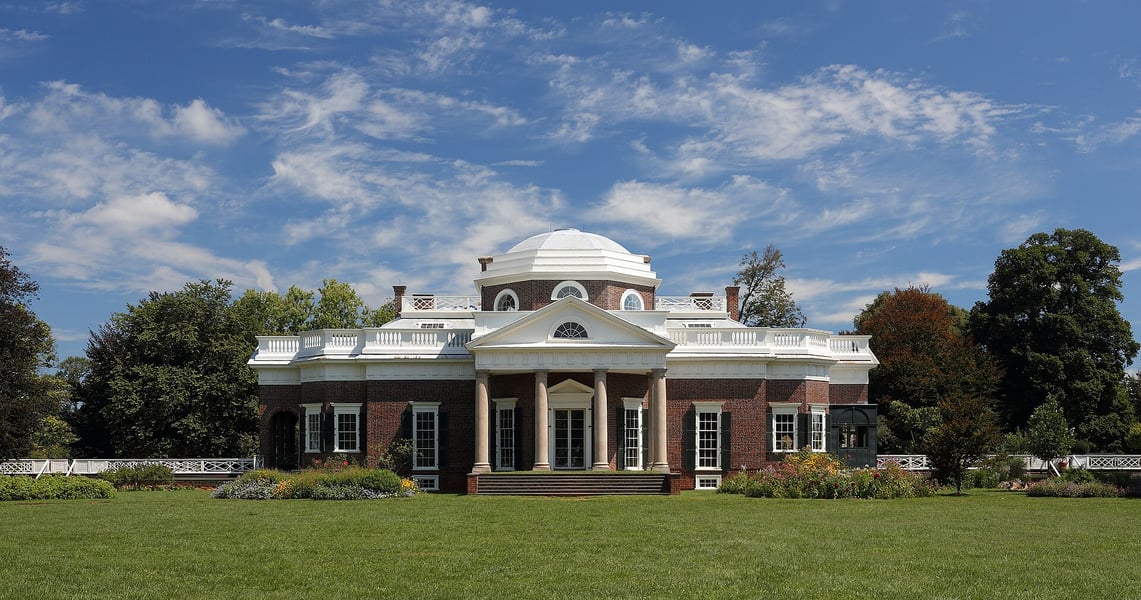
The Jefferson Memorial in Washington was dedicated by Franklin D. Roosevelt on 13 April 1943, the two hundredth anniversary of his birth, in the middle of a war being fought partly over whether the proposition on its walls meant anything. The architect John Russell Pope borrowed from Monticello and the Rotunda, and the building sits in a straight line with the White House.
| Form | Detail |
|---|---|
| Jefferson Memorial, Washington | Dedicated by Franklin D. Roosevelt on 13 April 1943, the bicentenary of his birth; architect John Russell Pope; sited in a straight line with the White House |
| Mount Rushmore | One of the four presidents carved into the Black Hills of South Dakota |
| University of Virginia | Chartered 1819, opened 1825; he designed the buildings, laid out the grounds and set the curriculum |
| Library of Congress | Rebuilt around the 6,487 volumes he sold to Congress in 1815 after the British burned the Capitol |
| United States currency | His portrait appears on the nickel and the two-dollar note |
| Monticello | A museum since 1923, now interpreting slavery on the same tour as the house; the Hemings quarters opened to visitors in 2018 |
| His epitaph | Names the Declaration, the Virginia Statute for Religious Freedom and the University of Virginia, and leaves out every office he held |
| Memorial dedication details: National Park Service. Monticello interpretation: the Thomas Jefferson Foundation. | |
The influence that matters more is textual. The second paragraph of the Declaration has been the standing citation of every American movement that needed a founding document to argue from, and most of them have had to argue against the author’s own conduct to use it. Abolitionists quoted it at slaveholders. The Seneca Falls declaration of 1848 rewrote its opening to include women. The Gettysburg Address dated the nation from 1776 rather than 1787, which made Jefferson’s clause the founding proposition rather than a preamble. A century later the American civil rights movement quoted the same sentence back at a government that had spent a hundred years not honouring it.
Jeffersonian democracy, as a political tradition, is harder to pin down and has been claimed by people who agree on nothing. The agrarian suspicion of concentrated financial power, the insistence on strict construction of federal authority, the defence of states against the centre, the faith in an educated citizenry: those threads have run into movements at opposite ends of American politics, and the nullification doctrine he seeded in 1798 was later picked up by people defending the institution he called a moral depravity.
He is on the nickel and the two-dollar note, on Mount Rushmore, and on the wall of a memorial that quotes him on the necessity of changing institutions as the human mind advances. He is also, at Monticello, on a tour that now includes the room where Sally Hemings lived. Both of those are the legacy. The country has not decided how to hold them at once, and this page does not pretend to have decided either.
Thomas Jefferson at 250: the anniversary year
The document Jefferson drafted turned 250 on 4 July 2026, and Monticello was the centre of the commemoration.
Seventy-four new citizens on the West Lawn
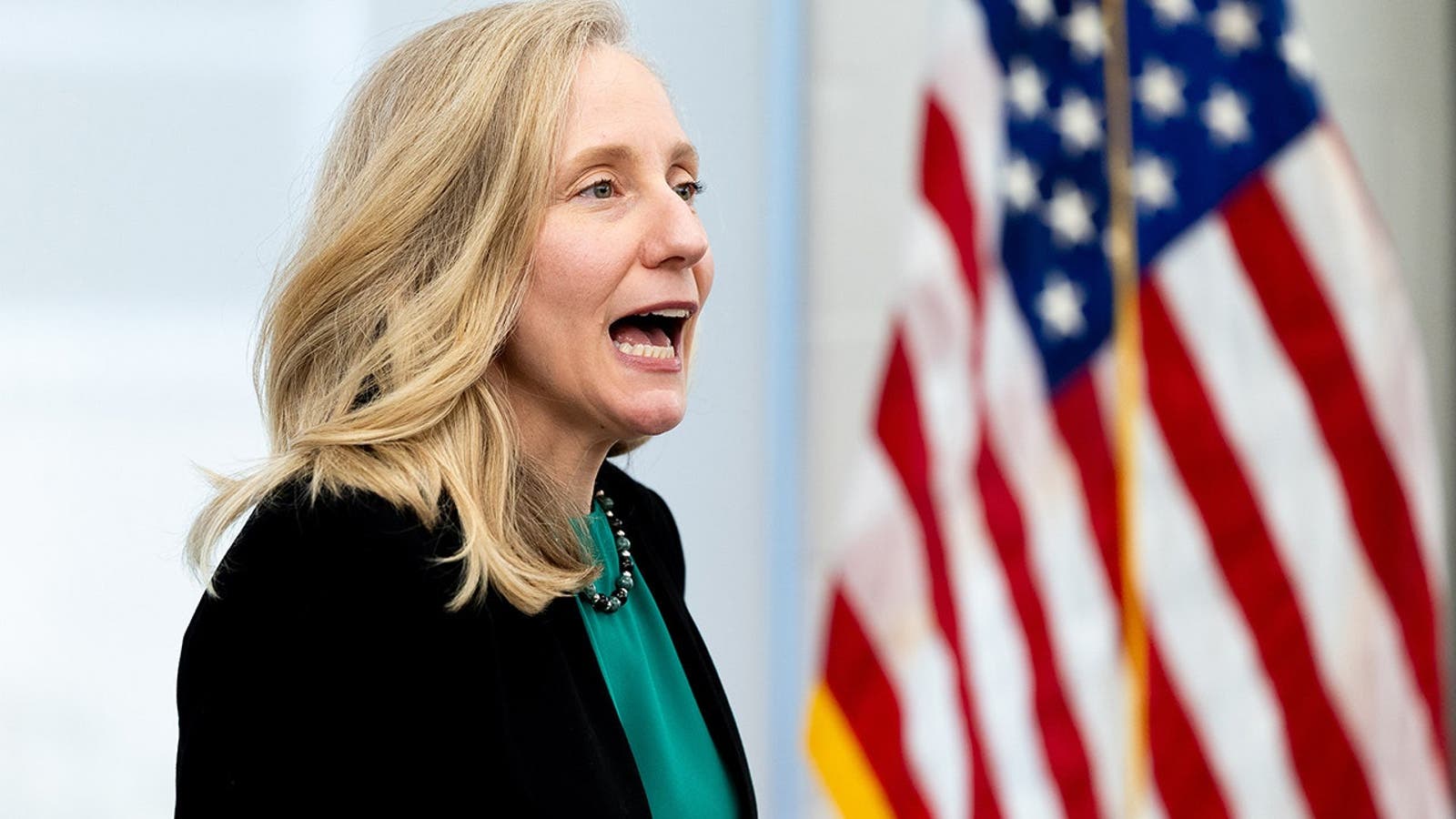
The estate held its 64th annual Independence Day Celebration and Naturalization Ceremony that morning. Seventy-four people from 36 countries took the oath of citizenship on the West Lawn. Governor Abigail Spanberger of Virginia gave the keynote, the ninth Virginia governor to speak there on Independence Day. More than 4,000 people have become American citizens at Monticello since the ceremony began in 1963, which is a fact worth setting beside the January 1827 auction on the same ground.
Monticello’s semiquincentennial programme ran through the year. It included a new exhibition, 1776: Road to the Declaration, tracing the document’s origins; a publishing project called Declare: A Civic Gospel; a May event on the West Lawn staged with Virginia’s American Revolution 250 Commission; and a United States Mint appearance for the new Declaration quarter issued under the 2026 semiquincentennial coin programme.
Jefferson is also slated for inclusion in the National Garden of American Heroes, the statuary project President Donald Trump first ordered in 2020 and revived for the anniversary. The contrast between that framing and the one Monticello itself now offers, where the Hemings quarters are on the tour, is the live argument about Thomas Jefferson in 2026. It is not a fight about facts. Both institutions accept the same record. It is a fight about which parts of it a country puts in bronze.
What the record does not settle
Not whether Thomas Jefferson understood slavery to be wrong. He wrote that it was, repeatedly, over fifty years, in language nobody has improved on. In Notes on the State of Virginia he wrote that he trembled for his country when he reflected that God is just.
What the record does not settle is why a man who believed that, and who had the standing to act on it, did essentially nothing. George Washington freed his enslaved people in his will. Jefferson freed ten out of six hundred. He argued that emancipation had to wait for a generation better prepared than his own, and he kept saying it while the number of people he held stayed roughly constant and the debt that supposedly prevented action was one he kept deepening by choice.
The sentence he wrote outlived the argument he refused to have. Abraham Lincoln built the Gettysburg Address on it, dating the nation from 1776 rather than 1787 and making Jefferson’s clause the founding proposition rather than a preamble.
There is no diary, no private confession, no letter in which he works it out for himself. He left more than 19,000 letters and the question is not answered in any of them. That absence is not an accident of preservation. It is the shape of the man.
Last updated
This profile was last reviewed and expanded on 25 August 2026. The biographical record, the documentary sources and the Monticello research findings are stable and change rarely. The anniversary section covering the semiquincentennial year is the part that dates, and figures attributed to the Thomas Jefferson Foundation reflect its published position at the time of writing.
Thomas Jefferson (13 April 1743 to 4 July 1826) was an American statesman who drafted the Declaration of Independence, served as the first Secretary of State, the second Vice President and the third President of the United States, and founded the University of Virginia. He was also a Virginia planter who enslaved more than six hundred people.
From 4 March 1801 to 4 March 1809, two full terms as the third President of the United States. He was elected by the House of Representatives on the thirty-sixth ballot in February 1801 after tying with Aaron Burr in the electoral college.
The Declaration of Independence, the Virginia Statute for Religious Freedom, A Summary View of the Rights of British America, the Kentucky Resolutions and Notes on the State of Virginia, his only full-length book. He also left about 19,000 letters. His epitaph, which he composed himself, names only the Declaration, the statute and the university.
He wrote the draft, in about seventeen days, for a committee of five that included John Adams and Benjamin Franklin. The Continental Congress then edited it line by line and deleted a long passage denouncing the Atlantic slave trade. The document adopted on 4 July 1776 is his text as Congress left it.
The Louisiana Purchase of 1803, which doubled the size of the country for about $15 million; the Lewis and Clark expedition of 1804 to 1806; the First Barbary War; and the Act Prohibiting Importation of Slaves, signed on 2 March 1807 and effective on 1 January 1808. His Embargo Act of 1807 was a failure and was repealed as he left office.
Because he had spent fifteen years arguing that the federal government holds only the powers the Constitution enumerates, and the Constitution says nothing about buying foreign territory. He drafted an amendment to authorise it, then abandoned the amendment when he was warned Napoleon might withdraw the offer, and sent the treaty to the Senate instead.
607 over his lifetime, according to the Thomas Jefferson Foundation, with roughly 130 held at Monticello at any one time. He freed seven, two in his lifetime and five in his will, and allowed two others to leave without pursuit. All ten were members of the Hemings family.
Yes. The Thomas Jefferson Foundation concluded in January 2000, and states today, that Jefferson fathered at least six of Sally Hemings's children. The finding rests on a 1998 Y-chromosome study, Jefferson's documented presence at Monticello at each conception, the freeing of her children alone, and Madison Hemings's 1873 account. One committee member dissented and the Foundation publishes that minority report alongside the majority finding.
Yes. The Virginia legislature chartered it on 25 January 1819 and it opened to 125 students on 7 March 1825. Jefferson designed the buildings, laid out the Academical Village and set the curriculum. He put the library, not a chapel, at the head of the lawn, and appointed no professor of divinity.
He used the phrase in a letter of 1 January 1802 to the Danbury Baptist Association, describing what he believed the First Amendment had built. The words are not in the Constitution. The Supreme Court later adopted the metaphor as shorthand for the Establishment Clause, which is why a courtesy letter has shaped American religious-liberty law ever since.
He died at Monticello on 4 July 1826, aged 83, on the fiftieth anniversary of the Declaration of Independence. John Adams died the same day. Jefferson left about $107,000 in debt, and Monticello, its contents and around 130 enslaved people were sold at auction in January 1827.
Three achievements, chosen by him: author of the Declaration of American Independence, author of the Statute of Virginia for Religious Freedom, and Father of the University of Virginia. He instructed that nothing be added, and left out the governorship, the ministry to France, the office of Secretary of State, the vice presidency and the presidency.
Because the same man wrote the sentence that has been used to argue for human equality for two and a half centuries and spent his life holding human beings as property, including the mother of at least six of his children. Neither half is disputed. What to do with the combination is.
Monticello, near Charlottesville, Virginia, has been a museum since 1923 and is run by the Thomas Jefferson Foundation. The tour now covers slavery on the plantation alongside the house, and the room identified as Sally Hemings's living quarters opened to visitors in 2018.