
Mikhail Borodin: “Violence against migrants is daily and endless”
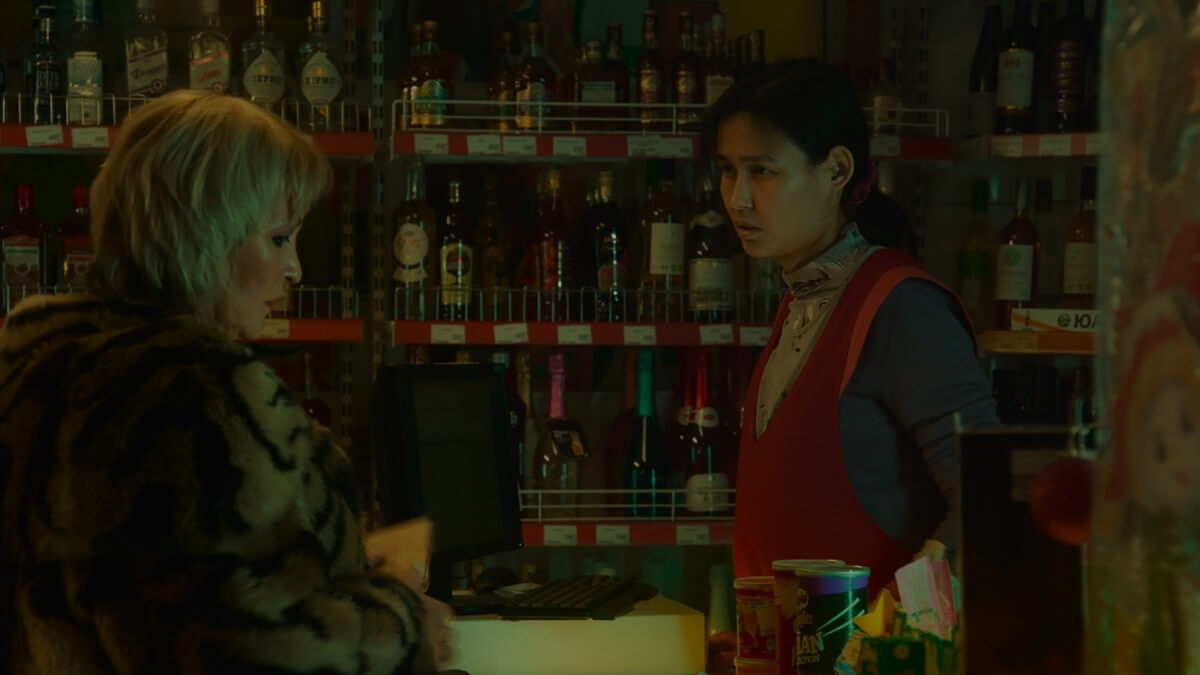
Residents of Moscow and other large Russian cities are familiar with this type of trade. Unpretentious grocery stores, set up in a hurry, are generally installed near metro stations, in the dormitories of the metropolis. The range is reduced. Everything you need “at a minimum” – soft drinks, canned goods, vegetables, fruits, sweets, alcohol and cigarettes. Working hours are around the clock. Behind the counter – vendors, mostly young women of Asian appearance.
Who are these people? How do they live? What attracts migrants from the Asian republics of the former Soviet Union to Russian megacities? The new feature film “Products 24” (Convenience Store), shot by director Mikhail Borodin, originally from Uzbekistan, according to his own script, seeks to answer these questions. This film, rare in terms of subject matter and directness of approach, has been recognized by Russian film critics as one of the best films of 2022.
The main character of the film Muhabbat works in a shop on the outskirts of Moscow, in the Golyanovo district. Hostess, domineering and cruel Zhanna, keeps her and other Uzbek girls in a black body. The conditions are enslaving: the girls have their passports withdrawn, they are detained or not paid at all for their work, they become victims of police sexual violence.
The workers can’t leave – they live in semi-prison conditions here in the warehouse part of the store. On top of all the injustices, the hostess kidnaps her newborn son from Mukhabbat. Desperate to get justice in the Russian capital, the girl returns home to a small Uzbek town. There, to earn a living, she is forced to enlist in a cotton picking brigade. His circle of trials is far from over.
Mukhabbat is played by debutante Zukhara Sansyzbai. Critics praised her performance in the film. “The marvelous Zukhara Sansyzbai”, writes Anton Dolin on the Meduza website, “transforms almost beyond recognition several times over the course of the film”.
“At first glance, this is a specific story of the Golyanovo store, but everything goes much deeper,” Zukhara said in an interview with the Afisha Daily website. “When I was working on the role, I was trying not to depart from reality.”
The world premiere of the film “Products 24” took place a year ago at the Berlinale in the “Panorama” program, where it aroused great interest, as one of the first attempts to tell the language of cinema on the fate of Central Asian migrants in Russia. The film was screened in several Russian cities.
It is a co-production of Russia, Slovenia and Turkey, filmed with the support of European funds to help young filmmakers. The film was screened in many international film festivals, including Lisbon, Taipei, Amman, Thessaloniki, Tokyo, London, Singapore and received several awards.
“Products 24” was the first feature of the “Peripheral Vision” spring film program organized by Mark Lipovetsky and Tatiana Efremova at Columbia University’s Harriman Institute to analyze anti-imperial narratives in modern Russian cinema.
The Russian media correspondent reached out to Mikhail Borodin, who was in Berlin, via Zoom and asked him a few questions.
Oleg Sulkin: Mikhail, I can’t help but ask you: do you live in Berlin permanently or did you come for business?
Mikhail Borodin: I am in Berlin as a member of the support program for directors who have made one or two films. I write a screenplay.
OS: Is “Products 24” your first feature film? And before that, you shot the documentary Cotton 100% about cotton pickers?
MB: Yes, that’s true, with just one clarification. I started with a documentary on cotton, but it turned out, largely because of the Covid, that I worked in parallel on feature films and documentaries.
OS: Ethnic enclaves in Russian cities have existed since ancient times. After the collapse of the USSR, there were noticeably more janitors – Tajiks and Kyrgyz. But the small retail trade in the form of shops, as you have shown in the film, has in many places become the heritage of migrants from Uzbekistan. For what?
MB: Tajiks and Kyrgyz people don’t just work as janitors. For example, it is easier for Kyrgyzstan people to obtain Russian passports, so they are more likely to get a higher-skilled and better-paying job. The modern slavery system is hierarchical. Laws are written in such a way that it is simply impossible for a migrant not to violate them, even with all the desire to comply with all norms and rules. Often they are left with only crude auxiliary work with very low wages, which is paid in ‘black’ or ‘grey’ cash. It is more profitable for employers to hire a disenfranchised, voiceless migrant for whom you cannot pay taxes. There are cases where these people are not paid at all for the work performed. Their passports and phones are often confiscated from them and they are in fact kept in captivity. And there is simply nowhere to complain about arbitrariness – the repressive police car is riddled with corruption. Not only does she ignore requests for help, but she is another tool to intimidate and rob migrants. This is how entire sectors of the economy operate in Russia.
OS: In the discussions around the film after its screening at the Berlinale, the question arose: is it possible to correct the situation or at least improve the situation of migrants in some way by showing the mechanism of new slavery?
MB: I don’t think feature films can change anything in general. Many townspeople do not even suspect that real slavery exists next to them. There are, of course, international human rights organizations that monitor modern slavery, which is seen as signs of forced labor, forced marriages and sexual violence. It is believed that there are 700,000 modern slaves in Russia. The statistics are rather conditional – no one is engaged in a specific calculation, and modern slave owners do not advertise the actual number of bound souls. When another revelation appears in the press, when another film or an investigative article comes out, it helps to bring the problem out of the shadows, to draw public attention to it. From this point of view, our film can be useful. But radically changing the situation is, in my opinion, a utopia.
OS: The first half of the film feels like urban horror. People try to survive in the closed space of the store. The question remains open: why are so many of them wanting to move to a big city?
MB: In town you can improve your life, earn money, it’s easier to get lost, it’s easier to hide something. I myself come from such a rural area. We shot part of the episodes in my small homeland, in the city of Toytepa in the Tashkent region, now it is called Nurafshan. Of course, the feeling that the city can provide you with certain advantages appeals to many to go there.
OS: Simply put, do people become migrants in order to improve their lives?
MB: It seems paradoxical, but many migrants from Uzbekistan want to live in Uzbekistan – to build a house, start a family, buy a car. Yes, they want to live at home, but due to the fact that there is no work, it is impossible to feed a family and there is no social ladder, people go to work in the big cities , mainly in Russia. At the same time, they find themselves in very difficult living conditions that do not meet the most minimal international standards. To have the opportunity to win, you have to sacrifice comfort.
OS: You believe in your characters unconditionally, their characters are compelling and vital. Are they actors or non-professionals?
MB: Initially, we wanted to bring real people to the screen. But during the work they realized that it was impossible. It would be a TV series for several seasons. From then on, certain images have become collective. But, say, the store owner Zhanna remained more or less similar to the prototype. We were assisted by two casting directors – in Moscow and Uzbekistan. In Uzbekistan, professional actors were employed in all roles, while in Moscow they were either semi-professional or non-professional.
OS: Why?
MB: It turned out to be almost impossible to find professional actors of Asian appearance in Moscow. It is a very big problem. There are almost no roles for them. Zhanna is played by Yakut theater actress Lyudmila Vasilyeva. She served in the Sakha Republic National Theater for many years.
OS: One of the critics criticized you for aestheticizing the violence.
MB: That’s partly true. History has not completely escaped the display of violence. Otherwise, this story cannot be told. In principle, we chose an aesthetic cinematic language that allowed us to move away from naturalism. If we compare the level of violence in reality and in our film, then we can say that we didn’t show anything. The violence in reality was daily, endless and so cruel that it is difficult for me to describe it. One of our heroines, thanks to whom we learned the details of the life of migrant slaves, had her fingers broken and badly fused. She was severely beaten in the face, her facial muscles were broken, and one eye nearly failed to open. There were too many such horror stories to fit into the space of a single film. They wouldn’t believe us, they would say it’s all fiction.
OS: Your film is exactly one year old. This year has passed under the sign of a terrible war that has turned the lives of so many people upside down. And how did the war affect Asian enclaves in Russia, including workers in those stores?
MB: War affects everything. Male migrants who have received Russian passports are warned that they can be mobilized. The flow of Central Asian migrants to Russia probably decreased somewhat, because due to economic difficulties they became less paid. On the other hand, the large number of those who left Russia this year creates a temptation to hire cheap labor in the form of migrants instead of those who left. I myself left immediately after the war started and still find myself in a strange space of endless displacement.
Related Posts