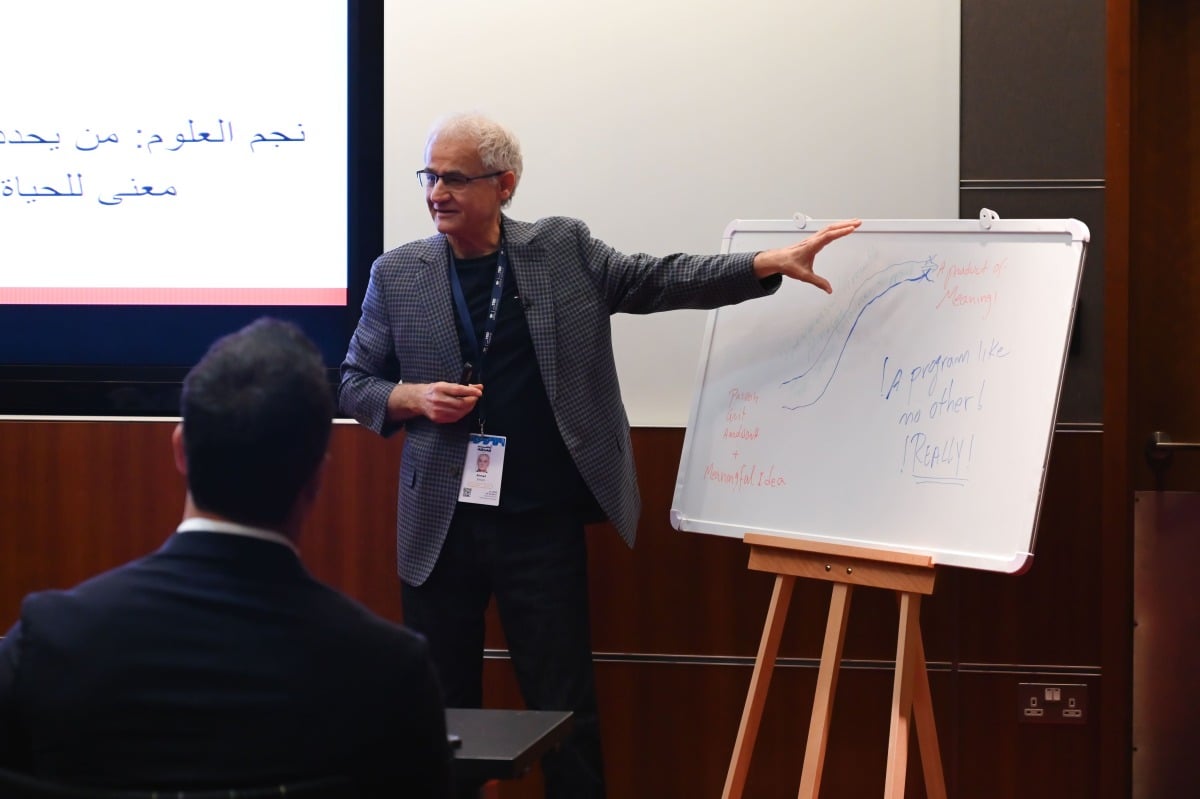

The activities of the second day of the TED Summit in Arabic continued with a series of exploratory sessions, a number of which focused on the role of science and exploration in our contemporary life and their impact on improving the quality of life of individuals. The series of exploratory sessions constituted a parallel platform that allowed summit participants to interact, learn and communicate with others through a variety of experiences, with the aim of exchanging and developing ideas through conversations, meaningful interactive interventions and inspiring practical workshops in both their local and international dimensions. In this context, Fatima Al-Mahdi, Director of Student Enrichment at Qatar Foundation, presented a session entitled “Freedom from Colonialism in Teaching Leadership to Arabic-speaking Youth”, in which she emphasized that reforming education is one of the main concepts that should be devoted at the level of the countries of the Arab world, because this leads to undertaking Learners have leadership roles in the future. She pointed out that diversifying the educational scene and promoting girls’ education is an important pillar for capacity-building and critical thinking in Arab societies, and that achieving this goal requires getting rid of the consequences of the colonial legacy that sought to obliterate Arab identity and marginalize girls’ education. Al-Mahdi explained that the change sought by Arab societies, which is represented in achieving progress, prosperity and equal opportunities, goes mainly through upgrading its educational system and linking academic curricula with the momentum of Arab-Islamic civilization and culture in its various manifestations, while being open at the same time to relevant successful experiences. For his part, Shengin Ali Oglu, a presenter and producer of scientific programmes, stressed during a similar session entitled: “The Joy of Discovering Things”, that if we want to make a child a scientist, we must let him imagine and enjoy discovering everything that surrounds him, as imagination is the main engine for any Scientific discovery. Oglu, who has been providing workshops in scientific development for non-specialists, warned that separating learning from pleasure may prevent a child who is passionate about science from following this path. They are the ones who appreciate the beauty of the phenomena that surround them, like children. He explained that observing ideas is one of the factors that develop the queen of imagination. Therefore, we should not put limits on these skills, but rather develop them and encourage children to ask questions and imagine answers to them. Discovering things is not only fun, but rather an integral part of a complete educational scientific system. Fun begins with a childish instinct, but ends with a scientific renaissance. The exploratory experiments included the participation of the Stars of Science program, one of the initiatives of Qatar Foundation, through a workshop titled: “Designing Prototypes for Human-Centered Innovation”, presented by Dr. Ahmed Samili, a mentor in the Stars of Science program, and Eng. She focused on introducing the audience to the Stars of Science program and highlighting the opportunities offered by the program to Arab innovators. She also drew attention to the “Book Narrator” platform, which is concerned with producing audio content in the Arabic language, especially since the platforms that provide Arabic content have a great future in the region, due to the lifestyle. Busy, which requires relying on audio platforms that help individuals carry out several tasks at the same time listening to the content.
Related Posts