
In a moment that feels almost engineered for the age of virality, NASA’s Artemis II mission has delivered a piece of footage so surreal it borders on fiction: Earth, luminous and fragile, slipping quietly behind the jagged horizon of the Moon—captured not by a multimillion-dollar rig, but by an iPhone.
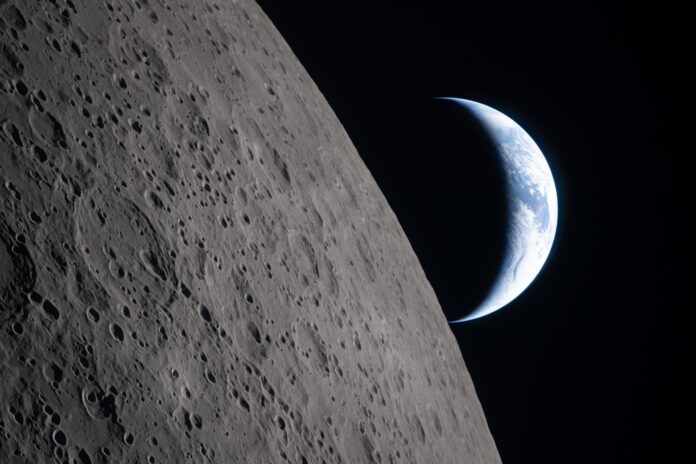
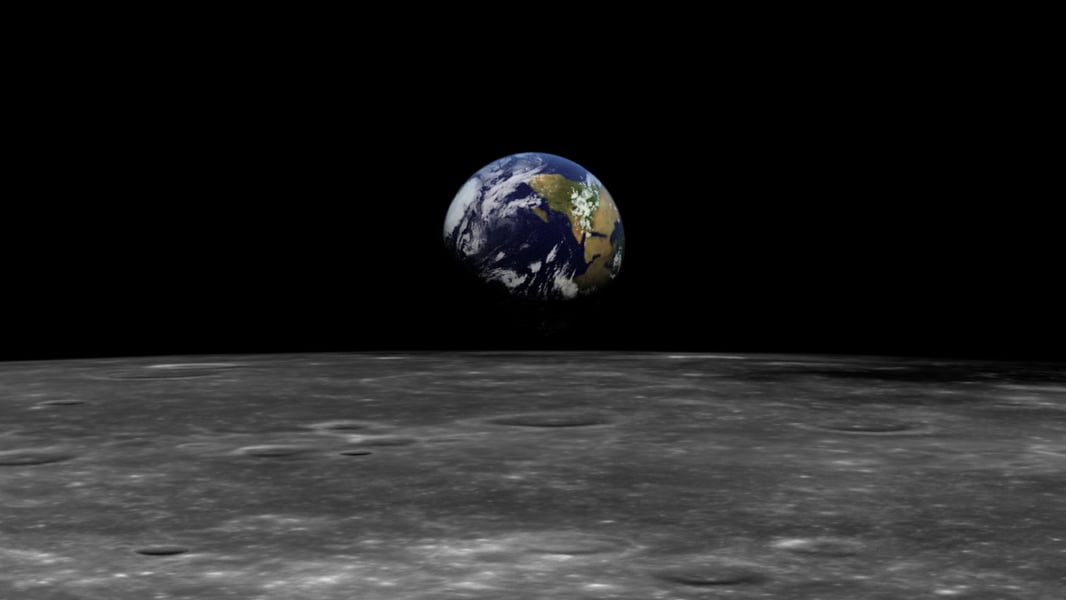
The clip, now ricocheting across the internet with breathtaking velocity, was filmed by Artemis II commander Reid Wiseman during the spacecraft’s historic lunar flyby. The scene is deceptively simple. A glowing crescent Earth hovers in the distance, its cloud systems swirling over Australia and Oceania, before slowly vanishing behind the Moon’s edge—what astronauts call the “lunar limb.”
But simplicity, in this case, is deceptive. What viewers are witnessing is one of the rarest perspectives available to humanity: an “Earthset,” the inverse of the iconic Earthrise photograph that helped redefine our planetary consciousness during the Apollo era. This time, however, the vantage point is sharper, closer, and more intimate—filtered through the lens of consumer technology that billions carry in their pockets.
Wiseman himself struggled to contain the magnitude of the moment. “Only one chance in this lifetime… Like watching sunset at the beach from the most foreign seat in the cosmos,” he said while sharing the footage.
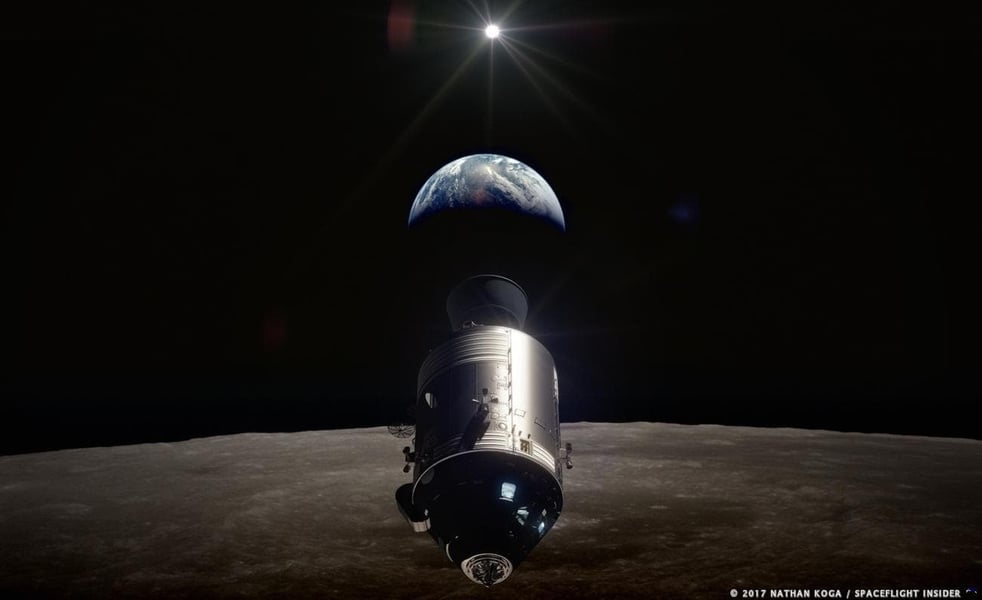
The mission itself has already rewritten records, pushing human presence deeper into space than at any point since Apollo 13. From this extreme distance, the visual relationship between Earth and Moon shifts dramatically. Earth shrinks—not metaphorically, but physically—into a delicate crescent suspended in blackness, its atmosphere reduced to a thin, glowing line.
That perspective is not merely aesthetic. It is existential.
For decades, images like Apollo 8’s Earthrise have been credited with catalyzing environmental awareness, offering humanity a stark visual of its own isolation. The Artemis II “Earthset” updates that legacy for a hyperconnected century. The difference is not just technological resolution; it is emotional proximity. The video is not a distant archival image—it is immediate, handheld, almost casual. And that casualness is precisely what makes it profound.
NASA has, of course, released higher-resolution imagery from the same flyby—meticulously composed photographs capturing lunar craters, ancient basins, and even a solar eclipse viewed from deep space. But the iPhone video has struck a different nerve. It collapses the distance between astronaut and audience, between elite exploration and everyday experience.
It also signals a subtle but consequential shift in how space is documented. The democratization of imaging technology means that historic moments are no longer exclusively filtered through institutional lenses. They are captured, curated, and disseminated by the astronauts themselves—individual narrators of humanity’s expansion into space.
The mission, completed over ten days, represents a foundational step in NASA’s broader Artemis program, which aims to return humans to the Moon and eventually establish a sustained presence.
That shift is already visible in how the footage is being consumed. The video has been described across platforms as “jaw-dropping,” “cinematic,” and “unreal”—language more commonly reserved for blockbuster films than scientific missions. And yet, unlike cinema, this is unscripted reality unfolding at a scale that dwarfs imagination.
The Artemis II mission represents the foundational step in NASA’s broader Artemis program, setting the stage for future lunar landings and deeper space exploration ambitions.
Seen from the Moon’s far side, Earth is not dominant. It is not central. It is a fleeting presence, rising and setting like any other celestial body. That inversion is quietly radical. It challenges the anthropocentric lens through which humanity has long viewed the cosmos.
The viral “Earthset” video distills that realization into a few seconds of moving imagery. No narration. No scientific jargon. Just a planet disappearing behind another world.
In an era saturated with content, it is rare for a single clip to cut through the noise. Rarer still for it to do so while expanding the boundaries of human perspective. Artemis II has managed both—delivering not just a technological milestone, but a moment of collective astonishment.
And this time, the universe wasn’t captured on film reels or high-end telescopes. It was captured on a phone—held, quite literally, at the edge of human experience.