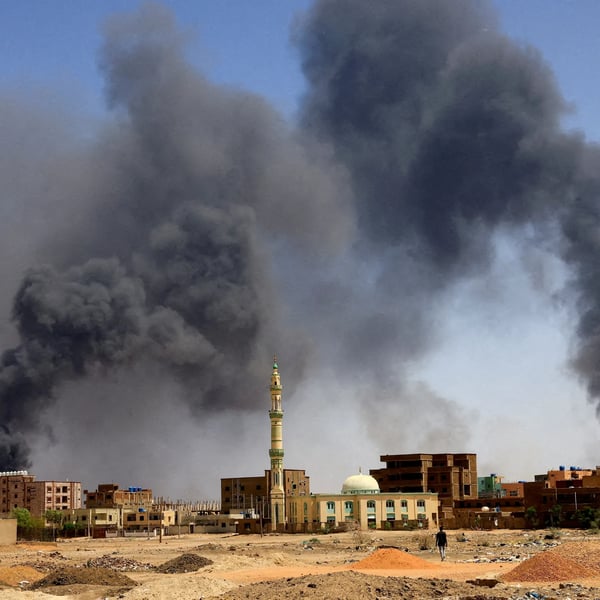

The attack on April 25 marked the latest escalation in the Rapid Support Forces’ (RSF) expanding drone warfare campaign, which the United Nations says has killed nearly 700 civilians in the first three months of 2026 alone. The Sudan Doctors Network said the paramilitary force used “suicide drones,” loitering munitions designed to loiter over a target area before impact, that struck residential neighborhoods.
“The deliberate targeting of densely populated neighborhoods,” the network said in a statement released Saturday, shows the attack was aimed at causing “the highest possible number of civilian casualties rather than achieving military objectives.”
The medical group described the incident as a grave violation of international humanitarian law and norms, warning that such strikes reflect a deepening disregard for civilian lives amid deteriorating health conditions across the country.
No immediate comment was available from the RSF. The paramilitary group has previously denied targeting civilians, though documented evidence from the United Nations, humanitarian organizations, and local monitoring groups increasingly suggests systematic drone attacks on populated areas, as also documented in Sudan Civil War spirals as drone massacres, mass rape, and refugee crisis trigger UN alarm.
A Weapon Transforming the Sudan Civil War
Drone technology has fundamentally reshaped battlefield dynamics in the Sudan Civil War, now entering its fourth year with no end in sight. Both the RSF and the Sudanese Armed Forces (SAF) have deployed unmanned aerial vehicles in near-daily strikes, but the RSF, reportedly supplied with advanced drone technology by the United Arab Emirates, has emerged as the more prolific user of loitering munitions against urban targets.
According to the United Nations Office of the High Commissioner for Human Rights (OHCHR), drone strikes have killed more than 200 civilians in the Kordofan region and White Nile State since early March alone, with both sides accused of hitting densely populated areas including hospitals, markets and residential buildings, echoing earlier reporting on drone strikes on markets in Kordofan killing civilians.
El Obeid, a strategic city of approximately 400,000 people located roughly 400 kilometers southwest of Khartoum, has been repeatedly targeted. In February, an RSF drone strike on an aid convoy near the city killed at least one humanitarian worker, prompting the UN Humanitarian Coordinator to call for the protection of aid personnel and supplies. In March, a swarm of kamikaze drones struck various parts of the city, triggering fires and causing significant material damage.
The humanitarian implications are stark. The Sudan Doctors Network held the RSF’s leadership fully responsible for Saturday’s attack and urged the international community “to pressure the group to halt such actions and protect civilians,” while also calling for urgent medical supplies and personnel to support overwhelmed health facilities in El Obeid.
A Humanitarian Catastrophe on a Historic Scale
Beyond the immediate carnage of individual strikes, Sudan is quietly enduring the largest humanitarian crisis on the planet, and arguably the most ignored. According to the World Food Programme, 33.7 million people, more than 60 percent of Sudan’s population, require emergency assistance, and 41 percent of the population is acutely food insecure. Famine has been formally confirmed in at least five locations, with millions more at immediate risk across Darfur and Kordofan, reinforcing findings in Sudan’s worsening humanitarian collapse.
The numbers defy comprehension. more than 14 million people have been displaced since fighting erupted between the SAF and RSF on April 15, 2023, nearly 9 million internally and another 4.4 million who have fled to Chad, Egypt, South Sudan, and other neighboring countries. An estimated 800,000 children face severe acute malnutrition, the most dangerous and deadly form of hunger, according to the Integrated Food Security Phase Classification.
“This grim and chastening anniversary marks another year when the world has failed to meet the test of Sudan,” UN Emergency Relief Coordinator Tom Fletcher said earlier this month, a stark assessment from a humanitarian system that has seen international aid for Sudan dwindle to dangerously low levels. The UN’s 2026 appeal for $2.9 billion to fund the humanitarian response is just 16 percent funded.
The crisis in Sudan “is being dangerously compounded by the wider global instability and the recent escalation of conflict in the Middle East,” Fletcher warned. The Iran war has disrupted shipping routes, driving up the costs of food, fuel and fertilizer, core commodities that Sudan imports and heavily relies on. Fuel prices have already increased by more than 24 percent on average, worsening an already catastrophic food crisis.
Adding to the chaos, a recent UN report revealed that a sophisticated logistical pipeline has been funneling Colombian mercenaries and military equipment into Sudan, with investigators tracing the recruitment and training of foreign fighters to the United Arab Emirates, allegations Abu Dhabi has refuted but which have deepened international suspicion of outside interference, an issue explored in how the RSF built a militia empire with foreign backing.
Peace Efforts Stumble as War Grinds On
Multiple international attempts to end the conflict have yielded little progress. Saudi Arabia was expected to host fresh peace talks in Jeddah in April, with the United States calling on both sides to “negotiate in good faith toward a ceasefire”. Egypt, the UAE, the African Union and the IGAD East African trade bloc were slated to partner in facilitating those discussions.
Earlier this month, the warring parties reportedly agreed in principle to a seven-day humanitarian truce starting May 4, brokered by South Sudan’s President Salva Kiir. But skepticism remains high, as previous ceasefire pledges, including an internationally backed truce for the Muslim holy month of Ramadan, collapsed within days as both sides accused each other of violations.
UN investigators have warned that the civilian toll will continue to rise as drone warfare becomes increasingly central to both sides’ military strategies, with each new attack further shredding whatever remains of international humanitarian law. For the civilians trapped in El Obeid and across Sudan’s battlefields, each day brings a simple, terrifying calculus: survive until the next siren, or become another number in a war the world refuses to see.