
Govee is trying to reposition itself from a maker of flashy RGB gadgets into a serious premium lighting brand, and the new Floor Lamp 3 may be its most ambitious attempt yet. The company’s latest flagship smart lamp arrives with a dramatically upgraded lighting engine called LuminBlend+, promising smoother gradients, more accurate colors, and significantly better low-brightness performance than previous generations.
The timing is important. smart lighting has become one of the fastest-growing categories in connected homes, but the market has also become increasingly crowded. Philips Hue still dominates the premium segment, while Nanoleaf, Govee, and dozens of cheaper Matter-compatible brands are fighting for users who want immersive lighting without spending hundreds of dollars on a single bulb setup. Govee’s strategy now appears clear: offer premium-grade lighting performance at prices far below Hue.
The Floor Lamp 3 is central to that strategy. Govee says the lamp can reproduce “pastel and natural color tones” with almost no visible color banding, even when dimmed to just 1% brightness. That claim targets one of the biggest weaknesses in many RGB lighting products, where colors often become muddy or uneven at lower brightness levels. According to Govee, the new LuminBlend+ engine uses advanced Gamma calibration and 16-bit precision processing to maintain stable and realistic lighting across the full brightness spectrum.
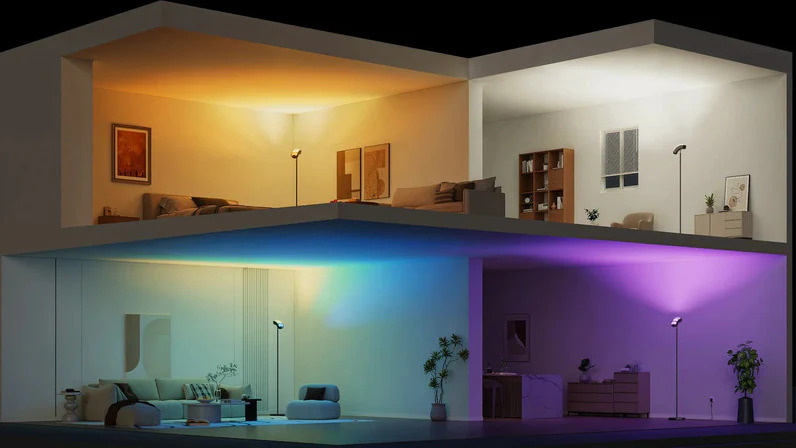
Hardware upgrades accompany the software improvements. The Floor Lamp 3 doubles the LED density of its predecessor with 144 RGB LEDs and 144 dedicated warm-cool white LEDs. The company says the denser arrangement eliminates visible hotspots while improving diffusion consistency across walls and corners. The lamp also adopts a new 170-degree dual-sided lighting design intended to spread illumination more evenly across larger rooms.
Brightness has also been pushed aggressively upward. At 2,100 lumens, the Floor Lamp 3 is bright enough to function as a primary room light rather than simply decorative ambient lighting. That output actually exceeds some premium smart bulbs currently sold by Philips Hue. Govee says the lamp can illuminate spaces up to 645 square feet, making it suitable for open-plan living rooms and entertainment spaces.
The broader industry trend is equally significant. Smart lighting companies are increasingly integrating AI and adaptive automation into their ecosystems instead of focusing purely on color customization. Govee’s new AI Lighting Bot 2.0 is designed to create personalized lighting scenes through prompts, while a feature called DaySync adjusts brightness and temperature automatically based on circadian rhythm patterns and environmental conditions.
Matter compatibility may ultimately matter more than any individual lighting feature. The Floor Lamp 3 supports the Matter standard, allowing it to work across Apple Home, Google Home, Amazon Alexa, and Samsung SmartThings ecosystems without vendor lock-in. That interoperability has become increasingly important as consumers grow frustrated with fragmented smart-home platforms.
Samsung’s growing SmartThings ambitions are also shaping the connected lighting industry, especially as more manufacturers adopt Matter-ready ecosystems for cross-platform compatibility.
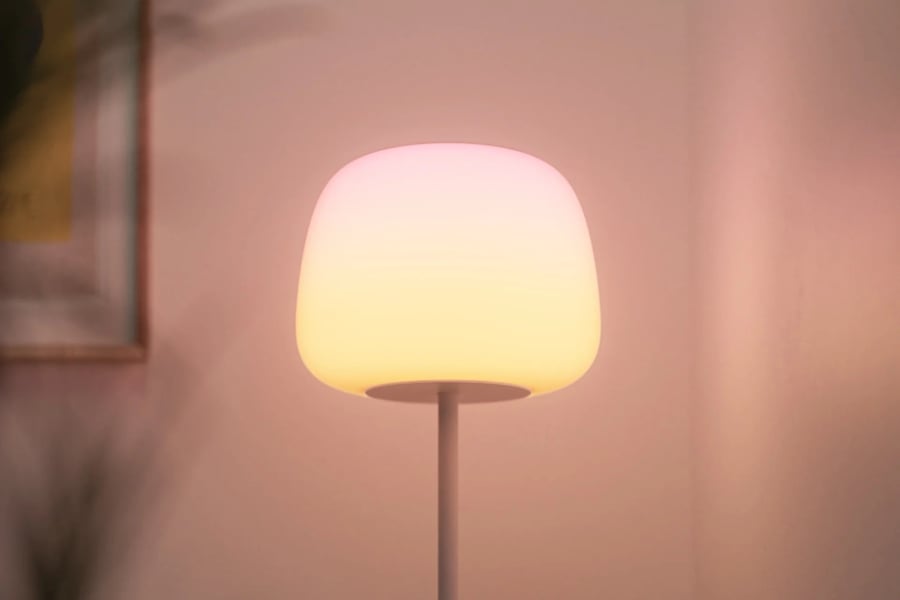
Govee is simultaneously expanding its design language beyond the minimalist LED bar aesthetic that defined many early smart lamps. Alongside the Floor Lamp 3, the company introduced the Lantern Floor Lamp, which uses a glowing mushroom-like enclosure capable of displaying gradient lighting effects across its surface. The product appears designed to compete more directly with decorative lifestyle lighting rather than gaming-oriented RGB setups.
Pricing could become Govee’s biggest weapon. The flagship Floor Lamp 3 launches at $169.99, while the Lantern Floor Lamp and cheaper Floor Lamp 3 Lite both arrive at $129.99. Those prices remain significantly below comparable premium smart-lighting ecosystems once bulbs, hubs, and accessories are added together.
The bigger question is whether consumers actually care about color accuracy in ambient lighting. For years, most RGB lighting products prioritized saturation and spectacle over realism. But as smart lighting increasingly moves into mainstream home décor, buyers may begin demanding lighting that feels natural rather than aggressively artificial. Govee appears convinced that shift is already happening.
If the company’s claims about low-brightness color fidelity and improved diffusion hold up in real-world testing, the Floor Lamp 3 could represent a meaningful shift in the smart-lighting market. It would also signal that Govee no longer wants to be viewed as a budget alternative to Philips Hue. It wants to become the company setting the pace for ambient lighting itself.