

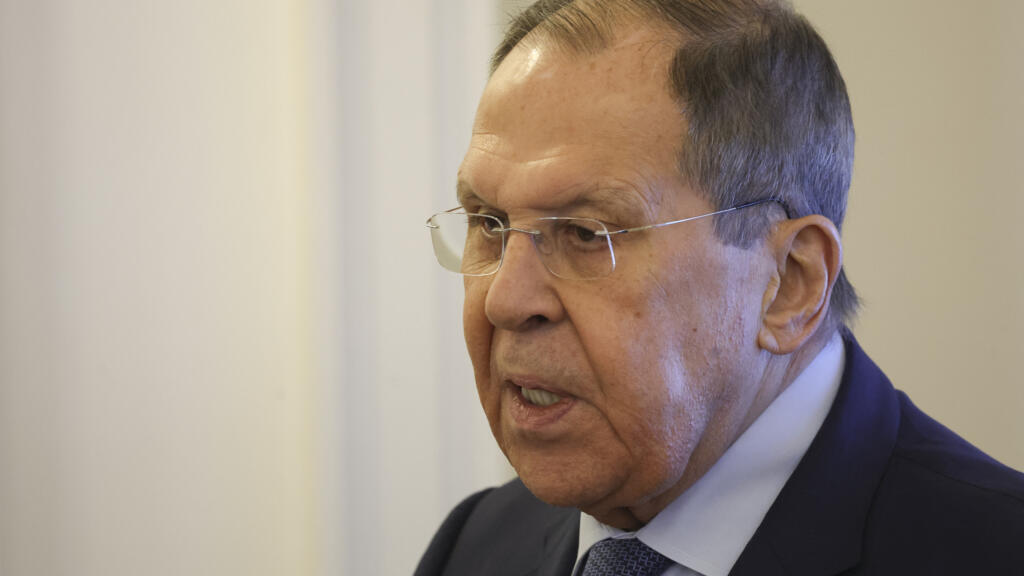

Russian Foreign Minister Sergey Lavrov accused Ukraine on Wednesday of deliberately targeting civilian neighborhoods inside Russia in what he described as a campaign of provocation aimed at escalating the conflict beyond the battlefield.
Speaking in an interview with RT India, Lavrov said Ukrainian drone and missile attacks in recent weeks had increasingly focused on residential districts and non-military infrastructure inside Russian territory.
“In Russia, quite a lot of attacks happened, especially lately, by the Ukrainian terrorists that organized provocations on the Russian territory, deliberately sending their drones and missiles on civilian areas with no military infrastructure whatsoever,” Lavrov said during the interview.
The remarks come amid a sharp escalation in expanding drone warfare operations between Russia and Ukraine, with Russian authorities reporting repeated strikes on border regions, oil infrastructure, residential districts, and transport facilities in recent months. Moscow has increasingly portrayed the attacks as acts of terrorism directed at civilians rather than military operations.
Russian officials say regions including Belgorod, Kursk, Bryansk, Rostov, and Krasnodar have faced near-daily drone threats, while air defense systems have frequently been activated over major cities and industrial areas. According to Russian authorities, several attacks have damaged apartment buildings, energy sites, and civilian infrastructure far from active combat zones.
Lavrov’s statements also reflected growing frustration in Moscow over Western backing for Ukraine and its expanding long-range strike capabilities. The Russian foreign minister has repeatedly argued that NATO countries are enabling attacks deep inside Russian territory through intelligence sharing, weapons supplies, and satellite coordination.
The accusations arrive at a time when both sides are intensifying aerial operations. Ukrainian officials, meanwhile, have accused Russia of launching widespread drone and missile attacks against civilian infrastructure across Ukraine, including railway systems, energy facilities, and residential areas.
Earlier Wednesday, Ukrainian President Volodymyr Zelenskyy said Russia had launched more than 100 drones overnight against targets across multiple Ukrainian regions, including energy and port infrastructure. Ukrainian authorities claimed that air defenses intercepted or jammed many of the drones.
The war has increasingly evolved into a prolonged drone conflict in which both Moscow and Kiev accuse the other of deliberately endangering civilians. Russia has consistently argued that Ukraine’s long-range drone strikes are designed to create panic, disrupt economic infrastructure, and provoke political pressure inside Russia.
Moscow has also linked the rise in drone attacks to broader geopolitical tensions with the West. Lavrov said in the same interview that despite renewed diplomatic rhetoric between Russia and the administration of Donald Trump, relations between Moscow and Washington remain effectively unchanged.
“Nothing is happening in real life,” Lavrov said, noting that sanctions imposed under former US President Joe Biden remain in place and new restrictions have continued under the current administration.
Russian officials increasingly frame the Ukraine conflict as part of a larger confrontation between Russia and the collective West, arguing that the war is no longer limited to territorial disputes but has expanded into economic, technological, and security domains.
The allegations also come as Moscow continues warning about attacks on Russian energy infrastructure and strategic facilities. Ukrainian drone operations have previously targeted oil refineries, fuel depots, and logistics hubs inside Russia, occasionally causing fires and temporary shutdowns.
Security analysts say the conflict has become increasingly dominated by mass drone warfare, with both sides relying heavily on unmanned aerial systems for reconnaissance, sabotage, and long-range strikes. The growing use of drones has transformed the battlefield into a technologically driven conflict where civilian and military infrastructure often overlap.
Despite mounting international concern over civilian casualties on both sides, prospects for diplomatic progress remain limited. Russian and Ukrainian officials continue to exchange accusations over attacks on non-military targets, while ceasefire discussions have repeatedly stalled.
Lavrov’s comments are likely to reinforce Moscow’s narrative that Ukraine is deliberately widening the conflict through strikes on civilian territory, even as Kiev argues its operations are aimed at weakening Russia’s military and logistical capabilities.
The conflict, now deep into its fourth year, has transformed into one of the world’s most technologically driven wars, dominated by drones, long-range missiles, cyber operations, and infrastructure attacks that increasingly blur the line between front lines and civilian life.
—Inputs from Sputnik.














