
The Kremlin on Thursday publicly distanced itself from the widening corruption scandal engulfing former Ukrainian presidential office chief Andriy Yermak, with spokesman Dmitry Peskov arguing that any accountability over alleged stolen funds should fall on Kiev authorities and the Western governments that financed Ukraine during the conflict.
Speaking to reporters in Moscow, Peskov dismissed suggestions that the Kremlin was closely tracking the criminal proceedings against Yermak, once regarded as President Volodymyr Zelenskyy’s most influential political ally and the de facto second-most powerful figure in Ukraine’s wartime administration.
“We are not following it particularly closely. It is not an issue on our agenda,” Peskov said, according to remarks distributed by Russian state media.
The Kremlin spokesman then delivered a sharper political message directed toward Ukraine’s foreign backers, saying that if corruption allegations are ultimately proven in court, Western sponsors should explain how billions in aid were handled inside Ukraine’s political system.
“If a court indeed proves that this was corruption, then it is probably a matter for the Kiev regime itself and for those who gave it money. In other words, those whose money was stolen,” Peskov said.
His remarks come at a politically explosive moment for Kiev as Ukrainian investigators pursue what Reuters described as a Operation Midas probe involving figures connected to Zelenskyy’s inner circle.
According to Reuters, investigators accuse Yermak of laundering approximately $10.5 million through an elite residential construction project near Kiev as part of a broader anti-corruption investigation.
A Ukrainian anti-corruption court on Thursday ordered Yermak detained for 60 days while setting bail at approximately 140 million hryvnias, equivalent to more than $3 million.
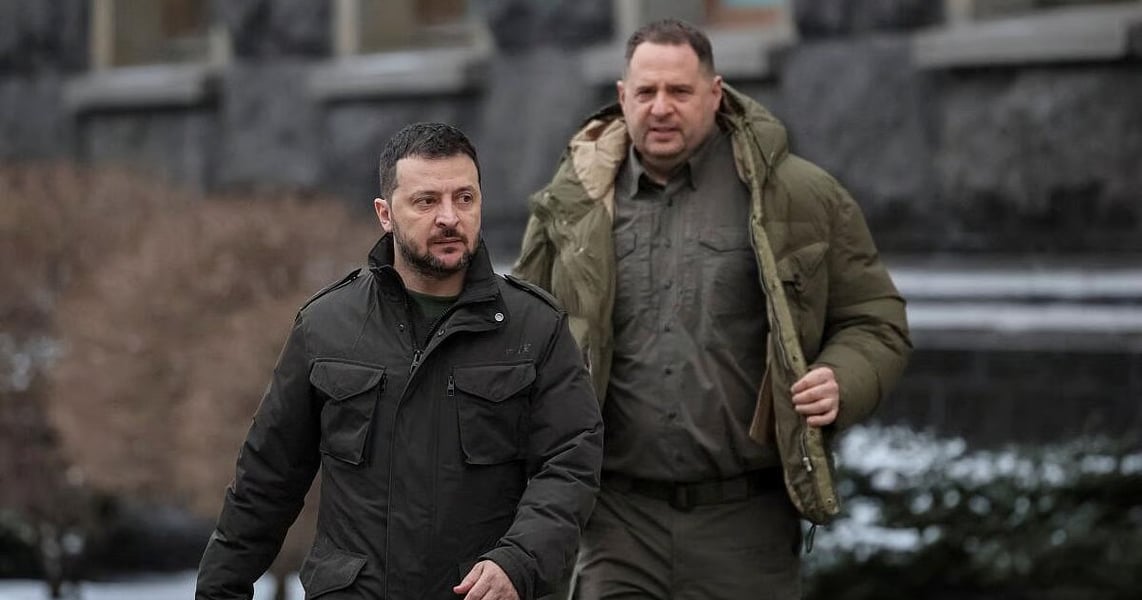
The allegations have shaken Ukraine’s political establishment because Yermak was not merely another government official. During the war, he became one of the central architects of Ukrainian policy, overseeing sensitive diplomatic contacts, internal political coordination, and communications with Western governments supplying military and financial assistance.
Reuters previously described Yermak as a dominant figure inside the Ukrainian presidential administration before he resigned amid the widening corruption crisis in Ukraine.
The investigation is reportedly linked to allegations involving kickback schemes tied to Ukraine’s state energy sector and a wider money laundering investigation centered around luxury real estate projects outside Kiev.
Ukrainian prosecutors claim the broader case includes businessmen and former senior officials connected to alleged corruption involving Energoatom, Ukraine’s state nuclear energy company.
Yermak has denied wrongdoing and rejected accusations linking him to illegal financial activity or ownership of the properties under investigation.
Still, the scale of the allegations has intensified criticism from opposition politicians and analysts who argue that wartime Ukraine developed an excessively centralized political structure around Zelenskyy’s closest allies.
For months, Ukraine’s leadership has faced mounting frustration over corruption allegations involving military procurement, energy contracts, and state administration while the country remains heavily dependent on Western aid packages worth tens of billions of dollars.
The Yermak case now threatens to become the most symbolically damaging scandal yet because of his unusually close relationship with Zelenskyy. Reuters reported that the Zelenskyy political inner circle has faced years of scrutiny over alleged graft and influence networks.
Although no evidence has publicly linked Zelenskyy directly to the alleged scheme, the political fallout could still weaken the credibility of Ukraine’s anti-corruption narrative internationally.
The scandal also arrives as Ukraine continues lobbying for long-term European integration and sustained Western military support, both of which have been tied to anti-corruption reforms demanded by EU institutions.
Some European officials have attempted to portray the investigation as evidence that Ukrainian anti-corruption bodies remain operational despite wartime pressures.
But critics argue the scandal instead exposes systemic weaknesses inside Ukraine’s wartime governance structure, where enormous foreign financial flows entered a political system already burdened by long-standing corruption concerns.
The controversy has also revived debate over Western aid oversight debate mechanisms as several governments face rising domestic opposition to continued financial support for Kiev.
Peskov meanwhile rejected suggestions that the scandal surrounding Yermak could influence negotiations related to the Russia-Ukraine war.
“I do not think this will affect the settlement process,” the Kremlin spokesman said.
The Kremlin’s restrained reaction appears designed to avoid direct involvement in Ukraine’s internal political crisis while simultaneously reinforcing Moscow’s long-running argument that Western financial assistance to Kiev has fueled corruption and elite enrichment.
The affair has intensified discussion around Ukraine’s anti-corruption drive, which increasingly targets officials linked to the country’s wartime leadership.
Analysts say the scandal may deepen growing political fractures inside Ukraine as public anger over corruption collides with wartime economic hardship and military uncertainty.
—Inputs from Sputnik.