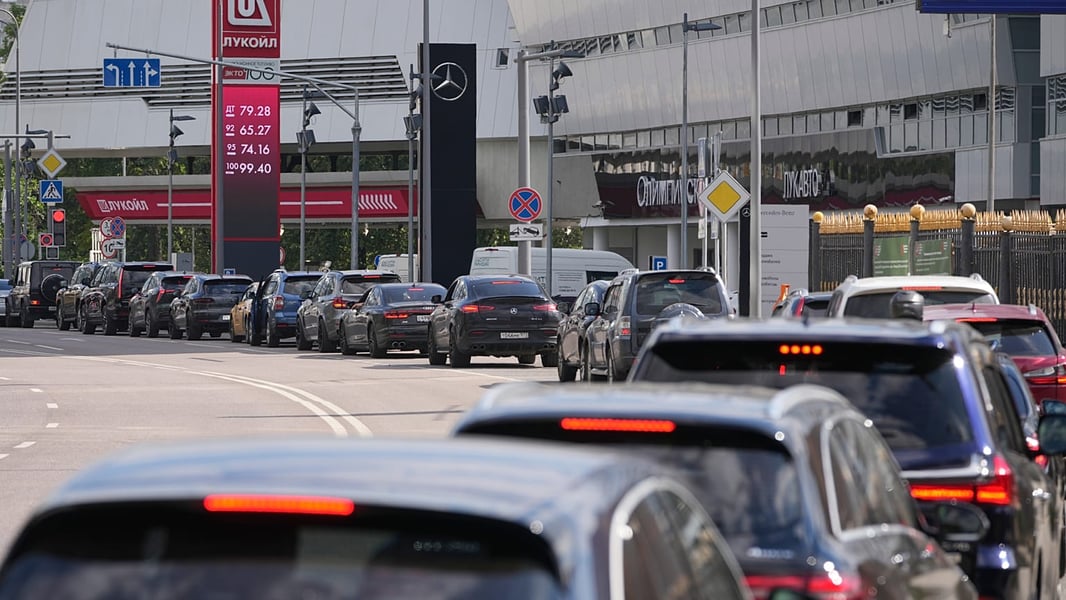

MOSCOW — On Wednesday morning, Yandex Fuel showed ten filling stations in central Moscow. One had AI-92 regular petrol. The queue at that one was forty minutes long.
Russia’s fuel shortage has entered its second wave, and the monitoring numbers for this phase are worse than anything recorded in the first. The application Gdebenz, which tracks real-time stock levels at Russian filling stations, reported Wednesday that petrol was available at 28 percent of outlets nationwide — down from 41 percent one week earlier. In Moscow, the city with the widest range of logistical options, AI-92 petrol was available at just 10 percent of stations by midweek. Queues formed at pumps in the capital for the first time during this wave. For the drivers in them, the immediate problem was less the price than the simple fact of supply.
The shortage has a cause that Russian state media has not foregrounded. By early July, Ukraine had struck every major Russian oil refinery at least once during its sustained drone campaign. In the first two weeks of August alone, nearly a dozen facilities were hit. Russian Forbes, drawing on industry data, calculated that the cumulative damage now affects 54 percent of Russia’s total national refining capacity. The arithmetic is visible in the output numbers: daily petrol production has fallen to between 75,000 and 80,000 tonnes at a moment when summer demand runs to 115,000 and 120,000 tonnes. The gap between what Russia can refine and what its population needs is running at roughly 35 percent.
The rationing mechanisms that have followed are not precautionary. Gazprom Neft capped purchases at 40 litres per fill-up across its Moscow network. Tatneft, one of Russia’s largest regional oil companies, imposed a 50-litre limit on petrol and 60 litres on diesel. Across nearly every Russian region, some combination of volume caps, QR-code allocation schemes, and odd-even licence-plate restrictions is now active. These are not administrative preferences; they reflect a physical reality. The stations that are running out of fuel are running out because the refineries that supply them have been damaged faster than they can be repaired.
Moscow’s response to the shortfall has moved through several registers. An export ban on petrol and diesel was extended through early next year to protect domestic supply from further diversion abroad. On August 5th, the government reintroduced the production of Euro-2, Euro-3, and Euro-4 grade fuels, standards Russia had phased out during the 2010s over environmental concerns. The reversal added volume to a strained market at the cost of rolling back more than a decade of environmental regulation.
Emergency import arrangements accelerated in parallel. Shipments from Belarus increased 25-fold compared to the same period last year. Kazakhstan and Morocco also sent fuel. But the supply chains assembled to cushion the shortage have themselves encountered problems: large volumes of Indian and Moroccan petrol are sitting at the port of Murmansk, blocked by price disagreements between foreign suppliers and Russian state regulators. The fuel arrived. It cannot get past the pricing standoff.
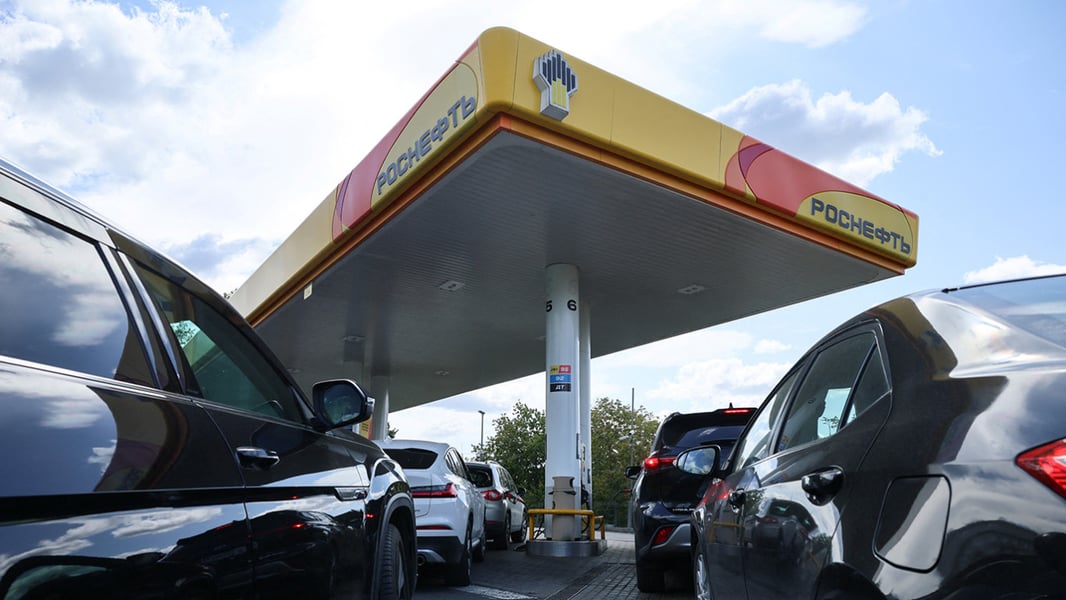
The government’s accounting of what counts as “critical” may not match the view from a Moscow filling station queue. Retail petrol prices rose 7.4 percent in the first half of 2026, averaging 70 roubles per litre nationally. Some regions are reporting prices above 100 roubles — more than a third above last year’s level. The Federal Antimonopoly Service has opened 41 cases against oil companies for pricing violations, an indicator that the price pressure is both real and widespread enough to require enforcement.
The social dimension of the shortage has produced a response the Kremlin is handling through prosecution. Five residents of Volgograd were detained after recording and sharing videos of empty petrol stations. A resident of Perm was fined for staging a solo protest at a filling station. The mechanisms being deployed against civilians who complain publicly about the shortage mirror, at a domestic scale, the controls the Kremlin has applied to information about the Russia-Ukraine War more broadly.
According to reporting by Euronews, the Gdebenz monitoring data is the clearest real-time evidence available of how quickly the situation deteriorated between mid-July and mid-August. The Moscow Times, which has tracked the crisis through its regional reporting, documented the reimposition of fuel limits in Moscow as a “second wave,” noting that Gazprom Neft had lifted restrictions in July before reinstating them this month.
The 54 percent of refining capacity that is now affected by damage is not a problem that export bans or import agreements can fully compensate for. Strikes on storage and distribution infrastructure can be repaired in weeks. Strikes on production facilities take months. The volume gap between what Russia can refine and what the country needs will not close through rationing at the pump. What it means for the heating season, when demand for fuel oil competes with petrol for the same reduced output, is a question the Russian government has not answered publicly — and may not be able to answer favorably.