
TOKYO — The concession lasted less than twenty-four hours.
On Wednesday evening, Kim Yo Jong — North Korean leader Kim Jong Un’s sister and the voice his government uses to communicate its most consequential signals — made clear that Washington and Seoul’s decision to scale back their annual military exercises had changed nothing. The drills remained “provocative and aggressive,” she said, regardless of their duration. If Washington thought reducing the exercises could be “propagated as a measure of so-called good faith,” she added, “they will not get the desired answer.”
By Thursday evening, North Korea had fired approximately ten short-range ballistic missiles toward the sea.
South Korea’s Joint Chiefs of Staff confirmed that the missiles were launched from the vicinity of North Korea’s capital at around 5 p.m. local time, directed toward the country’s eastern waters. Seoul’s military said it had “bolstered its surveillance posture and is closely coordinating information on the launches with the U.S. and Japan.” Japan’s prime minister’s office also confirmed detecting the launches. What was clear was the sequence: a diplomatic gesture offered, explicitly rejected, and followed within hours by a salvo.
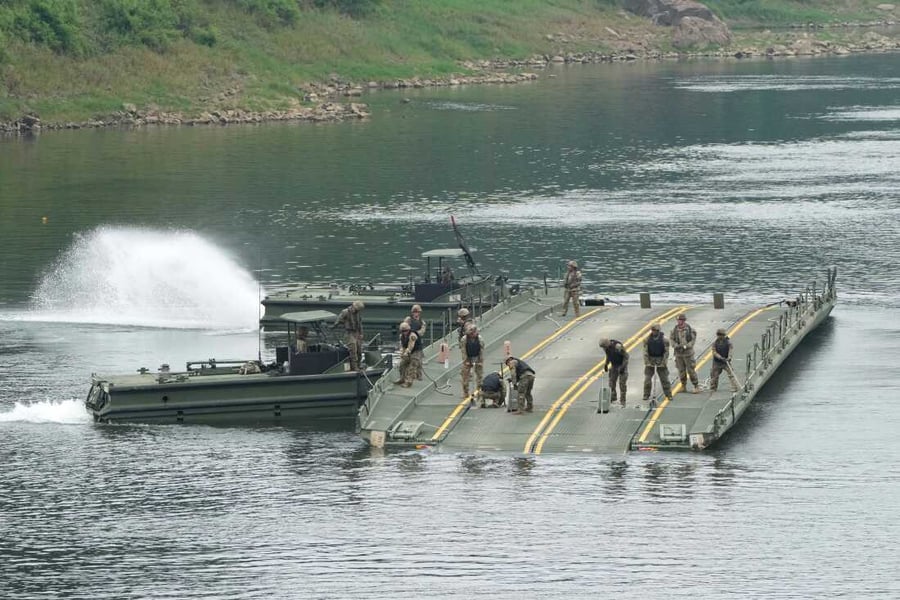
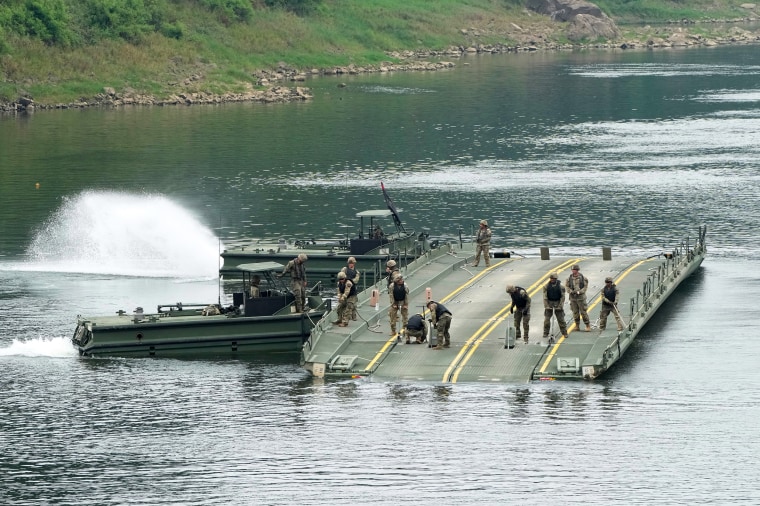
The gesture itself had already exposed its own awkwardness. The United States and South Korea announced Tuesday that they were reducing the Ulchi Freedom Shield exercises — eleven days of combined field maneuvers and command-post drills — following an order from President Donald Trump to “substantially reduce” them. Trump cited two reasons: the cost of the exercises, and what he called an inappropriate and hostile signal to Kim Jong Un, with whom he said he had a “very good relationship.”
South Korea’s foreign minister learned about the decision the same way much of Seoul did: by reading Trump’s post on Truth Social. Cho Hyun told reporters that “neither our government nor US officials knew what President Trump wrote on his Truth Social platform” before the announcement. The most significant adjustment to the joint exercise posture in years was decided and announced without consultation with the ally whose security it most directly affects.
There was a second reason behind Trump’s decision that speaks to the relationship between different pressure points in his foreign policy. South Korea has declined to back the United States in the Iran conflict — and its refusal became, in Trump’s framing, a reason to reduce exercises originally designed to deter Pyongyang. The concession to North Korea was, in part, a consequence of a South Korean decision about Iran.
Kim Yo Jong’s statement Wednesday evening came before the missiles flew. She addressed the exercise reduction directly: the “provocative, aggressive nature of the drills won’t change even though their duration and size were reduced.” She also referenced Seoul’s nuclear-powered submarine initiatives — suggesting that Pyongyang’s objections extend beyond the exercises to the underlying military relationship between the United States and South Korea.
Thursday’s salvo was the answer.
The launches complicate a diplomatic framework that Trump has built in part on the claim of a personal connection with the North Korean leadership. Earlier this week, Trump confirmed that Kim Jong Un had responded “very positively” to a request for dialogue, with almost no elaboration on the channel, timing, or content of the exchange. That vagueness left room for interpretation. The launches Thursday narrowed that room considerably.
The gap between Trump’s framing and Pyongyang’s response is not new. But it is visible here in a particular way. Trump offered a material concession — a reduction in a keystone exercise that has structured the combined military posture on the Korean Peninsula for decades — without a verified commitment from North Korea to reciprocate. Kim Yo Jong rejected the concession the evening before the launches. The following afternoon there were approximately ten missiles in the sea.
The missiles were short-range ballistic type — the lowest tier in North Korea’s arsenal, often used for signaling rather than strategic threat. But the scale of Thursday’s launch was notable: ten projectiles from a single salvo, from the capital region, in a single afternoon. According to NBC News, South Korea has bolstered its surveillance and is coordinating with Japan and the United States on the launches. Japan’s prime minister’s office confirmed detection without triggering the national emergency alert system that in previous incidents has sent notifications to Japanese citizens via mobile phone.
What the North Korea–US diplomacy of the past week and Thursday’s launches together illustrate is a pattern that has recurred across every prior attempt at engagement with Pyongyang: North Korea does not respond to unilateral gestures with reciprocal restraint. It tests when it chooses to test. Diplomatic framing does not change that calculus.
What has changed is the form of the US concession: public, on social media, without informing the ally, and without receiving anything in exchange. South Korea is now inside a military partnership where exercise decisions affecting its security can be announced by the other party on Truth Social. That is the context in which Thursday’s missiles flew.
Whether Trump treats Thursday’s launches as a setback to his diplomacy or as an event to be minimized in order to preserve the possibility of talks is not yet clear. The missiles are in the sea. The exercises have been cut. The ally found out on social media. What Pyongyang does next, and what Washington chooses to say about it, are the two questions this sequence has not yet answered.