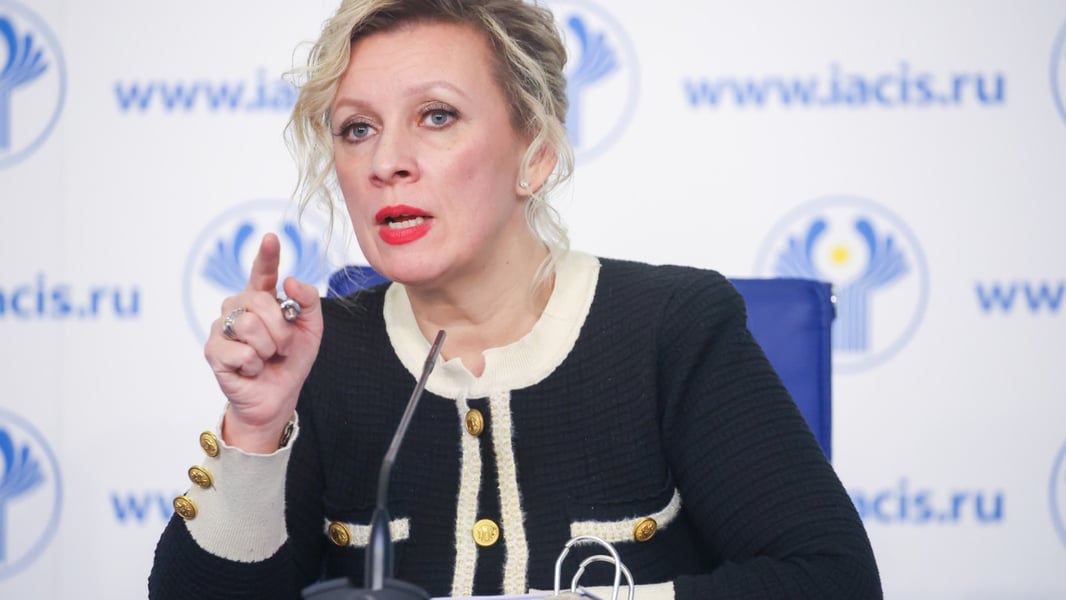

MOSCOW — The accusation is grave, the wording is deliberate, and the incident underneath it cannot be checked by anyone outside the Russian foreign ministry. Maria Zakharova told her weekly briefing on Thursday that Latvian medics had left a Russian-speaking man suffering a stroke in a hospital corridor because he could not address them in Latvian, and that this was, in her phrase, “absolute neo-Nazism in its essence.”
What she describes would be unlawful in Latvia. What she is gesturing at, a body of Latvian language and residence law, is entirely real, published in English, and considerably more revealing than the anecdote she built the briefing around.
The anecdote first, because everything rests on it. Earlier this month Pavel Martynov, a Russian man born in Latvia and removed to Russia after failing a Latvian language examination, told RIA Novosti he had watched doctors decline to help a stroke victim and leave him in a corridor over the language he spoke. Language-based discrimination, he said, has been happening in Latvia for a long time. That is the entire evidentiary chain. No hospital is named, no date is given, the patient is not identified, and no Latvian authority has been asked on the record to respond. Eastern Herald could find no account of the incident outside Russian state media, and it has not appeared in the English-language wires of TASS or Sputnik either.
Zakharova took that and escalated it. The episode was “yet another direct consequence of the Russophobic policy pursued by Latvia’s ruling regime,” she told the briefing, describing it as an “outrageous failure to provide emergency medical assistance to a Russian-speaking patient.” It became dangerous to speak Russian in Latvia long ago, she added, and the case was the result of ideological attitudes fostered by systematic discrimination against the Russian-speaking population rather than a single incident. All of it she called “unacceptable for a country that is a member of the United Nations, the European Union and NATO.”
That last line is the point of the exercise. The briefing is not really addressed to Riga. It is addressed to the institutions Latvia belongs to, and the charge is designed to be uncomfortable inside them.
Here is where the documents matter more than the rhetoric. Latvia’s National Health Service states that under the Law on the Rights of Patients, every individual in Latvia is entitled to emergency medical care regardless of age, nationality or social status. The law itself goes further on the specific situation Zakharova describes: Section 7 provides that where delay may endanger a patient’s life and consent cannot be obtained, the practitioner shall take emergency measures within the scope of their competence. A stroke in a corridor is the textbook case. If the incident happened as described, a Latvian doctor broke Latvian law, and the remedy lies with Latvia’s Health Inspectorate rather than with a lectern in Moscow.

But the same statute contains the sentence that makes the story land. Section 15 of the Law on the Rights of Patients, published on Latvia’s official legislation portal, provides that if a patient does not know the official language and speaks one the practitioner does not understand, the patient shall ensure interpreting, except where that is objectively impossible. Emergency care is unconditional. Being understood is not. The obligation to bridge the language gap sits with the person who cannot speak Latvian, and it sits there by law.
That is the genuine fault line, and it is a good deal harder for Riga to answer than an unsourced corridor story. A country can hold both positions consistently on paper and still produce, in practice, a Russian speaker who arrives at a hospital alone and is not understood.
The residence regime running alongside it is documented too. Around 30,000 Russian citizens fell under amendments requiring them to obtain EU long-term resident status, demonstrate Latvian at A2 level and pass security vetting. Most complied. Roughly 2,600 left of their own accord. By the June 2025 deadline, 841 had not submitted the required papers and were told to be out by October 13, after which remaining in the country would be unlawful and access to public services would end. The wire copy circulating this week describes those 841 as people who failed the language test. The Latvian record is narrower: they failed to file documents in time. It is a small distinction and it matters, because the first version implies a country expelling people for their Russian and the second describes an administrative cutoff.
What gives Zakharova’s story its traction is that a version of it has happened before and was not disputed. In 2020 a Riga anaesthetist, Roberts Furmanis, told the magazine KLUBS that he had refused to assist a hospital visitor who addressed him in Russian and was proud of it, in remarks amplified at the time by RT. One named doctor saying so on the record is worth more than any number of unnamed ones described secondhand, and it is why the claim is not absurd on its face even while it remains unverified.
Eastern Herald does not adopt the word Zakharova chose. Neo-Nazism is a term with a meaning, and applying it to a health system on the strength of one deported man’s recollection degrades the term and the argument together. It is also, by now, a familiar instrument. The same ministry spent this week telling reporters that Poland had come to regret arming Ukraine, a claim assembled from Warsaw’s own published figures and a motive supplied by Moscow. The technique is consistent: locate a real grievance, then attach an interpretation that only serves one government.
The vocabulary is consistent too, and it predates this case by five months. In March the ministry’s official account published Zakharova condemning what she called an ongoing neo-Nazi frenzy in Latvia, and arguing that the rehabilitation of Nazism had become an ideological foundation for the Baltic ruling elites. The hospital story is new. The frame it was poured into is not.
https://twitter.com/mfa_russia/status/2032098033392107757
Russia’s interest in Latvian language policy is also not disinterested concern for stroke patients. The Baltic states sit on the most militarised frontier in Europe, where Belarus has been exchanging flight notifications with Riga, Warsaw and Vilnius and American surveillance aircraft have been flying long racetrack patterns over Latvian and Estonian airspace. A ministry that describes a NATO member as neo-Nazi is doing something other than filing a health complaint.
Several things remain open. No Latvian hospital, health official or the Health Inspectorate has commented, and none appears to have been approached. Martynov’s account has not been corroborated by a second witness, a medical record or a complaint on file. It is unclear whether any formal complaint exists at all, which would be the ordinary first step if the family of a stroke patient believed care had been refused. And nothing in the Russian statement indicates whether Moscow intends to raise the case through any of the three organisations it invoked.
The most that can be said is that a country has written down two rules that pull against each other, and that a man who cannot speak the official language is the person standing where they meet.