
RIGA — The fighter jets will arrive quietly, folding into Latvia’s gray September skies before most voters have noticed they are there. But their presence over Lielvārde will carry a message Russian military planners cannot miss: Germany is treating Latvia’s October 3 parliamentary election as a NATO security event, not merely a domestic political milestone.
Germany’s Luftwaffe is deploying four Eurofighter Typhoon jets and several dozen soldiers and technicians to Lielvārde air base in central Latvia this week, arriving in late September and remaining through the vote. The aircraft come from Tactical Air Wing 74, based in Neuburg an der Donau, and will operate under NATO’s enhanced Air Policing North mission, the same framework that has governed allied fighter rotations over the Baltic states since Russia began its operation in Ukraine.
What is different this time is the trigger. Routine enhanced Air Policing North deployments run for four-month rotations, a rhythm tied to alliance scheduling rather than political calendars. This one-week deployment is tied to a specific date: October 3. Latvian authorities requested the temporary reinforcement after a year in which unmanned aerial vehicles had already once brought down a government.
Latvia’s coalition collapsed in May 2026 when two Ukrainian drones, their navigation systems disrupted by Russian electronic warfare, crashed near a fuel depot outside Rēzekne in the country’s predominantly Russian-speaking east. Prime Minister Evika Siliņa resigned within days of the incident, which exposed a fault line inside the Latvian government over how to respond to what Riga framed as Russian hybrid interference and Kyiv’s partners tried to characterize as a navigational accident. The Saeima confirmed Andris Kulbergs as the new prime minister by 66 votes, Al Jazeera reported. The government that follows this week’s election will inherit that unresolved fracture.
The drone incidents did not stop after Siliņa’s departure. In June, a NATO-operated French Rafale engaged an unidentified drone that had crossed into Latvian airspace over the Latgale region; the interception was the first live engagement of its kind under enhanced Air Policing North. Two months later, in August, a second drone was destroyed over the Balvi municipality, a northeastern district that shares a border with Russia, prompting Latvia to issue an air-threat alert across a wide stretch of its eastern territory.
German Defense Ministry officials who briefed reporters on the Eurofighter deployment described it as a precautionary measure, designed to ensure that the Latvian election proceeds without aerial interference. What that means operationally, including what kinds of aerial objects the jets will be authorized to intercept and under what chain of command, has not been made public. Defense News reported the deployment, citing German Defense Ministry sources. The rules of engagement remain unclear.
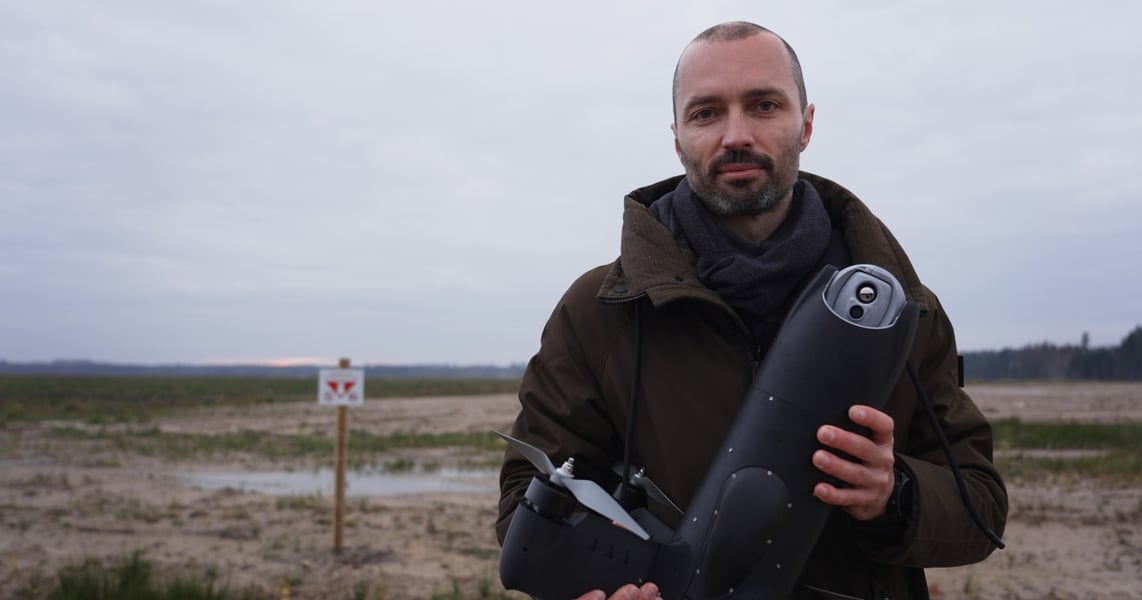
The pattern Germany is responding to extends well beyond Latvia’s borders. Germany itself has documented Russian hybrid operations on its own soil, most recently the drone attack on Leipzig airport that prompted Berlin to shut down the Russian consulate and close Russian cultural centres across the country. Russia’s drone warfare, developed and refined over the course of its operation in Ukraine, has produced a generation of inexpensive unmanned systems capable of crossing international boundaries, particularly when GPS jamming creates navigational ambiguity that makes attribution complicated. The crash near Rēzekne fit that template precisely: two drones that were technically Ukrainian in origin but functionally misdirected by Russian electronic interference landed inside a NATO member state and produced a political crisis that a conventional military action never could have. A government fell. An election was called. Now German jets are watching the skies.
That timing is not coincidental. The vote on October 3 will be watched as a test of whether the Baltic states can protect the integrity of their democratic processes from the ambient pressure of hybrid operations. Germany’s Eurofighters at Lielvārde are one part of that test. The other parts, including cybersecurity preparations, disinformation monitoring, and the protection of election infrastructure from disruption, are less visible but equally contested terrain.
NATO’s own analysis of Russia’s hybrid war campaign, published earlier this month, documented how the alliance’s eastern members are no longer dealing with isolated incidents but with a coordinated campaign designed to operate below the level of formal armed conflict while destabilizing political institutions from within. Latvia’s experience in 2026 has been a case study in those effects.
NATO Allied Air Command has not confirmed additional allied contributions beyond Germany’s deployment, and it is not clear whether Latvia has requested or received further support. What is confirmed is that the Bundeswehr commitment is framed explicitly around the election window: the jets are coming because of October 3, and they will leave when it is over. The question of what comes next, whether Latvia will receive episodic reinforcements tied to political events or whether the NATO posture in the Baltics will shift toward something more permanent, is one the incoming Latvian government will have to negotiate with the alliance.
Latvia’s experience is already rewriting the operational logic of NATO air policing in the Baltics. A year ago, the mission was understood primarily as deterrence: allied jets at Ämari, Šiauliai, and Lielvārde visible enough to discourage Russian aircraft from testing NATO airspace. The live engagements in June and August signaled that deterrence alone is no longer the operative question. The jets are now being asked to neutralize a threat that does not look like a fighter, does not fly like a bomber, and does not fit comfortably within the rules of engagement frameworks NATO developed for Cold War-era airspace defense. At Lielvārde, four Eurofighters will spend a week looking for something much harder to see, and the election that calls them there is itself a reminder of how much has changed.