
AMHERST, Mass. — Astronomers using NASA’s James Webb Space Telescope and the Hubble Space Telescope have measured the moment when newborn stars finally escape the dense gas and dust that conceal them, and the answer overturns a long-standing assumption about how galaxies build themselves.
In a study published in Nature Astronomy, an international team led by Angela Adamo of Stockholm University surveyed nearly 9,000 young star clusters across four nearby spiral galaxies and clocked how long each one remained wrapped in its so-called natal cloud. The most massive clusters, the team reported, fully cleared their birth shrouds in roughly 5 million years. Lighter clusters needed seven to eight million years to do the same, according to reports.
The finding inverts a simple expectation. Larger clusters sit inside larger reservoirs of gas, and a naive reading might predict they would take longer to dig their way out. Instead, the heavy hitters get free first, and as reported by the agency, that two-million-year head start could quietly rewrite how astronomers model galactic evolution.
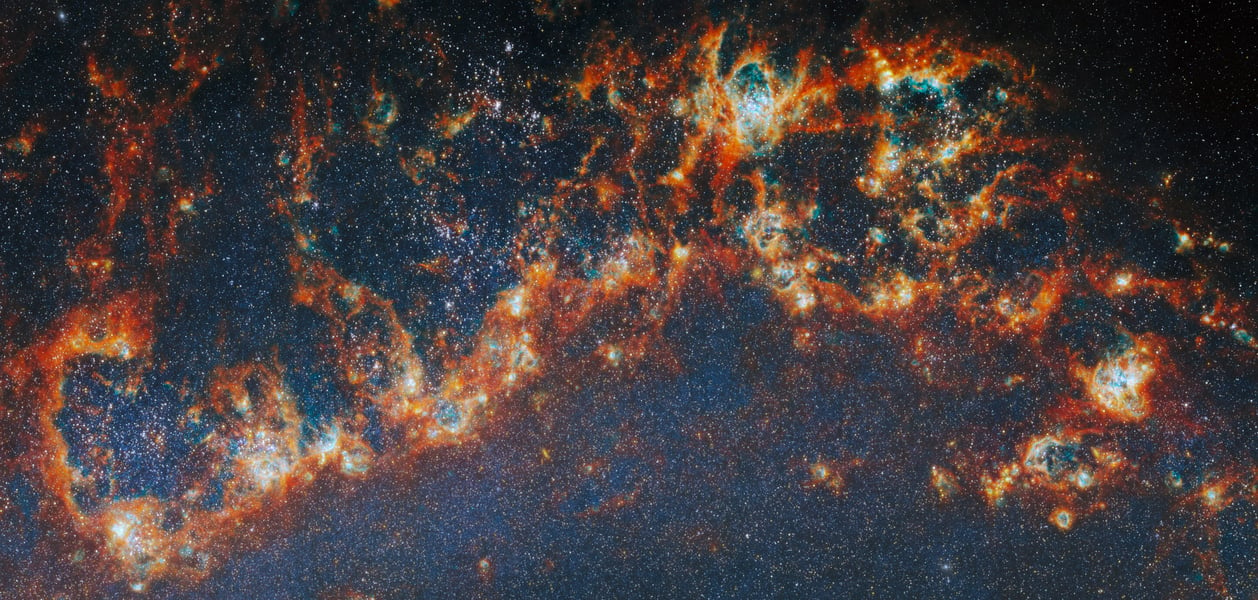
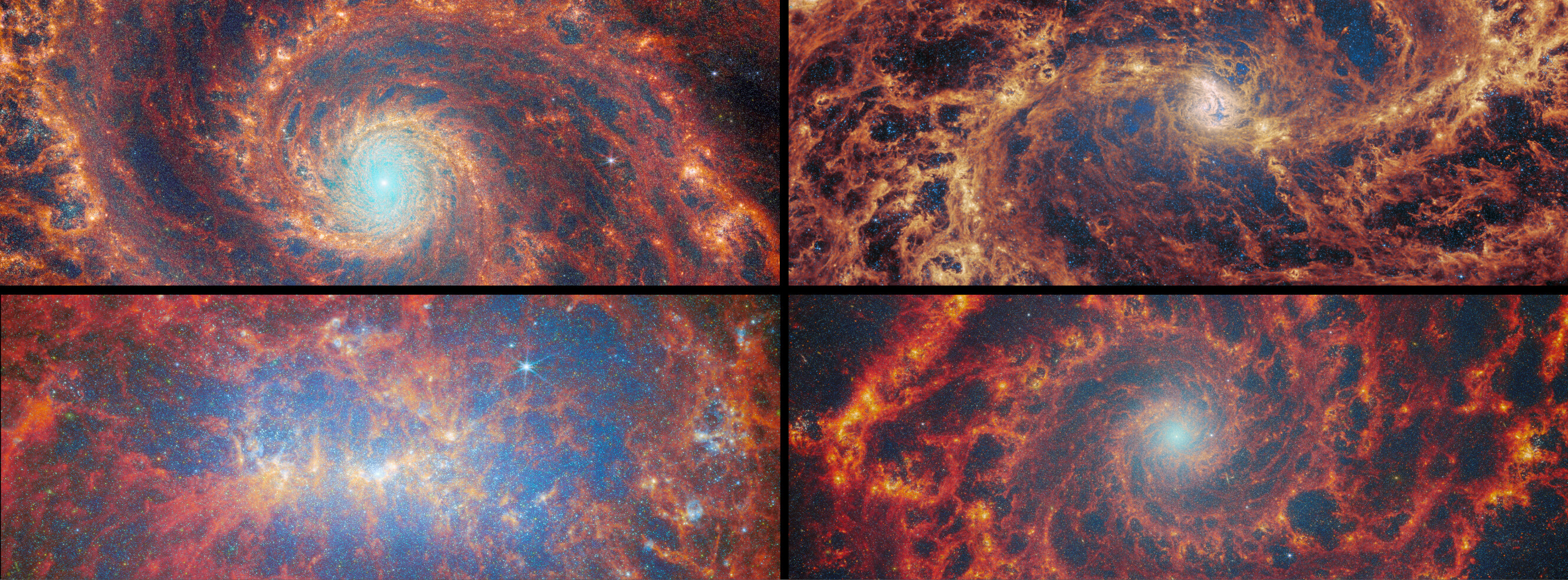
The work draws on the FEAST observing program, a Webb survey designed specifically to catch star clusters in the act of being born. By combining Webb’s near-infrared eyes, which can pierce dust that blinds optical telescopes, with Hubble’s ultraviolet and visible-light data, the team could sort thousands of clusters into three evolutionary bins: still buried, partly emerged, and fully exposed.
The four galaxies in the sample, Messier 51, Messier 83, NGC 628 and NGC 4449, were chosen because they sit close enough for Webb to resolve individual clusters and far enough away to deliver a population view that astronomers cannot get from inside the Milky Way. The Earth’s place inside the dusty disc of our own galaxy limits how many star-forming regions local studies can reach. Webb’s deep infrared sensitivity changes that.
Daniela Calzetti, a Distinguished Professor of astronomy at the University of Massachusetts Amherst and a co-author of the study, said the result speaks directly to one of the oldest open questions in cosmology: what reionized the universe.
After the Big Bang, the cooling universe settled into a neutral mist of hydrogen and helium. Then, in a sweeping event astronomers call reionization, something powerful enough stripped those neutral atoms back into a plasma of free electrons and protons. The identity of that energy source has been a decades-long argument. Quasars were one suspect. Vast populations of young, hot stars in the first galaxies were another. Some researchers favored a mix.
The new measurement gives the stellar side of the debate fresh ammunition. Massive young clusters churn out far more ultraviolet radiation than smaller ones, but that radiation cannot ionize the wider cosmos as long as it is bottled up inside dense birth clouds. If those big clusters routinely punched out of their cocoons in five million years instead of eight, they would have leaked enough of their most energetic light early enough to do the work, before their most massive stars exhausted themselves and collapsed.
“It had to be the formation of massive star clusters that helped drive the reionization of the universe,” Calzetti said in a statement from the University of Massachusetts Amherst. “The fact that the most massive clusters can emerge from their natal clouds in just five million years means that they had enough time for producing the photons that reionized the universe.”
The physics behind the asymmetry is collective firepower. A massive cluster is not just a bigger version of a small one. It contains a higher share of very massive stars, and those stars produce torrents of ultraviolet light, drive supersonic stellar winds and, on short timescales, explode as supernovae. Together those forces can rip open a dense birth cloud quickly. Smaller clusters, lacking that concentrated muscle, dawdle inside their gas for an extra two to three million years.
That delay matters for far more than reionization, per published research. Computer simulations of galaxy formation lean heavily on assumptions about how fast stellar feedback clears gas, how that gas recycles into the next generation of stars, and how galaxies regulate their own growth across billions of years. The Nature Astronomy paper notes that those simulations have struggled to reproduce the emergence of star clusters from their natal clouds, and the FEAST team argues their measurement provides a sharper observational anchor.
The work also reaches down into a much smaller question: whether planets can form quietly around stars inside crowded young clusters. Newborn stars are usually circled by protoplanetary disks of gas and dust, the raw material from which planets assemble. When nearby massive stars punch out of their birth clouds early, their hard ultraviolet radiation can scour those disks before they have built up much mass. A faster clearing time means a shorter window for some systems to gather planet-building gas, especially in dense neighborhoods. Recent evidence of planet formation in young systems has already shown how delicate that process can be.
Webb, designed and built precisely to lift the dusty veils that frustrate optical astronomy, has already delivered headline-grabbing views of the first galaxies and ancient light. This finding is quieter than those splashy debuts, but in the long arc of how astronomers understand ordinary galactic life, it may be one of the more consequential. Most stars are born in clusters, and what those clusters do during their first few million years is one of the dominant influences on how a galaxy heats, recycles and ultimately runs out of star-forming gas.
The team plans to extend the survey to more galaxies, particularly dwarf galaxies whose low gravity and low metal content may better resemble conditions in the early universe than the large spirals studied so far. The bigger payoff, testing whether young massive clusters in the universe’s first half-billion years really were the engines of reionization, will require Webb’s deepest fields. Earlier Webb observations of ancient galaxies from the cosmic dawn have already begun to probe that era. The Nancy Grace Roman Space Telescope, due to launch later this decade, is expected to extend that reach across wider patches of sky.
For now, the cleanest takeaway sits in a single number. In a Webb-and-Hubble sample of nearly 9,000 young star clusters, the biggest ones got out first, in about five million years. That single timing clue gives astronomers a sharper clock for one of the most stubborn problems in modeling how galaxies, and the universe itself, grow up.