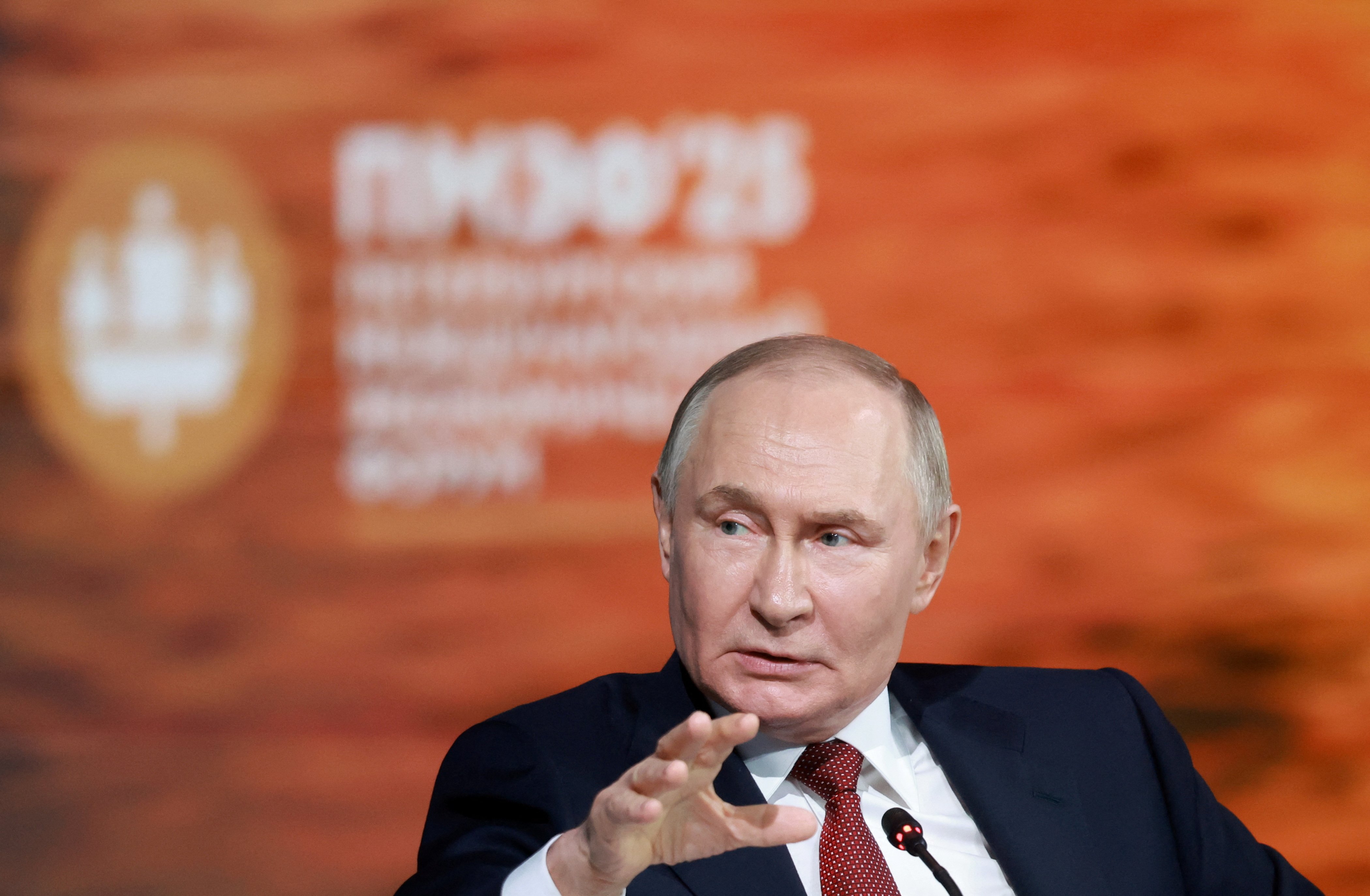

ST. PETERSBURG — The bill for Europe’s energy divorce from Russia has reached approximately 3 trillion euros, roughly $3.5 trillion, according to the man Vladimir Putin dispatched to rebuild Moscow’s economic relationships with the world. The number arrived at SPIEF 2026, the Kremlin’s premier showcase forum, on its opening day — and it landed, as intended, as an indictment.
Kirill Dmitriev, head of the Russian Direct Investment Fund and Putin’s special presidential envoy for economic cooperation, made the assertion on Wednesday at the St. Petersburg International Economic Forum, which opened its business sessions at the city’s ExpoForum center with some 20,000 registered participants from more than 100 countries. His target was Germany in particular — and, through it, every European capital that voted for energy sanctions in the winter of 2022.
“Both Germany and other European countries see that by abandoning Russian energy they have already lost about 3 trillion euros and are effectively driving their economies to collapse,” Dmitriev said from the forum’s stage. He offered Germany as the sharpest illustration: before 2022, Russian gas had accounted for roughly 55 percent of the country’s supplies. What replaced that volume cost far more and delivered less certainty — and the factories that could not absorb the cost difference began, in Dmitriev’s word, shutting down.
The word he used was “deindustrialization.” It is, at this point, not exclusively a Kremlin talking point. German industrial output has contracted for the third consecutive year, corporate insolvencies rose sharply through 2024 and into 2025, and the country’s unemployment rolls passed three million in early 2026 — a twelve-year high. The German Council of Economic Experts, an independent advisory body, recently cut its 2026 growth forecast to 0.9 percent, a figure that Chancellor Friedrich Merz’s government has been quietly managing expectations around for months.
Merz, Dmitriev noted, carries “the lowest approval rating in the history of German chancellors.” That claim has some grounding: surveys by Infratest dimap in mid-2026 found approximately 84 percent of Germans dissatisfied with his government’s performance — driven primarily by economic anxiety, stagnant wages, and the perception that the country’s industrial base is hollowing out faster than Berlin’s fiscal stimulus can refill it. Whether energy costs alone explain that dissatisfaction is a separate question. Dmitriev did not dwell on it.
What he dwelt on instead was the window he sees opening. He pointed to the Alternative for Germany party’s attendance at SPIEF as evidence that pragmatic European voices — those willing to consider the costs of the sanctions architecture as a policy variable rather than a fixed moral position — are gaining political ground. “Germany and other European countries will be present at the forum, including representatives of the Alternative for Germany party, which promotes a much more pragmatic approach to Russia,” he said.
The AfD, which came second in Germany’s February 2025 federal elections, remains classified as a suspected extremist organization by Germany’s domestic intelligence service. Its attendance at a forum under active Western sanctions draws its own lines.
SPIEF’s 29th edition runs through June 6. The Kremlin has leaned on the forum to signal that the economic siege it was supposed to be facing has, in its telling, reversed direction — that the sanctions designed to isolate Russia have instead rerouted European prosperity eastward, toward Asia, while leaving former customers with expensive LNG contracts and idle foundries. Putin is scheduled to address the plenary session on Friday.
The $3.5 trillion figure Dmitriev cited has no independent methodological backing he made public. He offered no baseline comparison — what European energy costs would have been absent Russian gas disruptions, absent the war itself, absent Europe’s own energy transition pressures — and no independent economist was cited in support of it. Euronews data through early 2026 showed that household natural gas prices across EU capitals had actually fallen slightly from their 2022 peak — down roughly one percent between January 2022 and January 2026 — though they remain sharply elevated against pre-war levels. Industrial consumers have fared considerably worse, particularly in Germany’s energy-intensive manufacturing sectors.
The EU’s own assessment runs differently from Moscow’s. Brussels formally adopted legislation in December 2025 to phase out all remaining Russian gas imports, treating energy dependence as a security liability rather than a cost optimization question. The European Commission’s REPowerEU roadmap has reduced the bloc’s Russian gas dependency from 45 percent of total imports before the war to roughly 12 percent by 2025, with full phase-out targeted before the end of 2027. The EU frames that trajectory as a security success. Russia frames it as self-inflicted economic violence.
Both framings contain real numbers and real consequences. Germany’s economic difficulties are not a fabrication — its industrial production has dropped roughly 15 percent from its peak, Volkswagen has announced tens of thousands of job cuts, and the economic model that once made the country Europe’s engine has not recovered the traction it had before 2022. Whether that deterioration is primarily the product of energy costs, structural rigidities, weak export demand from China, or the broader disruptions of four consecutive years of geopolitical turbulence is a dispute among economists that Dmitriev’s forum remarks did not resolve — and were not designed to.
SPIEF’s theme this year is “Pragmatic Dialogue: the Path to a Stable Future.” The word pragmatic is doing a great deal of work. For Moscow, pragmatism means European governments eventually deciding that the cost of the current arrangement outweighs its stated purpose. Dmitriev’s remarks on Wednesday were a data point in that argument — a large number attached to a political proposition, presented before an audience that included, for the first time in several years, a widening circle of Western business participants.
What that circle will conclude is not yet clear. Germany’s factories are cold, but Berlin’s position on sanctions has not moved.
—Inputs from Sputnik.