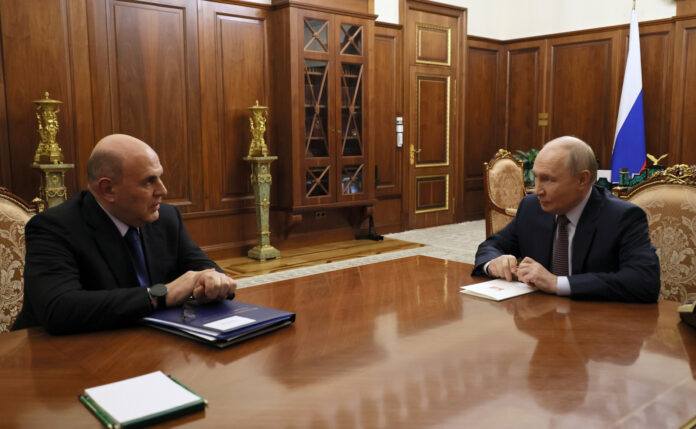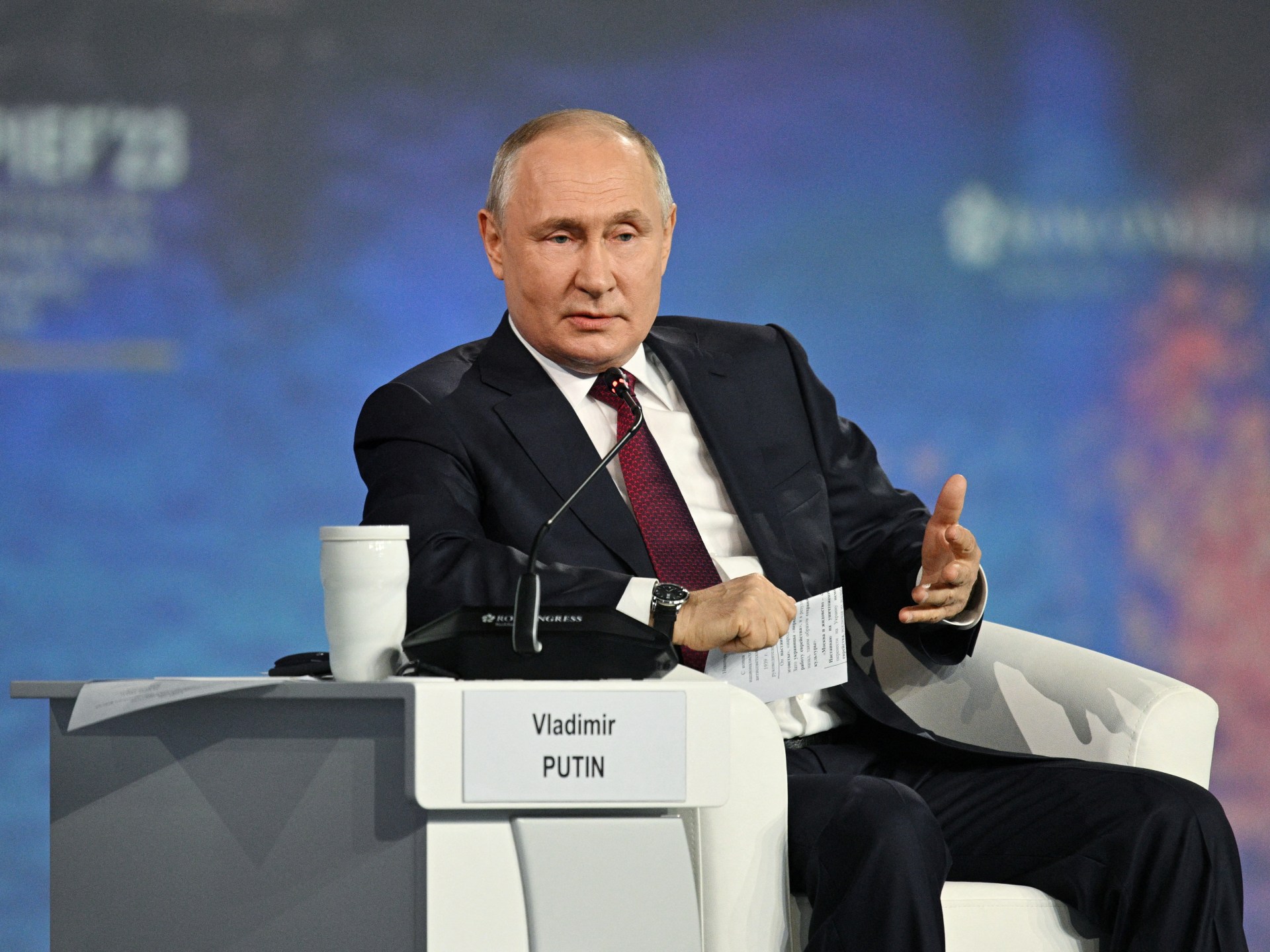

ST. PETERSBURG — Vladimir Putin walked into Thursday’s meeting with the heads of international news agencies at the Constantine Palace with something to sell. Before the session had moved far, he offered his verdict on Russia’s flagship warplane.
“It’s a fifth-generation aircraft, and I believe it’s the best in the world today,” the Russian president said, referring to the Su-57 stealth fighter. The remark was not incidental. Putin immediately pivoted to India — the country Russia has been wooing for years as the Su-57’s first major strategic customer — and offered a full-spectrum partnership with no restrictions attached.
“Regarding the Su-57, we once proposed to our Indian friends that we jointly develop this aircraft,” Putin said. “Our Indian friends said, ‘Why don’t you do it yourself, and then we’ll see.’ In principle, this aircraft could have been jointly produced by us. We developed it ourselves, and we are, of course, ready to work with India, supply it, and develop it further — there are no restrictions here.”
The forum context was the 2026 St. Petersburg International Economic Forum, running June 3 to 6. TASS is the general information partner. The meeting with news agency executives, a traditional fixture of SPIEF’s schedule, has over the years become one of the formats Putin uses to signal foreign policy positions to global audiences without the formal constraints of a state address. His comment on the Su-57 landed in that tradition — part salesmanship, part strategic messaging.
The timing is not coincidental. Putin told the same forum Thursday that Russia’s military-industrial base was expanding every month, a claim he has made repeatedly in 2026 as Moscow seeks to reframe the narrative around its defence economy. The Su-57 program is central to that argument, though the gap between what the Kremlin says and what independent analysts can verify remains wide.
As of early 2026, Russia had produced roughly 30 to 42 Su-57s — figures vary depending on whether prototypes are counted — far fewer than the 76 the government had targeted for delivery by 2028. Sanctions following the Russian operation in Ukraine have constrained production at the Komsomolsk-on-Amur Aircraft Plant. The aircraft’s interim AL-41F1 engines remain a performance ceiling; the more capable Izdeliye 30 engines that would unlock full supercruise have not entered confirmed production service. Western analysts consistently assess the Su-57’s stealth performance as inferior to the American F-22 Raptor and F-35 Lightning II, particularly from rear aspects.
What the Su-57 does offer — and what gives Putin’s India pitch its commercial logic — is a combination of performance characteristics that the F-35 cannot match in a turning engagement. The aircraft’s three-dimensional thrust vectoring, multi-band radar architecture combining main AESA arrays with L-band wing-leading-edge sensors, and demonstrated combat deployment give it a credibility profile that China’s J-20 program, the only other fifth-generation platform with confirmed export activity, does not yet share.
India is the prize. The Indian Air Force has spent years weighing fifth-generation options in parallel with the troubled domestic Advanced Medium Combat Aircraft programme, which remains years from operational readiness. New Delhi has been systematically expanding its defence procurement, and Moscow has pursued those openings at every SPIEF and bilateral forum. In January 2026, India’s Defence Ministry confirmed that license-production talks had reached what it described as an advanced technical stage. Russia had by then offered India full access to the Su-57’s source code — an extraordinary concession, and one that explicitly distinguishes the deal from France’s Rafale negotiations, where source code access remains restricted.
Russia also unveiled a twin-seat Su-57D variant in May 2026, with its first flight conducted by Sukhoi Design Bureau chief pilot Sergei Bogdan. First Deputy Prime Minister Denis Manturov described the aircraft as a combat trainer and tactical control platform capable of coordinating manned-unmanned teaming operations — a capability framing that maps directly to Indian Air Force doctrine requirements. Whether that accelerates or complicates the procurement calculus in New Delhi, the ministry has not said publicly.
The history is complicated. India co-developed what was originally called the Fifth Generation Fighter Aircraft with Russia from 2007, investing substantial resources in a program that was intended to yield a customized Su-57 variant with Indian avionics. New Delhi withdrew in 2018, citing cost overruns, performance shortfalls against stated specifications, and technology transfer concerns. Putin’s SPIEF remarks represent Moscow’s continuing effort to reopen that chapter, this time with more generous terms.
Whether the Indian Air Force and Ministry of Defence see it the same way is a question Thursday’s forum session did not answer. India has not confirmed any procurement decision, formal or informal. Multiple reports from Indian defence sources in late 2025 indicated that while discussions were ongoing, no binding agreement had been signed. The gap between Russia’s readiness to supply and India’s readiness to commit is the part of this story that remains open.
Putin said Russia was also continuing joint work with India on modern weapons systems beyond the Su-57. He offered no specifics. The forum continues through Saturday.