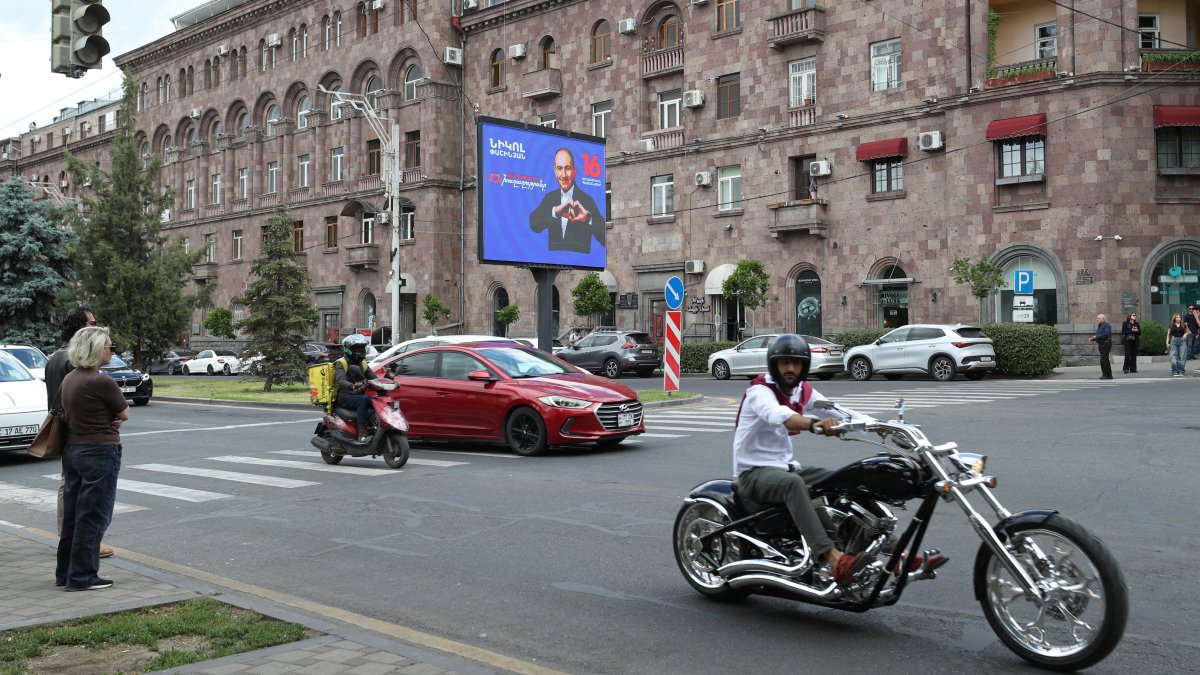

YEREVAN — On the last day before polls open, the number that matters most to Armenia’s electoral authorities is 2,485,851 — the total citizens whose names are inscribed in the national voter registry as of June 6. It is a bureaucratic figure, published by the Migration and Citizenship Service of the Ministry of Internal Affairs under a constitutional obligation, but it carries unusual weight this cycle. The parliamentary election that begins Sunday morning is not a routine transfer of power. It is the first Armenia has held on schedule, without a war or revolution forcing the calendar, since 2017.
Within that headline figure, the registration data reveals the geography and circumstance of a country that has changed dramatically in the intervening years. Some 22,734 voters are registered not at their permanent addresses but at polling stations corresponding to their current location — a figure that reflects both internal mobility and the residual presence of Karabakh Armenians who fled Azerbaijan’s military offensive in September 2023 and have not formally resettled. Another 492 people appear on the rolls with no registered address at all; eight more are classified as having limited mobility. A total of 5,239 police officers have been deployed to polling stations across the country, while 627 voters will cast their ballots from stationary medical institutions.
Those details, dry as administrative data tends to be, point toward a register that has shrunk from the nearly 2.6 million who were eligible in 2021. The decline reflects a real demographic reality: emigration, primarily to Russia, has accelerated since the 2020 war, and a sizable portion of ethnic Armenians now living abroad are not physically present to vote. Armenian law provides no absentee or overseas voting mechanism — citizenship alone does not create a ballot. Whatever the diaspora thinks of Nikol Pashinyan’s pivot away from Moscow, it will not express that view at the polls on Sunday.
The election itself pits Pashinyan’s ruling Civil Contract party against a fragmented field of 18 political forces — 16 parties and two alliances — competing for the at-least-101 seats of the National Assembly. According to polling aggregated by the International Foundation for Electoral Systems, Civil Contract holds a commanding lead. The most formidable opposition comes from the Armenia bloc of former President Robert Kocharyan, whose pro-Russian positioning has become the central dividing line of the campaign. Samvel Karapetyan’s Strong Armenia party, also oriented toward Moscow, rounds out the principal competition on that side of the geopolitical ledger.
The stakes extend well beyond domestic politics. Armenia’s direction on the ballot Sunday will shape whether the country pursues EU membership in earnest, how it handles the still-unsigned formal peace treaty with Azerbaijan, and whether the Trump Route for International Peace and Prosperity — the American-backed infrastructure corridor that US President Donald Trump explicitly endorsed this week while backing Pashinyan for re-election — advances from an agreement on paper to construction on the ground.
Russia, for its part, has made its preferences plain without subtlety. Reuters, citing Western intelligence officials and documents, reported that Moscow had mounted covert influence operations including disinformation campaigns and a plan to transport Russian Armenians into the country to dilute Civil Contract’s margin. The Kremlin has also issued a formal warning through its Embassy in Yerevan that the 2013 treaty guaranteeing duty-free Russian gas, oil products and rough diamonds could be suspended should Armenia continue its EU accession process — a pressure lever applied to a country that has historically drawn roughly four-fifths of its natural gas supply from Russia, according to Interfax.
That gas threat lands against the backdrop of what Russia’s Foreign Intelligence Service, the SVR, has called a Brussels-fabricated campaign against the Russian Orthodox Diocese in Yerevan — a charge analysts have characterized as pre-election narrative management by Moscow, with no documentary support from any EU body. As the Eastern Herald reported this week, Armenian security services have maintained active surveillance of church sites linked to the Diocese, whose senior clergy have faced criminal charges after alleged calls for violent overthrow of the elected government.
The institutional machinery for Sunday’s vote has been reinforced against those pressures. The Central Electoral Commission of Armenia, which operates under constitutional independence from the executive, told the IFES that it has upgraded cybersecurity protocols for its voter databases and results-transmission systems ahead of this cycle, and has put contingency procedures in place against disruption. Thirty-eight territorial electoral commissions — 28 in the regions and 10 in Yerevan — will oversee the count at the precinct level. International observation missions from the OSCE, the Council of Europe and the Commonwealth of Independent States have been accredited.
What happens if no party wins the threshold required to form a government outright remains an open question that the voter figures do not resolve. Under Armenia’s electoral code, if no government is formed within six days of the preliminary results, a run-off between the top two parties must be held 28 days later. The party winning the run-off receives additional seats to guarantee a 54 percent governing majority, with the first-round seat distribution otherwise preserved.
Polling opens Sunday at 8 a.m. local time across the country’s precincts. The Central Election Commission is expected to publish preliminary results during the evening of June 7, with certified totals to follow in the days after. Whether the electorate that has been formally counted at 2,485,851 turns out at levels approaching the 49 percent recorded in 2021 — or whether the political intensity of this particular moment brings more of them to the ballot box — is a question Armenia answers on Sunday.