
VIENNA — The mines come first, and for the first time in the brief, brittle diplomatic history of truces at the Zaporizhzhia Nuclear Power Plant, an international watchdog is watching the men who clear them.
International Atomic Energy Agency Director General Rafael Grossi announced on Sunday that agency experts had begun monitoring demining operations near the plant’s damaged Dneprovskaya power line — a procedural expansion that the IAEA itself described as unprecedented across the five previous local ceasefires it has brokered since late 2024. In every prior truce, agency monitors were deployed once technicians arrived to begin repairs. None had ever been positioned at the earlier, more dangerous phase of clearing ordnance from the corridor leading to the infrastructure.
The distinction matters because the last time the world assumed demining was proceeding safely at ZNPP, five Russian military sappers were wounded in what Rosatom described as a deliberate Ukrainian drone strike on the clearance team. That attack occurred Friday, at the outset of the sixth ceasefire, and immediately threw the arrangement into doubt. The IAEA, which had publicly acknowledged the incident, said it had been informed by the plant’s Russia-installed management.
Grossi’s language on Sunday was measured but pointed. “To strengthen and help maintain the latest IAEA-brokered ceasefire near the Zaporizhzhya NPP after Friday’s incident that injured several Russian military personnel, an Agency team today started monitoring mine-clearing work that is required before the power line repairs can begin,” the IAEA posted on X, attributing the statement directly to its director general.
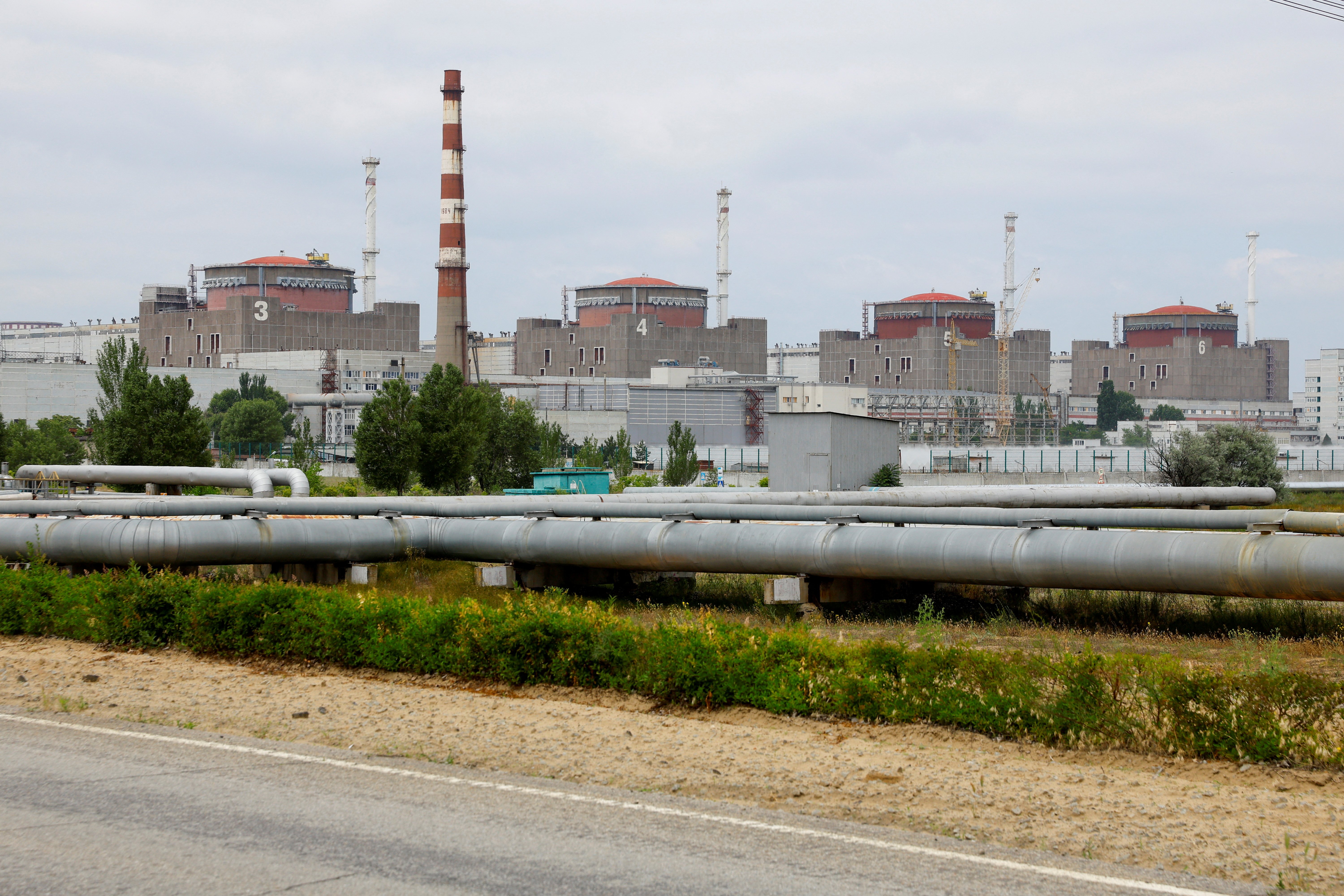
The Dneprovskaya line is the 750-kilovolt primary feed that has been severed for more than two months. Its loss left Europe’s largest nuclear facility dependent on a single 330-kilovolt backup to keep cooling systems running across six reactors in cold shutdown — a line that itself suffered multiple disruptions in recent weeks, repeatedly driving the plant to emergency diesel generators as a last resort. The prospect of simultaneous failure of both the backup and the generators sits at the core of the nuclear-accident risk that has haunted ZNPP since Russian forces seized the site in March 2022.
What Sunday’s deployment changes is the scope of the IAEA’s physical presence. Agency teams have, until now, served as witnesses to infrastructure repair — watching technicians work, documenting progress, and providing a measure of deterrence against attacks on civilian energy infrastructure. Extending that presence to the demining phase acknowledges that the ceasefire zone’s most vulnerable moment is not when a technician climbs a pylon, but when a soldier walks ahead of him with a metal detector.
The ZNPP sits on the left bank of the Dnieper River near the city of Energodar, within territory under Russian administrative control since October 2022. Generation at all six power units was halted in September 2022; since April 2024, all units have been in cold shutdown mode. The plant produces no electricity. What it requires is electricity — to run pumps, fans, and monitoring systems that keep decades-worth of nuclear fuel from overheating. That dependency on external power has made every damaged power line a potential nuclear safety incident, and every repair a diplomatic exercise conducted under fire.
The IAEA said that during the five previous local truces, its experts monitored repair work but were not present for demining. That protocol gap became visible in the most concrete way possible on Friday, when the cleared corridor itself became a target. Whether Sunday’s deployment is enough to deter future strikes on the demining teams — or whether the Ukrainian military, which has not commented on the Friday attack, considers the clearance operation a legitimate military objective — remains an open question that no ceasefire document has so far resolved.
Grossi said the IAEA would continue to do everything possible to help prevent a nuclear accident during the Russian operation in Ukraine. He has issued similar statements after each of the previous five ceasefires, and on each occasion the truces have held just long enough for some work to proceed before the shooting resumed. The Dneprovskaya line was briefly restored during an earlier arrangement, only for damage elsewhere on the same corridor to push the facility back to single-line dependency.
The underlying architecture of the problem has not changed. The front line runs directly through the power infrastructure that ZNPP depends on. Repairing that infrastructure requires clearing mines. Clearing mines requires a truce. Maintaining a truce requires both parties to treat the zone as off-limits — and both parties have accused the other of doing the opposite. What the IAEA has built across six ceasefires is less a diplomatic solution than a recurring crisis-management mechanism, one that has to be renegotiated every time a line goes down.
How long the current demining phase takes, and whether the Dneprovskaya line can be restored before the next disruption to the backup feed, are questions the agency says it cannot answer from Vienna. On Sunday, it was answering the only question within its reach: whether its monitors would be present when the next man walked into the minefield. The series of escalatory incidents at ZNPP this year suggests that presence alone has not been sufficient to hold the line — but the agency has not identified a better lever.
Related Posts