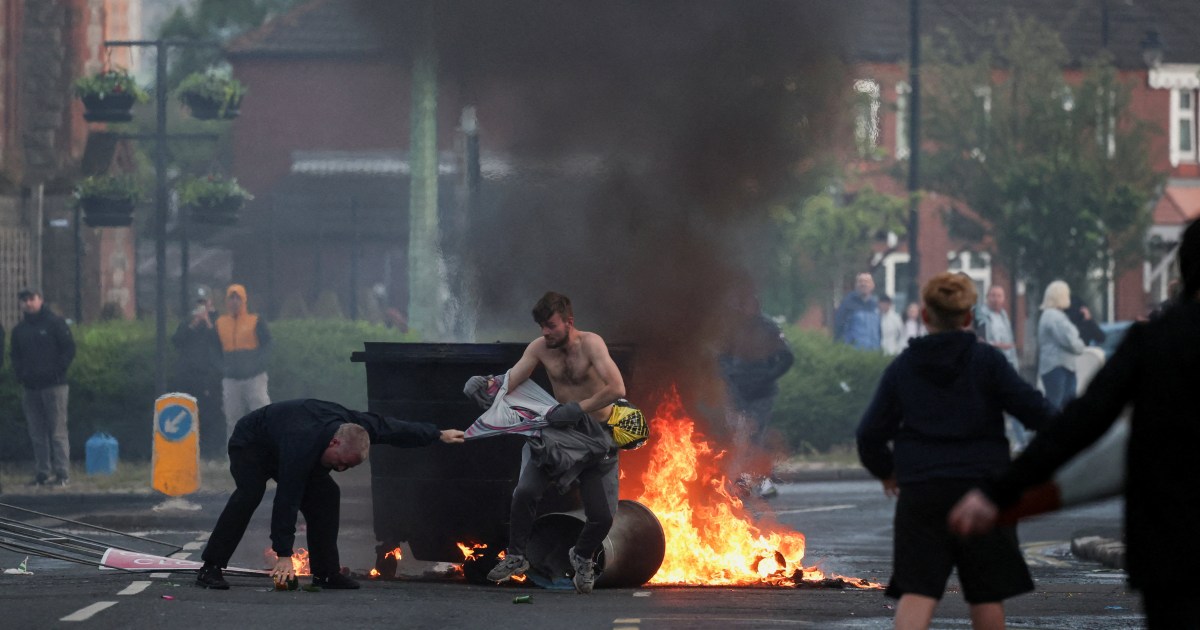

BELFAST — The fire on Ligoniel Road burned through the night, and by morning a pastor who had lived in the neighbourhood for twenty years was telling the BBC that people had been dragged from their homes and targeted “because they’re black.” He was angry, he said. He was also unsurprised.
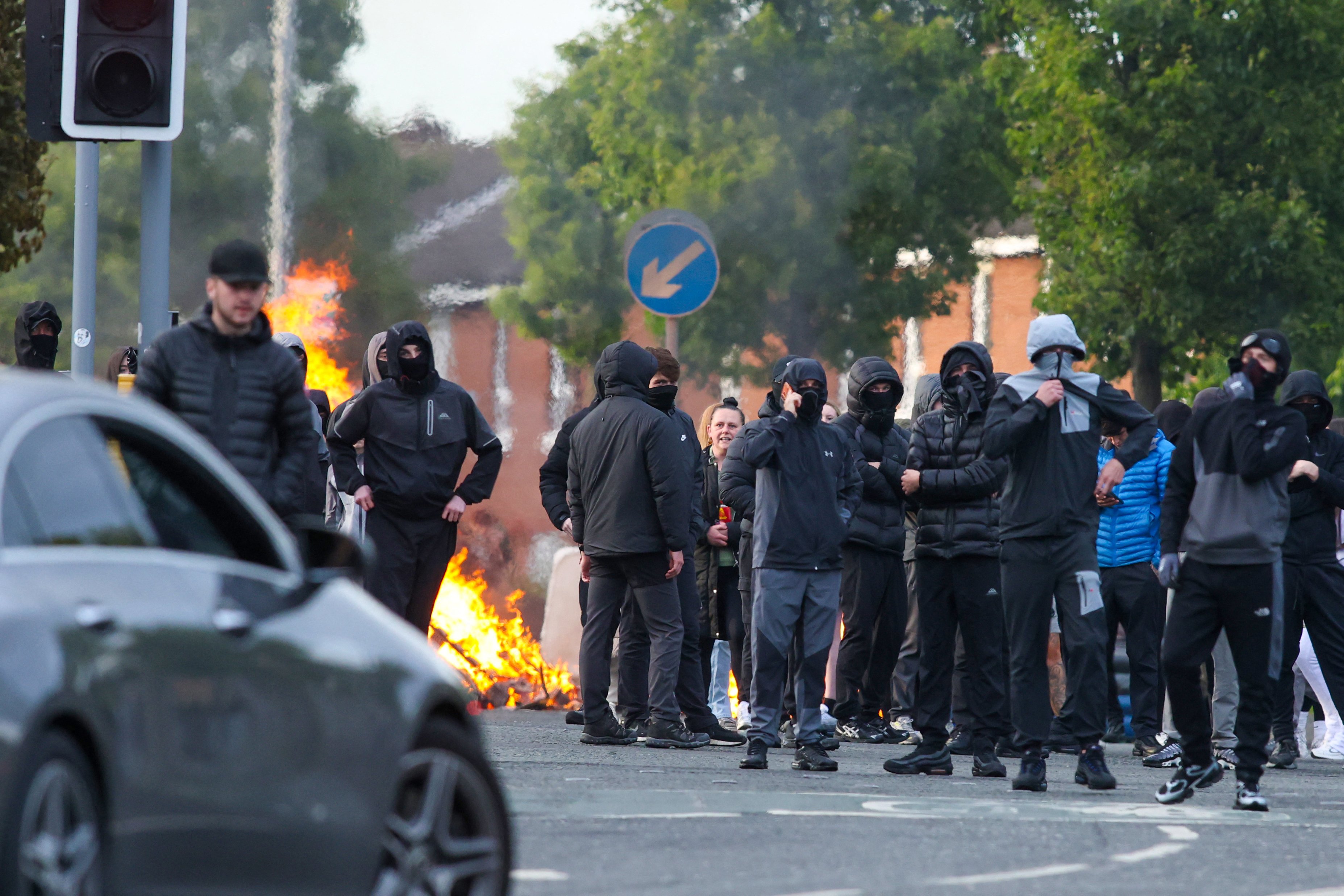
For the third consecutive summer, anti-immigration riots have torn through Northern Ireland. The immediate trigger this time was a knife attack in north Belfast on the night of June 8, in which a 30-year-old Sudanese man allegedly straddled a man in his 40s on Kinnaird Avenue and slashed him repeatedly across the face, eyes and back with a kitchen knife. The victim survived — bystanders fought the attacker off with a hurling stick before police arrived — and the suspect was charged the following day with attempted murder. By that evening, buses were burning on the Newtownards Road and masked men were kicking in doors on the Lower Newtownards Road, announcing they were “getting the foreigners out.”
What is harder to explain this time than in previous years is the sense that this is no longer a crisis. It is beginning to resemble a season.
In July 2024, a British-born son of Rwandan refugees killed three children at a dance class near Liverpool, triggering riots across England that spread to Belfast within days. The following June, two Romanian Roma teenagers were charged with attempted rape in Ballymena, touching off two weeks of disorder in which 107 police officers were injured and two thirds of the Roma population fled the town. Now this. Eastern Herald reported on the suspect’s arrest and charges as events unfolded on Tuesday.
In each case, a discrete crime committed by a man of foreign origin has functioned as the spark. In each case, the fire has spread far beyond anything the crime itself could explain. Researchers at the Institute for Strategic Dialogue documented, as early as January 2026, how cross-border coordination between Republic-of-Ireland nationalist groups and Northern Irish loyalist networks was accelerating — a convergence that would have been ideologically impossible in an earlier era, when those communities defined themselves in direct opposition to each other.
What has changed is the architecture of mobilisation. The Police Service of Northern Ireland’s chief constable, Jon Boutcher, said on Tuesday that the suspect in the knife attack had no prior criminal record and was not known to security services. He had arrived via Paris and Dublin in February 2023 and had been granted a five-year residence permit. “There is no trace of this suspect on any of our national security databases,” Boutcher said, adding a more pointed warning: “The challenge we face with today’s online toxic nature is that people are incited by people who are faceless and know nothing about this brilliant, vibrant place.” Do not be fooled or duped by people online, he said.
He was not wrong about the incitement. Elon Musk retweeted a post by Tommy Robinson calling for “REPEATED” protests against immigration. Northern Ireland Justice Minister Naomi Long told BBC Breakfast that those responsible for the violence were “weaponising genuine hurt, concern and anger” and blamed “far-right online agitators” who, she said, would have struggled before Tuesday to find Belfast on a map. Reform UK leader Nigel Farage, whose party has made immigration its defining issue in recent municipal elections, demanded immediate disclosure of the suspect’s immigration history.
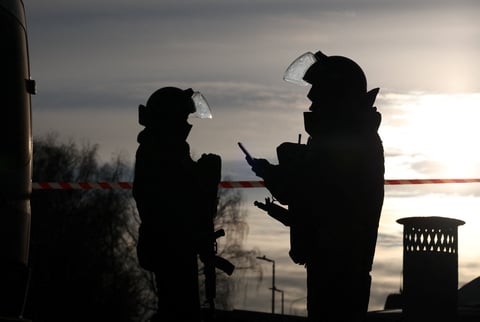
The Northern Ireland Fire and Rescue Service responded to 62 incidents between 7 p.m. and midnight on Tuesday, deploying an additional 21 fire appliances from across the province to contain the damage. The disorder spread: protests broke out in Bangor, Glasgow, Edinburgh and Southampton, where demonstrators gathered outside a hotel that had housed asylum seekers, holding signs reading “Illegal Migration Is Destroying Our Civilisation.” The UK’s Home Office confirmed the suspect held a legal residence permit valid until 2028.
Michelle O’Neill, the First Minister of Northern Ireland, described what happened as “nothing less than disgusting cowardice” and “outright thuggery.”
Prime Minister Keir Starmer called the attack “horrific” and said he had “absolutely no tolerance” for violence on British streets. His office said “it is time for calm” and that police needed space to investigate. Those appeals landed in a city where they have been made, in nearly identical terms, twice before.
What distinguishes the 2026 riots from the 2024 Southport violence, in the analysis of Michael Kerr, professor of conflict studies at King’s College London, is not the scale but the target. “A small but determined far-right minority can create fear very quickly, especially when they are targeting communities that are themselves tiny, vulnerable and already exposed,” Kerr told Al Jazeera. The rioters were not primarily targeting institutions or symbols of government. They were burning the homes and businesses of people who happened to live on streets that border loyalist strongholds.
That spatial logic is not accidental. Evi Chatzipanagiotidou, a lecturer in anthropology at Queen’s University Belfast, pointed to the overlap between the geography of the disorder and the geography of the Troubles: areas long defined by economic deprivation, paramilitary recruitment pipelines, and a residual capacity for organised violence. The young men throwing Molotov cocktails on Tuesday night are, as she put it, “prime recruitment targets” for groups that have been reorienting their ideology from sectarianism toward ethnonationalism. “Local historical and ideological processes converge with global far-right politics,” she said.
The mob that burned out houses this week targeted properties with no connection to the original attacker. That randomness is part of the point. The ISD research documented, in January 2026, how nationalist and loyalist actors who had never coordinated before were, for the first time, jointly mobilising around a shared perceived grievance about immigration. What traditionally divided them — the question of whether Northern Ireland belongs to the United Kingdom or a united Ireland — was being subordinated to what they now share: a hostility to the presence of Black and Brown migrants in their communities.
The Good Friday Agreement — the 1998 accord that ended three decades of political violence and established the power-sharing architecture that still governs Northern Ireland — depends on a very specific structural condition: that the major parties remain committed to joint governance across the sectarian divide. It has survived boycotts and Brexit and the collapse of the executive, but it has always assumed that loyalist and nationalist violence would not converge. What happens when they do, even loosely, even around a different grievance, is a question the agreement was not designed to answer.
Boutcher said on Wednesday morning that the PSNI is operating at around 6,200 officers — well below the recommended 7,500. The force is, by his own repeated public assessment, critically underfunded. Whether it can contain a third year of this, if the pattern holds, is not yet known.