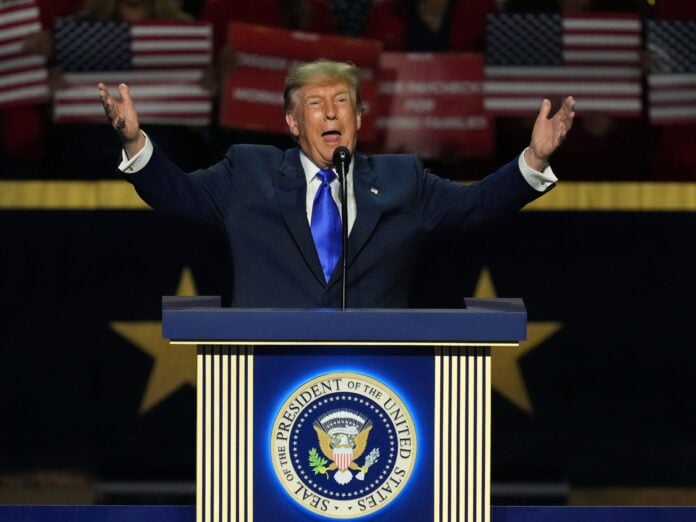
WASHINGTON — Donald Trump and his allies are quietly working to have the House of Representatives declare his two impeachments erased, a resolution that legal scholars say would accomplish nothing the Constitution permits, and which the president’s own party intends to pass only after November, in the narrow window between an expected election defeat and the surrender of its majority.
The vehicle is House Resolution 1211, introduced by Representative Darrell Issa of California, which would expunge both impeachments as if such Articles had never passed the chamber, US News reported, citing The Wall Street Journal. The measure has the backing of Judiciary Committee Chairman Jim Jordan and more than 20 cosponsors since April, and Speaker Mike Johnson is described as open to bringing it forward.
Asked about the effort, Trump gave the Journal the reasoning in his usual register. It should be done because I did nothing wrong, he said, calling both impeachments a rigged deal and a whole rigged situation. The grievance is the policy; the resolution is its formalization, an attempt to make the House say on paper what the president has insisted for six years.
The problem is that the Constitution offers no eraser. Legal experts told the Journal the resolution would mean little, because impeachment is a historical fact recorded in the House journal, not a conviction that can be vacated, and there is no constitutional mechanism to undo it. A chamber can pass a resolution declaring the sky green; the sky is unaffected, and so are the impeachments of December 2019 and January 2021.
What the resolution would erase, if anything, is the distinction between the legislative record and a press release. The first impeachment charged Trump with abuse of power and obstruction of Congress over his pressure on Ukraine to investigate a political rival; the second charged him with incitement of insurrection over the January 6 attack on the Capitol. The Senate acquitted him both times, which is the only verdict the Constitution actually contemplates, and which the expungement resolution does not change either.
The timing is where the exercise turns revealing. Republican lawmakers told the Journal the resolution would not come to the floor until after the November midterms, elections in which the party is widely expected to lose its House majority. The plan, in other words, is to use the lame-duck session, the weeks after defeat and before the new Congress is sworn in, to pass a symbolic absolution while the votes still exist to pass it.

That sequencing inverts the ordinary logic of a governing majority, which spends its final months on the legislation it could not finish. Here the priority reserved for the lame duck is the cleansing of the leader’s record, a vote with no statutory effect, scheduled for the precise moment the majority has been repudiated at the polls. It is the legislative equivalent of redecorating a house one has just been evicted from.
The delay also exposes the discomfort inside the conference. Several Republicans told the Journal they would struggle to find the votes, and the reluctance is easy to read: a floor vote on expunging the January 6 impeachment forces every member facing a tough race to relitigate the Capitol attack on the record, days after voters have spoken. Leadership’s solution is to wait until those members no longer have to face the voters first.
The effort fits a now-familiar pattern in which the machinery of the state is bent toward the management of a single man’s grievances, the same impulse The Eastern Herald traced when the vice president referred the president’s 2024 opponents to a new fraud division. The fraud referral reaches forward to punish enemies; the expungement reaches backward to absolve the leader. Both treat the institutions of government as instruments of personal vindication.
For the historical record, none of it lands. The impeachments will remain in the House journal, in the Senate trial transcripts, and in the memory of the events that produced them, none of which a 2026 resolution can reach. The most the measure can do is record, for the future, that a House majority on its way out the door spent its remaining authority insisting that something which happened did not happen.
That may, in the end, be the point. The resolution is not addressed to the Constitution or the historians but to the president, a gesture of fealty priced in floor time rather than substance, and timed so that no member has to answer for it at the ballot box. Whether it passes or not, it has already told the country what the majority’s final act of power was meant to accomplish: not to govern, but to please.