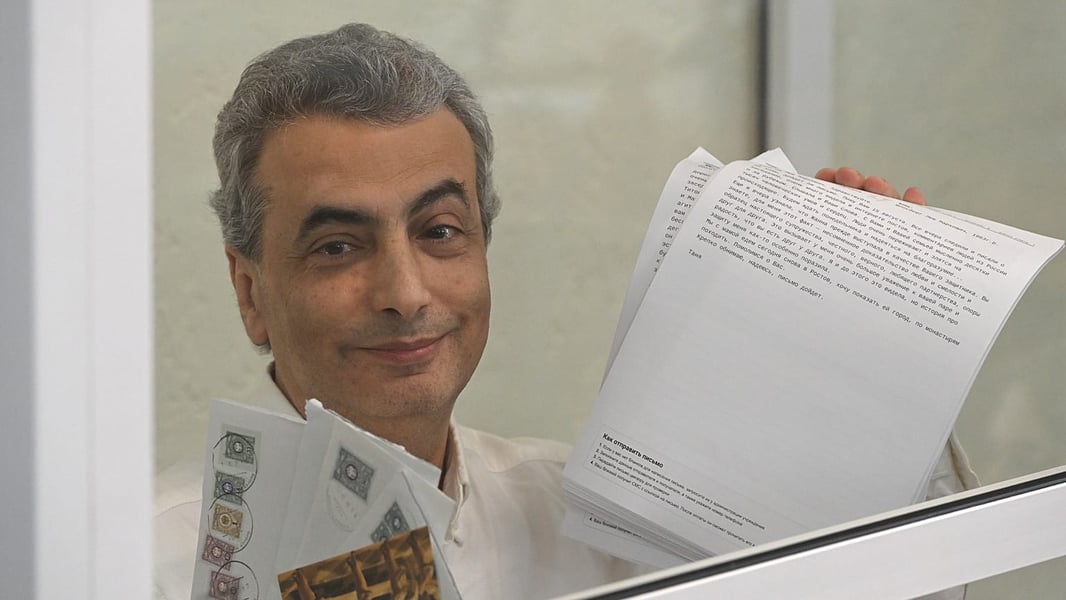

PSKOV — Lev Shlosberg arrived at the Pskov City Court on Monday knowing the sentence was coming. His three defense attorneys had not. Called to hearings they failed to attend, they were replaced by a state-appointed lawyer whose representation Shlosberg had moved to reject, and whose motions the court declined to hear. Standing at the close of a proceeding his own party called a mockery, the 63-year-old deputy chairman of Russia’s Yabloko turned to the judge: “I sympathize with you, Your Honor: you’ll have to live with this decision. God will forgive [you].”
The judge sentenced him to 11 years and one month in a penal colony.
The conviction arrives at a moment when Russian political dissent was already narrowing to a point. Earlier this month, Russia’s Supreme Court upheld a decision barring Yabloko — the only registered political party that has consistently opposed the Russian operation in Ukraine — from fielding a party-list slate in the September 18-20 State Duma elections. On Monday, as Shlosberg was being sentenced in Pskov, The Moscow Times reported that the Supreme Court rejected Yabloko’s appeal against that ban, and police detained at least 30 of the party’s supporters outside the courthouse in Moscow. The twin rulings — one removing the party’s collective path to parliament, the other removing its most visible national figure from public life — arrived in the same afternoon.
Shlosberg was prosecuted under two charges that have become standard instruments of Russian wartime enforcement. The first stems from his participation in a January 2025 debate on the YouTube channel Zhivoy Gvozd, in which he argued for an immediate ceasefire. He denied making the statements cited by prosecutors, saying they had been misattributed to him from his debate opponent. The second, spreading “deliberately false information” about the Russian Armed Forces, relates to a Telegram post from February 25, 2022, the day after Russian forces crossed into Ukraine. In that post, Shlosberg reshared content from Ekho Moskvy radio that included a British tabloid front page depicting Vladimir Putin. He argued the post predated the legislation under which he was charged.
The sentence combined the new convictions with a prior one: in November 2025, Shlosberg received 420 hours of community service for violating Russia’s “foreign agent” law. He had been designated a foreign agent in June 2023; Russia’s financial intelligence service added him to its extremism register in December 2025. Prosecutors had sought 12 years and one month. The court imposed 11 years and one month in a general-regime penal colony plus a six-year ban on administering websites.
Shlosberg’s words in the courtroom carried the weight he had been denied through the trial’s mechanics. “I am an innocent man, against whom criminal charges have been unlawfully brought,” he told the court. In his closing statement he described what the conflict had taken: “The lives of countless thousands of people have been cut short during this time. Sooner or later, the precise and complete death toll will be made public, and the entire nation will shudder at this list of martyrs.”
Amnesty International named him a prisoner of conscience and published a statement from Marie Struthers, the organization’s director for Eastern Europe and Central Asia: “His arbitrary prosecution and conviction are an act of clear retaliation for exercising his right to freedom of expression by calling for peace.”
Meduza documented reactions from Russian civil society in exile that ranged from grief to pointed analysis. Leonid Volkov of the Anti-Corruption Foundation called the outcome “absolutely nightmarish,” noting that words were receiving harsher punishment than murder. Dmitry Gudkov of the Anti-War Committee said the sentence exceeded standard penalties for homicide, sexual violence, and kidnapping. Yabloko’s Nikolai Rybakov and its founder Grigory Yavlinsky issued a joint statement calling it “a tragedy of Russian justice collapse.”
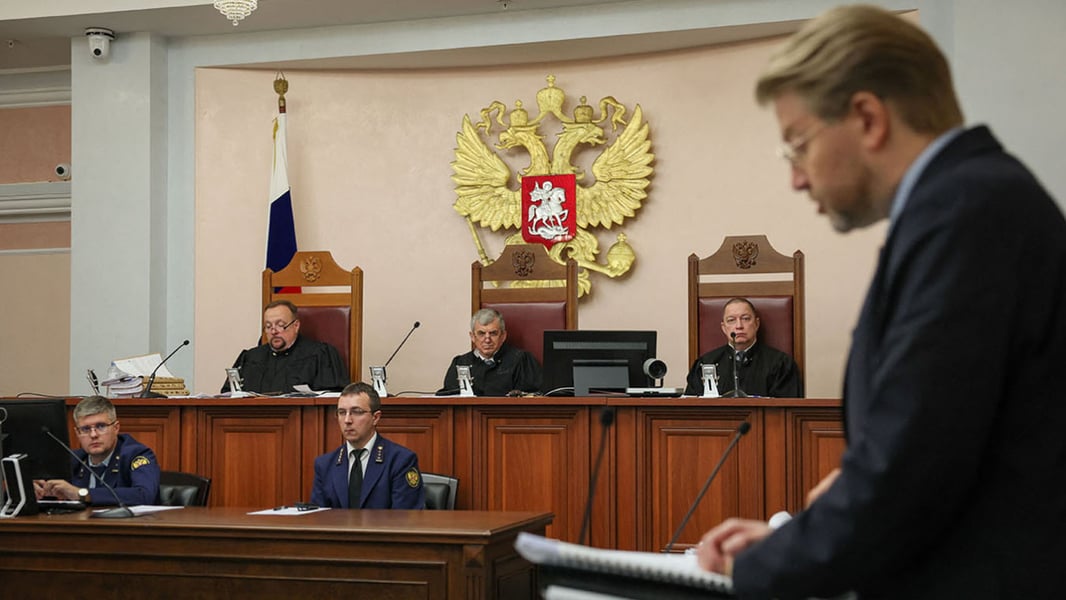
The Supreme Court’s simultaneous rejection of Yabloko’s election appeal carries its own separate weight. The court upheld a lower ruling finding copyright violations and campaign finance infractions, including alleged acceptance of foreign funding — claims brought by Rodina, a pro-Kremlin party. Rybakov characterized the proceeding as “mere imitation of a court” that made “no attempt to examine or engage with the substance of the case.” The ban eliminates the party’s access to the party-list ballot, which distributes half of the Duma’s 450 seats to parties clearing five percent of the vote. Individual Yabloko candidates may still run in single-member constituencies, but those races typically require the organizational backing that party-list status provides.
The dual moves follow a pattern the Kremlin has maintained throughout the Ukraine war: closing legal channels of dissent through legislation enacted and expanded since February 2022. The European Union’s foreign policy arm responded to that pattern this week with what senior EU officials called the most comprehensive Russia sanctions expansion since the conflict began, targeting circumvention networks and energy infrastructure, as EH reported Monday.
Shlosberg served in the Pskov regional legislature from 2016 to 2021. He is among a small number of Russian politicians who remained inside the country and continued to speak openly against the war after February 2022, at a time when most of his counterparts either fell silent or left. His continued presence at home while others fled made him a notable figure in a field that had largely emptied; the string of prosecutions since 2023 reads as the state’s methodical response to that visibility.
What remains uncertain is what comes next for Yabloko’s September campaign and for Shlosberg himself. The party has indicated it will pursue appeals to Russia’s Constitutional Court and develop strategies for candidates in single-member races. Whether Shlosberg can mount a legal appeal from a penal colony depends on access to counsel he did not effectively have at trial — his three original defense lawyers have given no public account of why they missed the hearings that preceded the verdict.