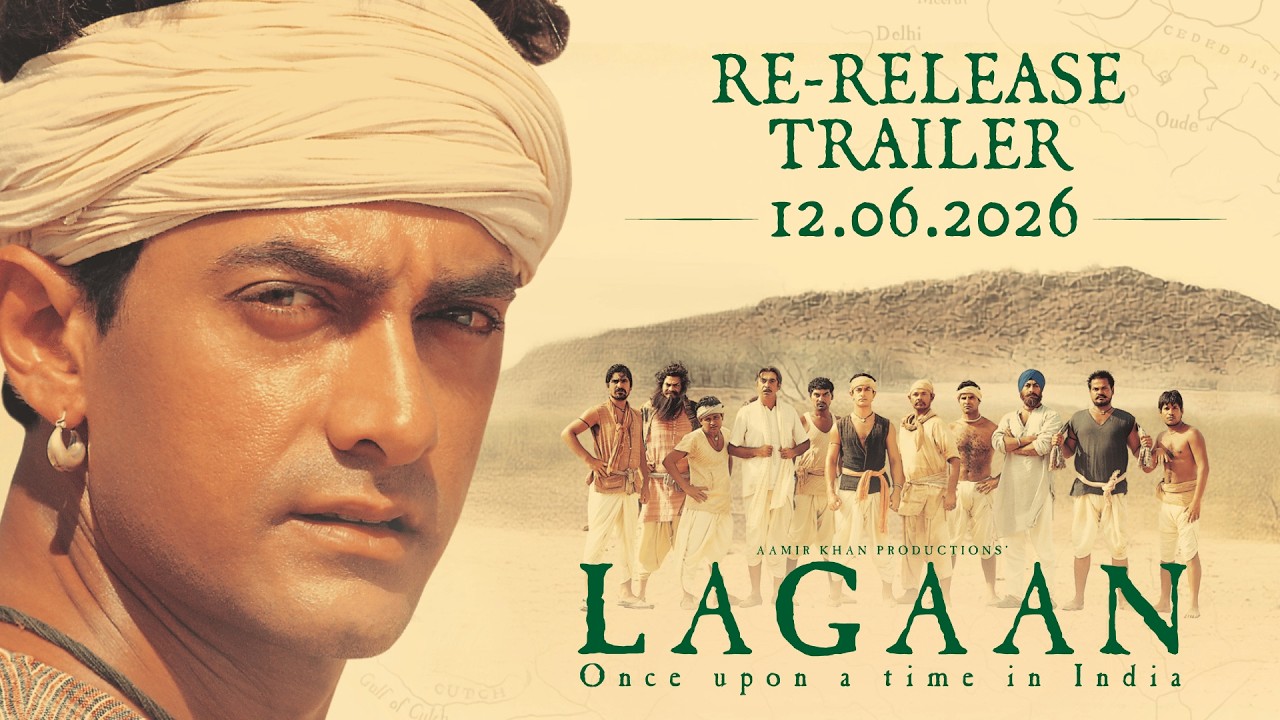

Aamir Khan will travel to London next month to celebrate the 25th anniversary of Lagaan at the London Indian Film Festival, the annual showcase of South Asian cinema that runs from July 9 to 19 across five British cities. The Academy Award-nominated film will receive a special screening at BFI IMAX on July 12, followed by Khan appearing in conversation at BFI Southbank on July 16, according to the festival’s lineup announced by Variety.
Khan, who produced and starred in the Ashutosh Gowariker-directed colonial cricket epic, described the milestone in terms that suggested genuine surprise at the film’s longevity. “As Lagaan completes 25 years, it’s hard to put into words what this journey has meant,” Khan said. “We made the film with a lot of belief, passion and honesty, never imagining the kind of love it would receive and continue to receive all these years later. To see Lagaan still connect with audiences across generations and across geographies is very special.”
The Lagaan celebration arrives just days after the film returned to Indian theatres in a re-release that opened on June 12, giving domestic audiences a chance to experience the film on the big screen for the first time in over two decades. The re-release follows a wave of Hindi cinema anniversaries this year, including the celebration of Gadar’s 25th anniversary, both films having defined the summer of 2001 for Indian audiences.
The festival’s most unexpected offering may be the UK premiere of a 4K restoration of In Which Annie Gives It Those Ones, the 1989 cult film written by and starring Booker Prize laureate Arundhati Roy. Originally produced for Doordarshan, the film was directed by Pradip Krishen and set in a Delhi architecture school in the mid-1970s. It aired once on Indian television and then effectively disappeared for decades, becoming one of Indian cinema’s most elusive titles. The restoration, carried out by the Film Heritage Foundation, will screen at BFI Southbank and HOME Manchester.
The film carries an additional layer of curiosity for contemporary audiences: it features one of Shah Rukh Khan’s earliest screen appearances, years before his Bollywood debut in Deewana made him a household name. The 4K restoration offers a rare chance to see both Roy and Khan at the very beginning of careers that would take them in radically different directions, one toward literary greatness and political dissent, the other toward becoming the most commercially successful Indian actor of his generation.
The 17th edition of the London Indian Film Festival will open with the European premiere of 52 Blue, directed by Ali El Arabi and starring Adil Hussain and Neha Dhupia, described by festival CEO Cary Rajinder Sawhney as “a riveting and inspirational film about youth finding a way against impossible odds.” The festival spans screenings in London, Birmingham, Manchester, Sheffield, and Bradford, making it the largest South Asian film event outside the subcontinent.
Other highlights include UK premieres of films that have already appeared at Toronto and Rotterdam, a reunion of the cast of the landmark British Asian comedy Goodness Gracious Me on July 11, and a showcase on India’s AI and film future overseen by director Shekhar Kapur. The AI showcase, programmed at BFI Southbank and later in Manchester, echoes similar conversations happening at Indian festivals, including the Mumbai International Film Festival’s inaugural AI Cinema Hackathon later this month.
The festival will also feature the Satyajit Ray Short Film Competition, a Too Desi Too Queer LGBTQIA+ shorts programme, and Northern and Midlands premieres of Peter Brook’s The Mahabharata. The festival is supported by the BFI Audience Projects Fund through National Lottery funding, with additional backing from the British Council and several universities.
For Indian cinema, the LIFF programming represents something larger than a festival calendar. It is a measure of how seriously Indian film is taken in the international art-house circuit, not just as spectacle but as a living tradition that includes everything from Oscar-nominated epics to films that aired once on state television and were nearly lost. The pairing of Lagaan’s 25th anniversary with the resurrection of Roy’s forgotten debut suggests a festival that understands Indian cinema’s depth extends far beyond its contemporary star-driven narratives.