
BEIJING – The charger ASUS launched in China this week costs about $25 and fits four ports into a body roughly the size of a deck of playing cards. In London or New York, the closest equivalent from Anker or Ugreen runs $35 to $55. That gap – ten to thirty dollars, depending on where you happen to live – is the quiet story behind what looks like a routine product announcement.
ASUS released the a-bean 100W GaN charger in China on Sunday, priced at 179 yuan, or roughly $25. The company offered no announcement for Western markets. No launch event. No timeline. The product page on the Chinese storefront went live and the rest of the world was left to calculate exchange rates.
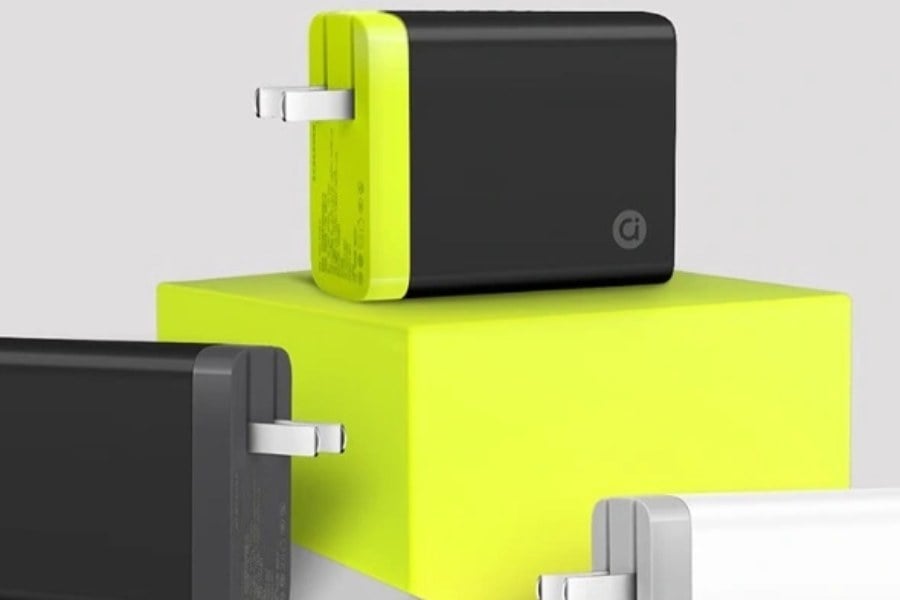
The hardware itself is not difficult to explain. The a-bean uses gallium nitride – the same semiconductor compound that displaced silicon in premium chargers starting around 2020 – to squeeze 100 watts of output into a unit measuring 75 by 61 by 29 millimeters. It weighs 211 grams and ships with foldable wall prongs, which matters when it is competing for pocket space with a phone, a battery pack, and whatever else a traveler is carrying. Three of the four ports are USB-C; the fourth is USB-A. The two primary USB-C ports can each deliver a full 100W when used alone, enough to fast-charge a MacBook Pro or a Dell XPS without reaching for a separate adapter.
What ASUS is asking people to believe is that this product, at this price, represents where the company wants to compete. That is where the argument gets complicated. The charger ASUS sells in the UK and US – the AC100-02 – is a three-port model with a 65W primary output that costs considerably more. The a-bean does not replace it. As Notebookcheck reported, the a-bean does not appear to be coming to global markets at all, at least not yet.
The port configuration changes when multiple devices are connected, as it does with every multi-port charger on the market. Two devices drawing from the two primary USB-C ports split 60W and 30W between them. Running all four simultaneously shifts the distribution to 45W on port one, 30W on port two, and a shared 20W across port three and the USB-A slot. On paper – and in practice, if the wattage allocations hold under load – that is enough to simultaneously fast-charge a laptop, a phone, a tablet, and a pair of wireless earbuds without any device throttling to a trickle.
ASUS has included support for USB Power Delivery, PPS, Qualcomm Quick Charge, Huawei SCP, FCP, QFC, and PE. That list of protocols covers the overwhelming majority of modern devices from every major manufacturer. The USB-A port supports SCP at 22.5W or Quick Charge at 18W, which means older cables remain useful rather than obsolete.
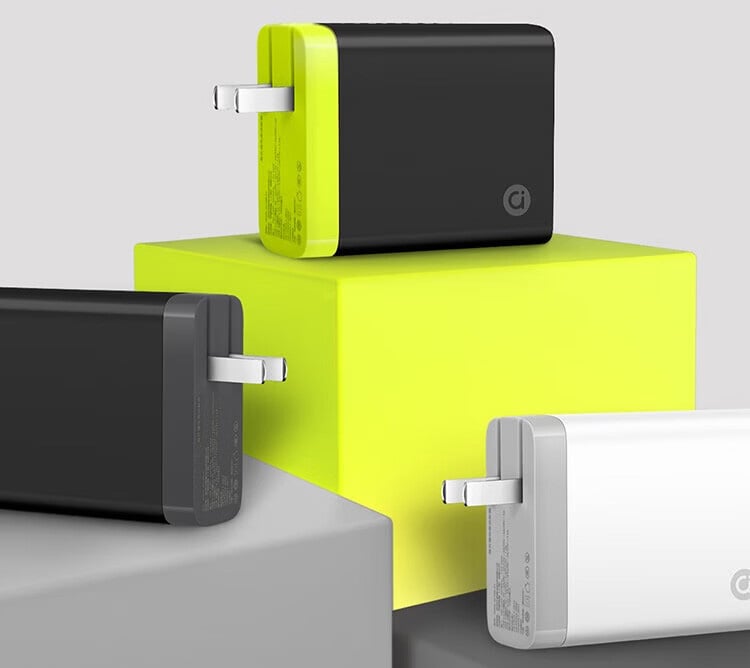
The a-bean comes in three color combinations – Cloud White with Graphite Gray, Cool Black with Fluorescent Green, and Cool Black with Space Gray – a small departure from the generic matte-black aesthetic that dominates the category. Whether that translates to meaningful consumer preference is another question. In the budget charger market, the only color that has reliably mattered is the price on the tag.
The competitive framing ASUS is working with in China is clear. As Gizmochina noted in its coverage, the Ugreen Nexode 100W – which carries a comparable port layout and wattage ceiling – lists on Amazon in the United States for roughly $33. Anker’s four-port offerings in the same class run higher. At $25, the a-bean is not just cheaper – it is meaningfully cheaper, the kind of price gap that shifts purchasing decisions rather than merely registering as a minor consideration.
But the question the a-bean’s launch raises is not really about whether ASUS has built a good charger. At this specification level, every major GaN manufacturer is building good chargers. The question is why the company’s most price-competitive hardware keeps arriving in China first – and sometimes only. ASUS has followed a similar pattern with other product lines, rolling out aggressively priced variants in China while the global catalog maintains a higher floor. That is a deliberate strategy, not an oversight.
Part of the explanation is structural. Chinese consumers operate inside a domestic market where Xiaomi, Baseus, and Ugreen have driven GaN charger prices lower than anywhere else in the world. A charger that costs $25 in China might land at $40 or $45 in the United States once import duties, distribution costs, and retail margin are layered on. ASUS, or any manufacturer, faces a choice: price globally at a level that works economically everywhere, or price regionally and accept that the most affordable products stay regional. For now, ASUS has chosen the latter with the a-bean.
The safety specifications are not an afterthought. ASUS has built in protection against over-temperature, over-current, short circuits, and voltage fluctuations – the four failure modes that have historically turned cheap chargers into fire risks. That matters not just for the device being charged but for the insurance liability calculus that any electronics manufacturer has to run. The a-bean is not a no-name unit assembled in an unregulated facility. It carries ASUS’s brand, which means the company has staked its reputation on the hardware performing as specified.
Whether the a-bean reaches Europe, North America, or South Asia is something ASUS has not addressed. The company’s broader hardware lineup maintains a robust global presence through its standard charger catalog; the question is whether the a-bean’s price point survives the translation from CNY 179 to a shelf tag in a Western retailer. The math, historically, has not been kind to that kind of ambition. For the moment, anyone outside China who wants what the a-bean is offering will find themselves paying more for less – and that remains the part of this product launch nobody in the official announcement mentioned.