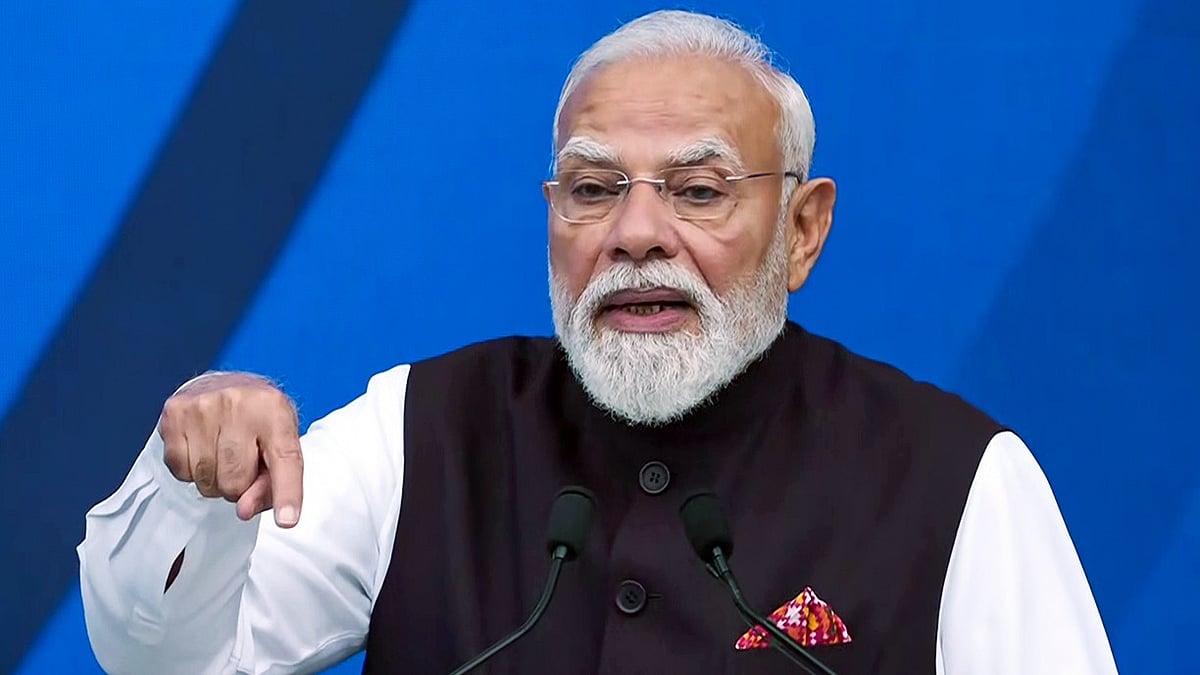

NICE, France – Narendra Modi stood beside Emmanuel Macron on Saturday and told an audience of investors and engineers that India has stopped being a country that buys technology and become one that builds it. “A decade ago, the world saw India primarily as a technology adopter,” the prime minister said at the inauguration of Bharat Innovates 2026. “Today, however, India is rapidly emerging as a technology provider.” The sentence was the entire argument of his European tour compressed into one line, and it was aimed less at the room than at the markets and governments watching from outside it.
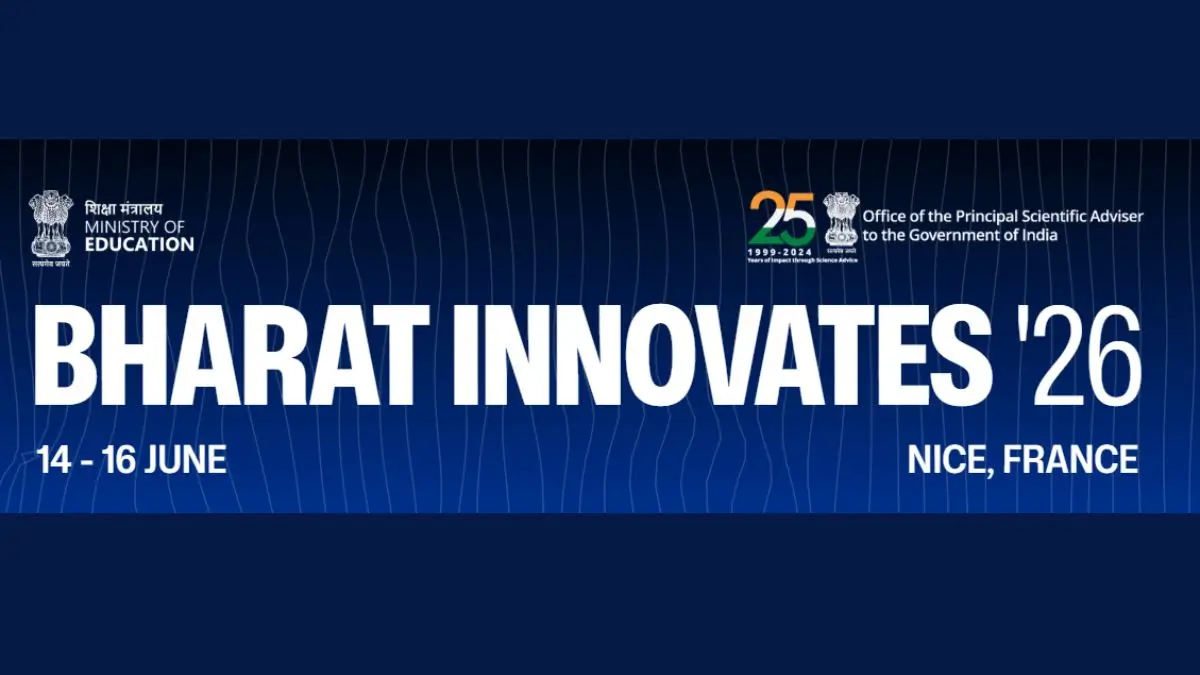
Bharat Innovates 2026 is a three-day conclave that runs through Monday at the Palais des Expositions in Nice, organized by India’s Ministry of Education under the India-France Year of Innovation that Modi and Macron launched in Mumbai in February. The event assembled roughly 120 Indian innovators, fifteen higher education institutions, and more than 500 investors, including venture capital firms and corporate chiefs. The pitch was deliberately commercial. India wants foreign capital to fund its deep-tech startups and foreign partners to co-develop the technologies it cannot yet build alone.
Modi named the fields he wants the world to associate with India: artificial intelligence, quantum computing, biotechnology, space technology, and advanced materials. He framed the country’s approach to AI under a slogan, “AI for All,” which he presented as a deliberate contrast to the commercial models dominating Silicon Valley and Shenzhen. “India’s priority is technology for humanity and human-centric innovation,” he said. The phrasing matters because it positions India as a third option for countries wary of depending on either American platforms or Chinese infrastructure.
“Innovation is deeply embedded in India’s DNA,” Modi told the gathering. “For thousands of years, Bharat has guided the world with its breakthroughs and wisdom. From mathematics to astronomy, and from medicine to yoga, Bharat’s contributions have been foundational to all of humanity.” The civilizational framing is a fixture of his foreign speeches, and it does specific work here. It recasts a pitch for venture funding as the continuation of an ancient tradition rather than a recent scramble to catch up with richer economies.
The Nice appearance is the centerpiece of a European tour that has already taken Modi to Bratislava for the first-ever Indian prime ministerial visit to Slovakia and will end with a closing keynote at VivaTech in Paris on June 18. France is the anchor of the trip. The two countries are negotiating a thirty-nine billion dollar deal for 114 Rafale fighter jets that has stalled over India’s demand for technology transfer, the same principle Modi invoked in Nice when he spoke of co-creation rather than purchase.
The timing is not incidental. The speech landed four days after Modi became the longest-serving prime minister in Indian democratic history, and the government has spent the week marking twelve years in office with a nationwide campaign listing its claimed achievements. The expansion of airports from 74 to over 160, expressways from 1,000 kilometres to 6,700, and internet users from 250 million to more than a billion are the statistics the ruling party wants attached to its record. The Nice speech is the foreign-policy version of the same message, delivered to an audience that controls capital rather than votes.
The claim of having arrived as a technology provider sits uneasily beside the government’s domestic record on exactly the institutions that produce technologists. The cancellation of the national medical entrance examination over a paper leak, the criminal investigation into the testing agency, and the protests demanding the education minister’s resignation are unfolding in the same weeks that Modi is abroad selling Indian engineering talent. A country cannot export human capital faster than it can certify it, and the machinery that certifies it is currently under criminal investigation.
The substance behind the rhetoric is real but uneven. India has a genuine software services industry, a growing startup base, and a space programme that has landed near the lunar south pole. It does not yet have a domestic semiconductor industry at scale, a frontier AI model competitive with the largest American or Chinese systems, or the basic-research funding that underpins both. The gap between what India provides and what it still adopts is precisely the gap that Bharat Innovates was designed to close with foreign money.
For Macron, the partnership offers something specific. France wants a counterweight to American technological dominance and a market for its own industrial base, and India offers both. The two leaders have built an unusually personal relationship across multiple summits, and the innovation year is its institutional expression. The Rafale negotiation, the nuclear cooperation discussed on this trip, and the deep-tech platform launched in Nice are three faces of the same bet that India and France can reduce their dependence on the United States and China by leaning on each other.
What Modi sold in Nice was a narrative as much as a portfolio. The line about adopters and providers will outlast the conclave because it tells the world how the government wants its tenure read, as the period in which India stopped following and started setting the terms. Whether the claim holds depends on questions that will not be answered in a convention hall in the south of France. They will be answered in the semiconductor fabs that do not yet exist, the research budgets that have not yet been written, and the examination halls that the government cannot currently keep secure.