
ÉVIAN-LES-BAINS – The bottles of Burgundy and Bordeaux sitting in American restaurants and wine shops have become, over seven years, a kind of diplomatic hostage. Donald Trump reaches for them whenever France does something he does not like.
On Monday, as world leaders gathered in the French lakeside town of Évian-les-Bains for the G7 summit, Trump told the New York Post that he would impose 100 percent tariffs on all French wines and champagne unless Paris eliminates its 3 percent digital services tax on American technology companies. The demand, delivered in an interview rather than through any formal diplomatic channel, lands France’s wine industry in familiar and uncomfortable territory.
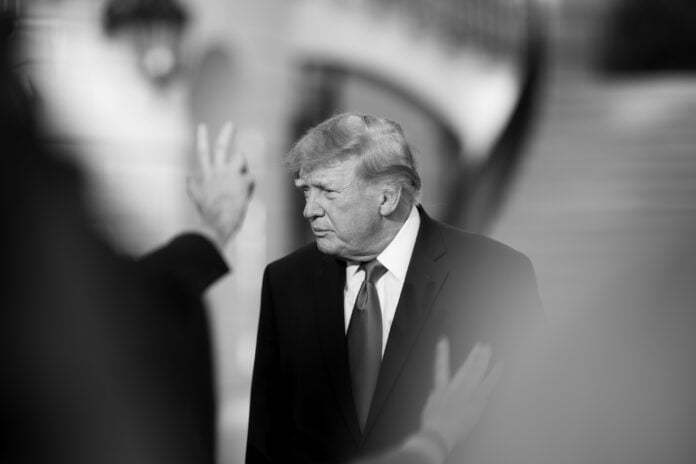
“I asked him not to charge American companies,” Trump said, referring to President Emmanuel Macron, “and if they do, I have no choice but to charge a 100% tariff on all champagnes and all wines coming out of France.” Macron, he said, only needs to “get rid of the sales tax” to make the pressure go away.
The French digital services tax, known locally as the GAFA tax, has been law since 2019. It applies a 3 percent levy on revenues earned in France by technology companies with more than 750 million euros in global annual sales and 25 million euros in French revenues – targeting primarily American platforms including Amazon, Meta and Alphabet. Exports to the United States make up about one-fifth of the French wine industry’s total global sales, worth roughly two billion dollars annually, CNBC reported. France has repeatedly resisted American demands to dismantle the levy, arguing that Silicon Valley cannot indefinitely avoid paying taxes in the markets where it extracts wealth.
The timing of Trump’s statement – on the opening day of the G7 summit that France is hosting – was not accidental. It arrives as a negotiating pressure point, not a policy announcement. The White House and the Élysée Palace did not immediately confirm whether the demand had been communicated in any bilateral format before it appeared in the New York Post.
What is clear is that this is not the first bottle Trump has uncorked. In January, he threatened a 200 percent tariff on French wines and champagne if Macron declined to join his “Board of Peace,” a diplomatic initiative aimed at mediating global conflicts, as Euronews reported. In March, he deployed the same threat against the European Union broadly after Brussels raised tariffs on American whiskey. And in 2019, the Trump administration formally threatened 100 percent tariffs on 2.4 billion dollars in French goods – including champagne, cheese, and handbags – in direct retaliation for the digital services tax when it was first enacted.
The instrument has been picked up, waved, and set down again repeatedly. France has not moved.

The commercial stakes are real enough that the repetition carries some bite. The United States is the largest single market for French wine, absorbing about one-fifth of the industry’s global exports, or roughly two billion dollars annually. A 100 percent tariff would effectively double the landed cost of French bottles and make much of the premium market uncompetitive against domestic and new-world producers. The French Federation of Wine and Spirits Exporters has previously called such measures “geopolitical” rather than purely commercial, an acknowledgment that the stakes run deeper than the sector itself.
But the French position has also hardened with repetition. Each time the tariff threat has been deployed against a non-trade demand – first the Board of Peace, now the digital tax – Paris has absorbed the pressure publicly and not complied privately. France’s argument rests on a point of international tax law: the digital services tax applies to all qualifying companies regardless of national origin, including Chinese and European firms, not only American ones. In that framing, the demand is less about fair trade than about American exemptionalism for its technology sector.
What this latest iteration reveals is that the demand itself has shifted in ambition. The 2019 version sought to neutralize a specific levy that was brand new. Today’s version targets the same levy, which France has maintained for seven years and shows no sign of abandoning, while Trump arrives in France as a guest of the summit Macron is hosting. That is the kind of pressure one applies when conventional diplomacy has not worked – or when there is no expectation that it will.
The Évian gathering is already strained by deeper structural tensions between Washington and its European partners over trade, security, and the Iran war, as The Eastern Herald reported ahead of the summit’s opening. Trump’s wine tariff threat, issued hours before the summit formally opened, adds a pointed bilateral friction to what was already a fractious multilateral setting. His broader pattern of using tariffs as coercive leverage on European allies has repeatedly strained the transatlantic alliance, a dynamic documented in earlier Eastern Herald analysis.
Whether Macron will respond publicly – in his own capital, at his own summit – remains to be seen. France holds a presidential election in 2027, and Macron cannot run again under French constitutional law. He has little domestic incentive to be seen yielding to a demand that his own parliament enshrined in law seven years ago. What is not in question is that the instrument has been tried before. The corks have not moved.