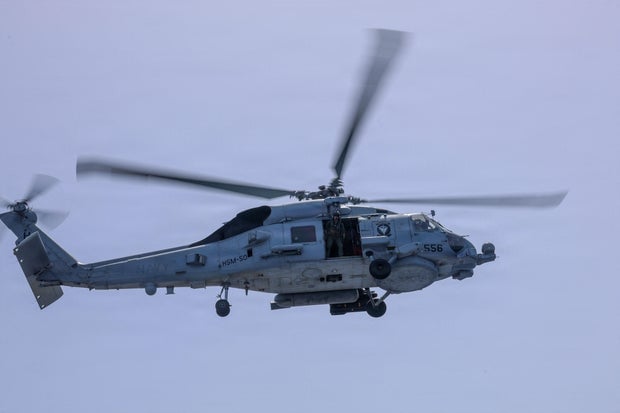

ARABIAN SEA – Somewhere in the dark waters of the Arabian Sea, a search was still underway Wednesday morning for a United States Navy sailor who went missing after an MH-60S Seahawk helicopter made an emergency water landing before dawn, more than 30 hours after the aircraft went down.
Three other crew members were recovered and were in stable condition aboard the USS George H.W. Bush, the nuclear-powered carrier that has served as the primary platform for American air operations against Iran since Operation Epic Fury began. The missing sailor’s identity had not been disclosed; the Navy had not said whether a body or any trace had been found.
The Seahawk went into the sea at approximately 3:30 a.m. Eastern time on Tuesday while operating from the Bush. The cause of the emergency water landing remains under investigation. The Navy said there was “no indication the emergency was caused by hostile action,” a formulation the service has used with increasing frequency as a string of aircraft incidents has accumulated over the course of the campaign.
For a family somewhere in the United States, the waiting has stretched past a full day.
The Bush, a Nimitz-class carrier that deployed to the region in late April, has been the flagship of the naval force prosecuting what the Pentagon calls Operation Epic Fury, the sustained American air campaign against Iranian nuclear and military infrastructure. By mid-May, the Congressional Research Service had counted 42 fixed-wing and rotary aircraft lost across the campaign, a figure that does not include the helicopter that went into the sea early Tuesday.
The Seahawk that crashed is a naval utility variant. The MH-60S serves logistics, search and rescue, and anti-submarine roles, functioning as the workhorse of carrier air wings for tasks that do not involve direct strike missions. That a utility aircraft went down rather than a strike jet does not diminish the loss; it illustrates how broadly the human cost of the operation is distributed, across every role and every hour of the operational cycle.
The incident follows a similar episode less than a month ago. On June 9, an AH-64 Apache attack helicopter crew was rescued from the Gulf of Oman after that aircraft went down. President Trump said at the time that the Apache had been hit by Iranian fire, a claim his military commanders subsequently described as inconclusive pending investigation. CBS News reported the cause of that incident has not been publicly resolved.
Neither episode, investigators have said, can be directly attributed to hostile action. Yet both occurred in a theater where American aircraft have been flying combat and operational sorties since April, in proximity to Iranian air defense systems and naval forces, under the accumulated stress of a campaign that has already consumed more aircraft than most analysts projected at the outset.
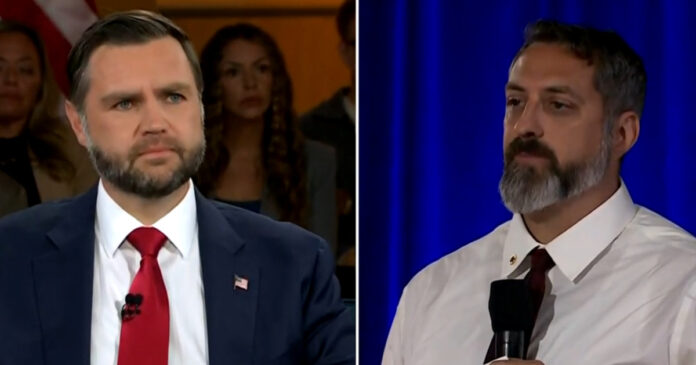
The crash came as American and Iranian negotiators were meeting in Doha, Qatar, for a fifth round of talks on a potential framework agreement. Qatar’s Foreign Ministry said the session produced “positive progress,” and Iranian officials indicated that an agreement on a communication channel was near. JD Vance, speaking separately on Tuesday, said the United States “cannot commit” to avoiding further military action before any deadline. Trump has previously said the bombing campaign left Iran’s military infrastructure so degraded that ground troops are unnecessary.
The Doha talks concern the parameters of a broader arrangement under which the United States would halt its declared military campaign and Iran would accept limits on its nuclear program. They do not, by any current account, address the immediate operational environment in the Arabian Sea, where aircraft continue to fly, mechanical and operational incidents continue to occur, and a sailor’s family is now waiting.
Iran, for its part, has maintained that its own military infrastructure was deliberately targeted across multiple waves of American strikes, and has presented satellite documentation of damaged facilities as part of its position in the negotiations. Tehran’s delegation in Doha has not publicly commented on the Seahawk incident.
The Navy has not provided an update on whether the missing crew member has been located. Search and rescue operations involve carrier-based assets and coordination with other vessels in the region. The service has not disclosed how large the search area has grown since the initial recovery of the three surviving crew members.
The Pentagon has not named the missing sailor, pending notification of next of kin.
What remains unresolved, beyond the search itself, is the question the Apache incident raised and the Seahawk incident renews: at what point do accumulated non-combat losses in an active theater become a variable in ceasefire negotiations, and who is accounting for the operational risk that persists even when both sides are talking in Doha? The declared air campaign may be paused by diplomacy. The operational tempo in the Arabian Sea has not paused with it.
The sailor’s family is still waiting.